Seligman is a census-designated place (CDP) on the northern border of Yavapai County, in northwestern Arizona, United States. The population was 456 at the 2020 census. It is one of the stops on historic U.S. Route 66.
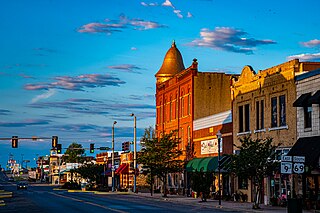
Eufaula is a city in and the county seat of McIntosh County, Oklahoma, United States. The population was 2,813 at the 2010 census, an increase of 6.6 percent from 2,639 in 2000. Eufaula is in the southern part of the county, 30 miles (48 km) north of McAlester and 32 miles (51 km) south of Muskogee.

Chappaqua station is a commuter rail stop on the Metro-North Railroad's Harlem Line, located in Chappaqua, New York, United States, within the town of New Castle.

U.S. Route 66 in the state of Texas extended across the Texas Panhandle from its designation in 1926 to its decommissioning in 1985.
U.S. Route 66 is a former east–west United States Numbered Highway, running from Santa Monica, California to Chicago, Illinois. In Missouri, the highway ran from downtown St. Louis at the Mississippi River to the Kansas state line west of Joplin. The highway was originally Route 14 from St. Louis to Joplin and Route 1F from Joplin to Kansas. It underwent two major realignments and several lesser realignments in the cities of St. Louis, Springfield, and Joplin. Current highways covering several miles of the former highway include Route 100, Route 366, Route 266, Route 96, and Route 66. Interstate 44 (I-44) approximates much of US 66 between St. Louis and Springfield.
U.S. Route 66 was a United States Numbered Highway in Illinois that connected St. Louis, Missouri, and Chicago, Illinois. The historic Route 66, the Mother Road or Main Street of America, took long distance automobile travelers from Chicago to Southern California. The highway had previously been Illinois Route 4 and the road has now been largely replaced with Interstate 55 (I-55). Parts of the road still carry traffic and six separate portions of the roadbed have been listed on the National Register of Historic Places.

The U-Drop Inn, also known as Tower Station and U-Drop Inn and Tower Café, was built in 1936 in Shamrock, Texas along the historic Route 66 highway in Wheeler County. Inspired by the image of a nail stuck in soil, the building was designed by J. C. Berry. An unusual example of art deco architecture applied to a gas station and restaurant, the building features two flared towers with geometric detailing, curvilinear massing, glazed ceramic tile walls, and neon light accents. It has traditionally held two separate business: "Tower Station," a gas station on the western side, and the "U-Drop Inn," a café on the eastern side. Though it has passed hands several times in its history, the building has consistently housed the same types of businesses it was originally constructed for.

The Enrollment Services Center is a building at Iowa State University in Ames, Iowa. It houses the Office of Admissions and the Office of the Registrar. In 1978, the building was placed on the National Register of Historic Places.

The Jenny Lake Ranger Station Historic District comprises an area that was the main point of visitor contact in Grand Teton National Park from the 1930s to 1960. Located near Jenny Lake, the buildings are a mixture of purpose-built structures and existing buildings that were adapted for use by the National Park Service. The ranger station was built as a cabin by Lee Mangus north of Moose, Wyoming about 1925 and was moved and rebuilt around 1930 for Park Service use. A store was built by a concessioner, and comfort stations were built to Park Service standard plans. All buildings were planned to the prevailing National Park Service Rustic style, although the ranger station and the photo shop were built from parts of buildings located elsewhere in the park.

The Park Motel is a historic building located in Denison, Iowa, United States. It is an example of a well-preserved highway motel during the early age of motoring. It appears this is also an early example of a motel in Iowa and may be one of the earliest in the Midwest.

The Building at 202 W. Third Street, also known as the M.D. Petersen Estate Building, is a historic building located in downtown Davenport, Iowa, United States. It has been individually listed on the National Register of Historic Places since 1983. In 2020 it was included as a contributing property in the Davenport Downtown Commercial Historic District.
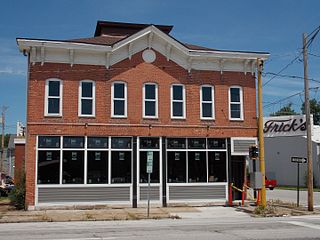
Frick's Tavern, also known as Frick's Place, is a historic building located in the West End of Davenport, Iowa, United States. It has been listed on the National Register of Historic Places since 1974. The building is a two-story brick structure that sits on the northwest corner of West Third and Fillmore Streets. It is part of a small commercial district near the historic German neighborhoods and the industrial areas along the Mississippi River. It is a typical commercial building in the West End which combined commercial space on the first floor and apartments on the second floor.

The Des Moines County Court House located in Burlington, Iowa, United States, was built in 1940. It was listed on the National Register of Historic Places in 2003 as a part of the PWA-Era County Courthouses of Iowa Multiple Properties Submission. The courthouse is the fourth structure to house court functions and county administration.

Cornudas is an unincorporated community in Hudspeth County, Texas, United States. Cornudas is located near the intersection of Ranch to Market Road 2317 and the concurrent U.S. Highways 62 and 180, 42 miles (68 km) northwest of the county seat, Sierra Blanca. Cornudas was located in 1929 strategically on the most direct route between El Paso and Carlsbad, New Mexico as a natural rest and resupply station. It was directly or indirectly named for the Cornudas Mountains that can be seen behind the Cornudas Cafe.

The Wagon Wheel Motel, Café and Station in Cuba, Missouri, is a 19-room independently owned historic U.S. Route 66 restored motel which has been serving travelers since 1938. The site opened as a café in 1936; the motel has remained in continuous operation since 1938. The motel rooms were fully restored in 2010, adding modern amenities such as HDTV and wireless Internet.

The Log Cabin is a historic restaurant in Oak Park Heights, Minnesota, United States. It was established in 1932 as a roadhouse—an eatery and nightclub catering to motorists in an isolated location. Opening in the last years of Prohibition, it was rumored to serve illegal alcohol and harbor gangsters. The Log Cabin was listed on the National Register of Historic Places in 2007 for having local significance in the themes of architecture and commerce. It was nominated for its associations with the roadhouse network that developed in the early-20th-century St. Croix Valley, and for its quaint log cabin motif designed to attract the first generation of automobile travelers. Over the years it has operated under the names Club Tara Hideaway, Club Tara, and—since 1997—Phil's Tara Hideaway.

The Pioneer Oil Company Filling Station is a historic building located in Grinnell, Iowa, United States. The northern half of the building dates back to the 1920s when it was associated with a local farmers' cooperative. One of the services they provided was selling gasoline. The building was expanded in 1931 into a more traditional filling station as selling fuel became a more prominent part of the operation. The building attained its present appearance in 1937 when the service bays and the decorative brick veneer were added. It retained its original name, "Pioneer Oil Company," throughout its time as a service station even though it became affiliated with Mobilgas in 1936. That affiliation ended in 1962. During World War II it became a tire inspection center under the wartime tire rationing program. The service station ceased operations around 2004. The building was re-purposed into the Mobil Wash and Wax, an automotive detailing business located in the service bays, and the Candyland Cafe in the northern portion of the building. It was listed on the National Register of Historic Places in 2013.

Big Chief Restaurant, located at 17352 Manchester Road in Wildwood, Missouri, currently operates under the name Big Chief Roadhouse. It was also formerly known as Big Chief Highway Hotel and Big Chief Dakota Grill. The restaurant opened in 1928 as part of a tourist camp that included overnight accommodations for travelers on the newly opened U.S. Route 66 in Pond, Missouri, now incorporated within Wildwood. After the highway was later routed to bypass Pond, the business struggled to survive, operating as housing for government employees during World War II. Eventually the cabins were demolished, and the restaurant was used for other business operations. It was reopened as a restaurant in the 1990s.

The Old Settlers' Association of Johnson County Cabins, also known as City Park Cabins, are historic buildings located in Iowa City, Iowa, United States. These are two log structures built by the Old Settlers' Association of Johnson County. The single-room log cabin was built in 1889 for Johnson County's semicentennial. It had been located at two different county fairground sites until it was moved to City Park in 1918. The second cabin was built here by the association in 1913. It is a dogtrot house that is meant to be a replica of an early trading post in this area. These are typical log house forms from Iowa's pioneer era whose existence are now rare. They also represent an effort by a social organization to commemorate the community's common pioneer heritage. A third element that is part of the historical designation is a bronze plaque affixed to a granite boulder. Located southwest of the cabins, it was installed in 1929 to mark a "Grand Army Tree" that was planted nearby. It is not known if the tree survives. The buildings and plaque were listed together on the National Register of Historic Places in 2013.

The King Tower Historic District, also known as The King Tower One-Stop, is a historic district located in Tama, Iowa, United States. It was listed on the National Register of Historic Places in 2020. The King Tower One-Stop is a gas station, tourist court, and cafe built by Wes Mansfield on the Lincoln Highway. The Spanish Colonial Revival gas station and cafe was completed in 1937, and 18 tourist cabins were completed the following year. The historic district is an example of a "one stop-food, gas, auto repair and tourist cabins" that were built during "the transition from mom-and-pop roadside businesses to the national chain gas, food and lodging businesses that would soon dominate the trade." At one time it was open 24-hours-a-day, seven-days-a-week. In addition to over-the-road truckers, travelers, law enforcement officers, and local families, it was a place the town's bar patrons would go after the bars closed at 2:00 am. Local clubs and organizations held their meetings here. It was also a stopping point for presidential hopefuls before the Iowa caucuses.