Origins
From the name Greek Zenobios, composed by Zeus (the God Zeus) and bios (life), can be translate in that takes life from Zeus. The name is an evolution of Zenobio, that it seems disappeared in Italy.

Zeus is the sky and thunder god in ancient Greek religion, who rules as king of the gods of Mount Olympus. His name is cognate with the first element of his Roman equivalent Jupiter. His mythologies and powers are similar, though not identical, to those of Indo-European deities such as Indra, Jupiter, Perkūnas, Perun, and Thor.
The name Zanobi is still very popular in Tuscany, in particular in Florence, this because of Saint Zenobius of Florence (Italian: San Zanobi). The Saint Zanobi is venerated as the first bishop of Florence, Italy. His feast day is celebrated on May 25.

Tuscany is a region in central Italy with an area of about 23,000 square kilometres and a population of about 3.8 million inhabitants (2013). The regional capital is Florence (Firenze).

Florence is the capital city of the Italian region of Tuscany. It is the most populous city in Tuscany, with 383,084 inhabitants in 2013, and over 1,520,000 in its metropolitan area.

Saint Zenobius (337–417) is venerated as the first bishop of Florence. His feast day is celebrated on May 25.
This page is based on this
Wikipedia article Text is available under the
CC BY-SA 4.0 license; additional terms may apply.
Images, videos and audio are available under their respective licenses.

Domenico Ghirlandaio was an Italian Renaissance painter born in Florence. Ghirlandaio was part of the so-called "third generation" of the Florentine Renaissance, along with Verrocchio, the Pollaiolo brothers and Sandro Botticelli. Ghirlandaio led a large and efficient workshop that included his brothers Davide Ghirlandaio and Benedetto Ghirlandaio, his brother-in-law Bastiano Mainardi from San Gimignano, and later his son Ridolfo Ghirlandaio. Many apprentices passed through Ghirlandaio's workshop, including the famous Michelangelo. Ghirlandaio's particular talent lay in his ability to posit depictions of contemporary life and portraits of contemporary people within the context of religious narratives, bringing him great popularity and many large commissions.

Taddeo Gaddi was a medieval Italian painter and architect.
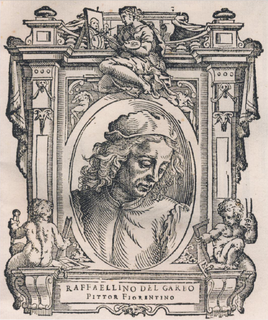
Raffaellino del Garbo was a Florentine painter of the early Renaissance.

Ulmus 'San Zanobi' is a hybrid elm cultivar raised by the Istituto per la Protezione delle Piante (IPP) in Florence, from a crossing of the Dutch hybrid 'Plantyn' and the Siberian Elm Ulmus pumila clone 'S 15'; it was released to commerce in 2002. 'San Zanobi' was introduced to the UK in 2004 by Hampshire & Isle of Wight Branch, Butterfly Conservation, as part of its assessment of DED-resistant cultivars as potential hosts of the endangered White-letter Hairstreak.

San Casciano in Val di Pesa is a comune (municipality) in the Metropolitan City of Florence in the Italian region Tuscany, located about 15 kilometres (9 mi) southwest of Florence.

Jacopo da Empoli was an Italian Florentine Reformist painter.

Giovanni Battista Naldini (1535–1591) was an Italian painter of a late-Mannerism in Florence.
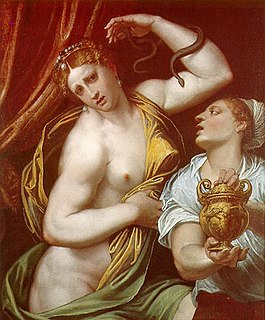
Domenico Riccio was an Italian painter in a Mannerist style from Verona.

Giovanni Antonio Sogliani (1492–1544) was an Italian painter of the Renaissance, active mainly in Florence.

Jacopo di Cione was an Italian Gothic period painter in the Republic of Florence.
The decade of the 1410s in art involved some significant events.
Zanobi Poggino of Zanobi di Poggino was an Italian painter, active as a portrait and historical painter in Florence. He was a pupil of Giovanni Antonio Sogliani. While he was noted by Filippo Baldinucci, none of his works could be identified by Luigi Lanzi.
Zenobios is a Greek masculine given name. Feminine form: Zenobia. Zenobius in Latin, Zinobi/Zinobiy (Зенобий) in Bulgarian, Zinovi/Zinoviy in Russian, and Zenob in Armenian, derive from it.
The Holy Martyrs Zenobios and Zenobia are recognized by Eastern Orthodox Church and the Roman Catholic Church; their day is October 30.

The Column of Saint Zanobi is a monumental marble column, surmounted by a cross above a crown of fire, located just north of the Bapstistery of San Giovanni in Florence, Italy.

Scenes from the Life of Saint Zenobius is a series of paintings by the Italian Renaissance artist Sandro Botticelli. Four panels from the series survive, which are now in three different museums. Each depicts three or more incidents from the life of Zenobius, an early Bishop of Florence who perhaps died in 417. The works are all in tempera on wood, and around 66 cm (26 in) high, though their length varies rather more, from about 149 to 182 cm.

Two small paintings in London and New York are believed to come from the same predella, and are attributed to Zanobi Strozzi, a Florentine painter who was probably a pupil of Fra Angelico. They are an Adoration of the Magi in the National Gallery in London, and a Nativity in the Metropolitan Museum of Art in New York. They date to about 1433–34 and are in tempera and gold on panel.


