Chinese classic texts or canonical texts refers to the Chinese texts which originated before the imperial unification by the Qin dynasty in 221 BC, particularly the "Four Books and Five Classics" of the Neo-Confucian tradition, themselves a customary abridgment of the "Thirteen Classics". All of these pre-Qin texts were written in classical Chinese. All three canons are collectively known as the classics.

劉 / 刘 is a Chinese surname. The Liu as transcribed in English can represent several different surnames written in different Chinese characters:

Zhao is a Chinese surname, ranking as the 7th most common surname in Mainland China and carried mainly by people of Mandarin-speaking regions. Zhao is the 1st surname in the famous Hundred Family Surnames – the traditional list of all Chinese surnames – because it was the emperor's surname of the Song Dynasty (960–1279) when the list was compiled.
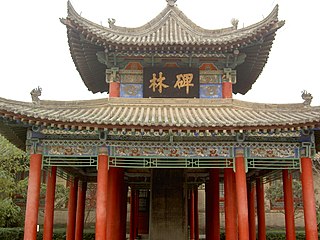
The Stele Forest or Beilin Museum is a museum for steles and stone sculptures in Beilin District in Xi'an, China. The museum, which is housed in a former Confucian Temple, has housed a growing collection of Steles since 1087. By 1944 it was the principal museum for Shaanxi province. Due to the large number of steles, it was officially renamed the Forest of Stone Steles in 1992. Altogether, there are 3,000 steles in the museum, which is divided into seven exhibitions halls, which mainly display works of calligraphy, painting and historical records.
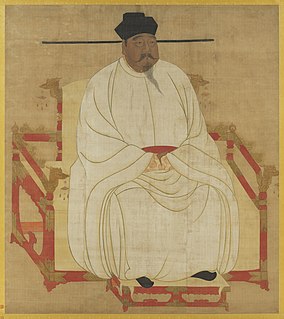
Emperor Taizu of Song personal name Zhao Kuangyin, courtesy name Yuanlang, was the founder and first emperor of the Song dynasty in China. He reigned from 960 until his death in 976. Formerly a distinguished military general of the Later Zhou dynasty, Emperor Taizu came to power after staging a coup d'état and forcing Emperor Gong, the last Later Zhou ruler, to abdicate the throne in his favour.
The grand chancellor, also translated as counselor-in-chief, chancellor, chief councillor, chief minister, imperial chancellor, lieutenant chancellor and prime minister, was the highest-ranking executive official in the imperial Chinese government. The term was known by many different names throughout Chinese history, and the exact extent of the powers associated with the position fluctuated greatly, even during a particular dynasty.
Li Jing or Jing Li may refer to:
Li Wei or Wei Li may refer to:
Fang is the 47th most prevalent Chinese surname. In Chinese, Fāng (方), means "square" or "four-sided". Fāng (方) is pronounced Fong in Cantonese, Hong or Png in some Min Nan dialects and Png or Pung in Teochew.

The Prince of Han Dynasty is a three-season Chinese television series featuring a fictionalised life story of Liu Che, Emperor Wu of the Han Dynasty. Season 1 was first broadcast on Beijing Television in 2001 in mainland China, followed by the second and third seasons in 2003 and 2005 respectively. Except for Huang Xiaoming, who played Emperor Wu in all three seasons, the cast members in each season are almost different from its preceding one.
The decade of the 1120s in art involved some significant events.
Can is a common Turkish and Circassian given name and surname, meaning spirit, life, soul or heart. Turkish use is derived from the Persian word Jan and Circassian use is derived from Circassian word Janberk. In Turkish, the name Can is pronounced just like the common English name John.

Invincible Knights Errant is a 2011 martial arts television series from Mainland China, based on the wuxia classics The Seven Heroes and Five Gallants. The show stars Alex Man as Bao Zheng from China's Song Dynasty and Vincent Zhao as Zhan Zhao.

Love Legend of the Tang Dynasty, also known as Da Tang Qing Shi, is a Chinese historical television series based on the legend of an illicit romance between the Tang dynasty Princess Gaoyang and a monk called Bianji. The series was directed by Gong Ruofei, starring Tang Guoqiang, Shen Aojun, Nie Yuan, Zhang Tong, Pan Yueming, Pan Yaowu, and Qin Lan. It was first broadcast in mainland China in 2001.
Fu is a Chinese surname, such as 傅, 符, 苻, 付, 扶, 伏, and 富.
Dugu Xin, known as Dugu Ruyuan before 540, was a Xianbei military general and official during the chaotic Northern and Southern Dynasties period. In 534, Dugu Xin followed Emperor Xiaowu of Northern Wei to the west to join the warlord Yuwen Tai, and in the ensuing years led Western Wei forces against their archnemesis, the Eastern Wei. Despite an early debacle, he captured the former Northern Wei capital Luoyang from Eastern Wei in 537. He rose to high ranks under Yuwen Tai, and his eldest daughter married Yuwen Tai's son Yuwen Yu. When the Northern Zhou dynasty replaced Western Wei, Dugu Xin was created Duke of Wei (衛國公), but was soon forced by the powerful regent Yuwen Hu to commit suicide for challenging him.