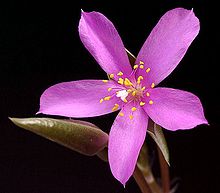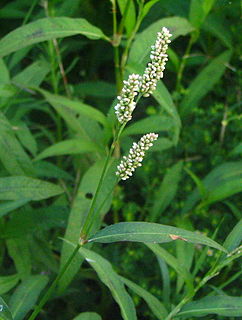
The Polygonaceae are a family of flowering plants known informally as the knotweed family or smartweed—buckwheat family in the United States. The name is based on the genus Polygonum, and was first used by Antoine Laurent de Jussieu in 1789 in his book, Genera Plantarum. The name may refer to the many swollen nodes the stems of some species have, being derived from Greek, poly meaning 'many' and gony meaning 'knee' or 'joint'. Alternatively, it may have a different derivation, meaning 'many seeds'.

Droseraceae is a family of carnivorous flowering plants, also known as the sundew family. It consists of approximately 180 species in three extant genera. Representatives of the Droseraceae are found on all continents except Antarctica.

The Clusiaceae or GuttiferaeJuss. (1789) are a family of plants including 13 genera and ca 750 species. Several former members of Clusiacae are now placed in Calophyllaceae and Hypericaceae. They are mostly trees and shrubs, with milky sap and fruits or capsules for seeds. The family is primarily tropical. More so than many plant families, it shows large variation in plant morphology. According to the APG III, this family belongs to the order Malpighiales.

Burmanniaceae is a family of flowering plants, consisting of 99 species of herbaceous plants in eight genera.

Plumbaginaceae is a family of flowering plants, with a cosmopolitan distribution. The family is sometimes referred to as the leadwort family or the plumbago family.

The Portulacaceae are a family of flowering plants, comprising 115 species in a single genus Portulaca. Formerly some 20 genera with about 500 species, were placed there, but it is now restricted to encompass only one genus, the other genera being placed elsewhere. The family has been recognised by most taxonomists, and is also known as the purslane family. It has a cosmopolitan distribution, with the highest diversity in semiarid regions of the Southern Hemisphere in Africa, Australia, and South America, but with a few species also extending north into Arctic regions. The family is very similar to the Caryophyllaceae, differing in the calyx, which has only two sepals.

The Crypteroniaceae are a family of flowering trees and shrubs. The family includes 13 species in three genera, native to Indomalaya.

Dilleniaceae is a family of flowering plants with 11 genera and about 430 known species. Such a family has been universally recognized by taxonomists. It is known to gardeners for the genus Hibbertia, which contains many commercially valuable garden species.

Basellaceae is a family of flowering plants, in the order Caryophyllales in the clade core eudicots, according to the Angiosperm Phylogeny Group. The family comprises ca 19 known species of herbaceous plants, some with climbing habits, in four genera:

Pteridaceae is a family of ferns in the order Polypodiales, including some 1150 known species in ca 45 genera, divided over five subfamilies. The family includes four groups of genera that are sometimes recognized as separate families: the adiantoid, cheilanthoid, pteridoid, and hemionitidoid ferns. Relationships among these groups remain unclear, and although some recent genetic analyses of the Pteridales suggest that neither the family Pteridaceae nor the major groups within it are all monophyletic, as yet these analyses are insufficiently comprehensive and robust to provide good support for a revision of the order at the family level.

The Achatocarpaceae are a family of woody flowering plants consisting of two genera and 11 known species, and has been recognized by most taxonomists. The family is found from the southwestern United States south to tropical and subtropical South America.

Molluginaceae are a family of flowering plants recognized by several taxonomists. It was previously included in the larger family Aizoaceae. The APG III system of 2009 made no change in the status of the family as compared to the APG II system of 2003 and the APG system of 1998, apart from a reassignment of several genera, such as the placement of Corrigiola and Telephium into Caryophyllaceae, Corbichonia in Lophiocarpaceae, Microtea into Microteaceae and Limeum in Limeaceae, because the family was found to be widely polyphyletic in Caryophyllales. In addition Macarthuria was found not to be related to Limeum as previously thought and thus it was placed in Macarthuriaceae, and similarly species formerly placed in Hypertelis, apart from type species Hypertelis spergulacea, a true Molluginaceae, were found to belong elsewhere and were described as Kewa in the family Kewaceae, named for the Royal Botanic Gardens Kew. Molluginaceae is still assigned to the order Caryophyllales in the clade core eudicots, although the generic circumscription is difficult because Mollugo is not monophyletic.
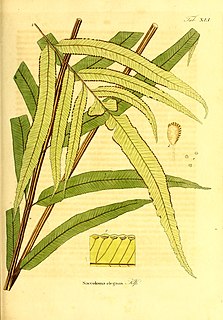
Saccolomataceae is a family of ferns in the order Polypodiales. It has been formerly treated as part of the Dennstaedtiaceae, however it has been classified as its own family according to Smith et al. (2006) The genus Saccoloma has been classified to include Orthiopteris, but the phylogeny of the group not yet fully understood. The family includes a dozen known species.
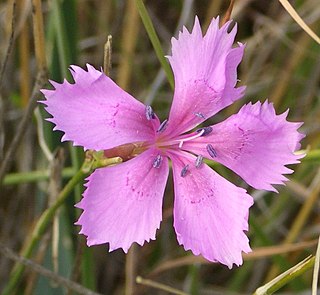
Caryophyllales is a diverse and heterogeneous order of flowering plants that includes the cacti, carnations, amaranths, ice plants, beets, and many carnivorous plants. Many members are succulent, having fleshy stems or leaves. The betalain pigments are unique in plants of this order and occur in all its families with the exception of Caryophyllaceae and Molluginaceae.

Hydrostachys is a genus of about 22 species of flowering plants native to Madagascar and southern and central Africa. It is the only genus in the family Hydrostachyaceae. All species of Hydrostachys are aquatic, growing on rocks in fast-moving water. They have tuberous roots, usually pinnately compound leaves, and highly reduced flowers on dense spikes.
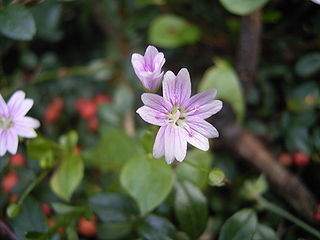
Montiaceae are a family of flowering plants, comprising about 14 genera with about 230 known species, ranging from herbaceous plants to shrubs. The family has a cosmopolitan distribution.
The Lophiocarpaceae are a family of flowering plants comprising mostly succulent subshrubs and herbaceous species native to tropical to southern sub-Saharan Africa to western India. It includes the genera Corbichonia and Lophiocarpus. The family is newly recognized through research by the Angiosperm Phylogeny Group III system to deal with long-standing phylogenetic difficulties in placing various genera within the Caryophyllales.
Portulacineae is a suborder of flowering plants in the order Caryophyllales comprising the families Anacampserotaceae, Basellaceae, Cactaceae (cacti), Didiereaceae, Halophytaceae, Montiaceae, Portulacaceae, and Talinaceae. All three major kinds of succulent plant — stem succulents, leaf succulents, and caudiciform plants — are represented within this suborder.
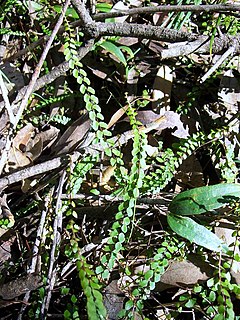
Lindsaeineae is a suborder of ferns (Polypodiopsida), order Polypodiales, created by the Pteridophyte Phylogeny Group (2016). It consists of two monogeneric families plus the larger Lindsaeaceae with seven genera, and the suborder contains about 237 species overall. It corresponds to Lindsaeaceae sensu Smith 2016.

Macarthuriaceae is a family of plants in the order Caryophyllales and consists of a single genus, Macarthuria.