giFT Internet File Transfer (giFT) is a computer software daemon that allows several file sharing protocols to be used with a simple client having a graphical user interface (GUI). The client dynamically loads plugins implementing the protocols, as they are required.

WinMX is a freeware peer-to-peer file sharing program authored in 2000 by Kevin Hearn in Windsor, Ontario (Canada). According to one study, it was the number one source for online music in 2005 with an estimated 2.1 million users. Frontcode Technologies itself abandoned development of WinMX in September 2005, but developers brought the service back online within a few days by releasing patches. WinMX continues to be used by a community of enthusiasts.
MLDonkey is an open-source, multi-protocol, peer-to-peer file sharing application that runs as a back-end server application on many platforms. It can be controlled through a user interface provided by one of many separate front-ends, including a Web interface, telnet interface and over a dozen native client programs.
Earth Station 5 (ES5) was a peer-to-peer network active between 2003 and 2005, operated by a company of the same name. The user client application also shared this name. Earth Station 5 was notable for its strong, if overstated, emphasis on user anonymity, and for its bold advocacy of piracy and copyright infringement. ES5's highly antagonistic position toward copyright advocacy and enforcement organizations garnered the group significant attention and peaked with an ES5 press release announcing a "declaration of war" against the Motion Picture Association of America. ES5 claimed to operate out of the Jenin in the Palestinian Authority-controlled West Bank, a region where they argued that copyright laws were unenforceable. Investigative journalism cast serious doubts on the company's Palestinian origin as well as many of its other claims. To this day, much about the company and its leadership remains uncertain or unknown.
An anonymous P2P communication system is a peer-to-peer distributed application in which the nodes, which are used to share resources, or participants are anonymous or pseudonymous. Anonymity of participants is usually achieved by special routing overlay networks that hide the physical location of each node from other participants.
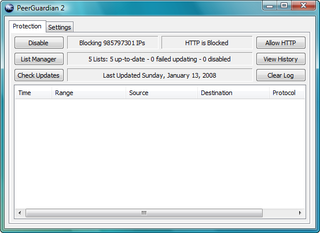
PeerGuardian is a free and open source program developed by Phoenix Labs (software). It is capable of blocking incoming and outgoing connections based on IP blacklists. The aim of its use was to block peers on the same torrent download from any visibility of your own peer connection using IP lists. The system is also capable of blocking custom ranges, depending upon user preferences.
The eDonkey Network is a decentralized, mostly server-based, peer-to-peer file sharing network created in 2000 by US developers Jed McCaleb and Sam Yagan that is best suited to share big files among users, and to provide long term availability of files. Like most sharing networks, it is decentralized, as there is no central hub for the network; also, files are not stored on a central server but are exchanged directly between users based on the peer-to-peer principle.

The Pirate Bay is an online index of digital content of entertainment media and software. Founded in 2003 by Swedish think tank Piratbyrån, The Pirate Bay allows visitors to search, download, and contribute magnet links and torrent files, which facilitate peer-to-peer file sharing among users of the BitTorrent protocol.
This is a timeline of events in the history of networked file sharing.

FrostWire is a free and open-source BitTorrent client first released in September 2004, as a fork of LimeWire. It was initially very similar to LimeWire in appearance and functionality, but over time developers added more features, including support for the BitTorrent protocol. In version 5, support for the Gnutella network was dropped entirely, and FrostWire became a BitTorrent-only client.

Peer-to-peer file sharing is the distribution and sharing of digital media using peer-to-peer (P2P) networking technology. P2P file sharing allows users to access media files such as books, music, movies, and games using a P2P software program that searches for other connected computers on a P2P network to locate the desired content. The nodes (peers) of such networks are end-user computers and distribution servers.
LokiTorrent was a BitTorrent indexing service operated by Edward Webber ("Lowkee") from 2004 until 2005. The domain name was originally registered on 24 February 2004.
Suprnova.org was a Slovenia-based website that distributed BitTorrent trackers for various music and video files, computer programs and games. Started in late 2002 by Andrej Preston and for a while considered the most popular BitTorrent search engine, Suprnova.org closed in late 2004 after legal threats. The site operators supported the development of the eXeem BitTorrent client software, deeming a fixed website too difficult to operate in the present legal climate. On 2 August 2007, the domain name was donated to The Pirate Bay, which relaunched the site on 21 August 2007.

The use of the BitTorrent protocol for the unauthorized sharing of copyrighted content generated a variety of novel legal issues. While the technology and related platforms are legal in many jurisdictions, law enforcement and prosecutorial agencies are attempting to address this avenue of copyright infringement. Notably, the use of BitTorrent in connection with copyrighted material may make the issuers of the BitTorrent file, link or metadata liable as an infringing party under some copyright laws. Similarly, the use of BitTorrent to procure illegal materials could potentially create liability for end users as an accomplice.
File sharing is the practice of distributing or providing access to digital media, such as computer programs, multimedia, documents or electronic books. Common methods of storage, transmission and dispersion include removable media, centralized servers on computer networks, Internet-based hyperlinked documents, and the use of distributed peer-to-peer networking.

YourBittorrent is a file sharing website founded as myBittorrent in 2003, the new site yourBittorrent is the result of a split in ownership in 2009. The site is a torrent tracking website for the P2P BitTorrent network. As such it does not host files, but hosts information about the location of these files in an indexed torrent file. These torrent files are read by a client located on an individual's computer.

Operation Payback was a coordinated, decentralized group of attacks on high-profile opponents of Internet piracy by Internet activists using the "Anonymous" moniker. Operation Payback started as retaliation to distributed denial of service (DDoS) attacks on torrent sites; piracy proponents then decided to launch DDoS attacks on piracy opponents. The initial reaction snowballed into a wave of attacks on major pro-copyright and anti-piracy organizations, law firms, and individuals. The Motion Picture Association of America, the Pirate Party UK and United States Pirate Party criticised the attacks.
The US Copyright Group (UCSG) is a business registered by the law firm Dunlap, Grubb & Weaver that also operates under the name SaveCinema.org. It is engaged in suing people in the U.S. who have allegedly used the P2P file sharing protocol BitTorrent to download certain movies.
Torrent poisoning is intentionally sharing corrupt data or data with misleading file names using the BitTorrent protocol. This practice of uploading fake torrents is sometimes carried out by anti-infringement organisations as an attempt to prevent the peer-to-peer (P2P) sharing of copyrighted content, and to gather the IP addresses of downloaders.
ZeroPaid.com was a website concerning news, computer software, community, and file sharing. It offered news, software reviews, links, and a user forum. Its main news staff consisted of Jared Moya since 2005 and Drew Wilson since 2007.
