Tabasaran language

Last updated
Tabasaran
Tabassaran
табасаран чIалtabasaran ç̇al
ихь чIалix ç̇al
Pronunciation[tɑbɑsɑrɑnt͡ʃʼɑl]
[ixt͡ʃʼɑl]
Native to North Caucasus
RegionSouthern Dagestan
Ethnicity Tabasarans
Native speakers
126,900 (2010 census) [1]
Northeast Caucasian
Official status
Official language in
Russia
Language codes
ISO 639-3 tab
Glottolog taba1259
ELP Tabasaran
Caucasus-ethnic tabasaren.png
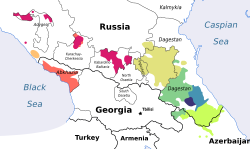
Map of Tabasarans in the Caucasus
Lang Status 80-VU.svg
Tabasaran is classified as Vulnerable by the UNESCO Atlas of the World's Languages in Danger .
This article contains IPA phonetic symbols. Without proper rendering support, you may see question marks, boxes, or other symbols instead of Unicode characters. For an introductory guide on IPA symbols, see Help:IPA.

Tabasaran (also written Tabassaran) is a Northeast Caucasian language of the Lezgic branch. It is spoken by the Tabasaran people in the southern part of the Russian Republic of Dagestan. There are two main dialects: North (Khanag) and South Tabasaran. It has a literary language based on the Southern dialect, one of the official languages of Dagestan.

Contents

Tabasaran is an ergative language. The verb system is relatively simple; verbs agree with the subject in number, person and (in North Tabasaran) class. North Tabasaran has two noun classes (that is, grammatical gender), whereas Southern Tabasaran lacks noun classes / gender.

Geographical distribution

It is spoken in the basin of Upper Rubas-nir and Upper Chirakh-nir.

Phonology

Consonants

Consonant phonemes of Tabasaran [2]
Labial Dental Post-alveolar Velar Uvular Epiglottal Glottal
plain sibilant plain labial
Nasal m n
Plosive/
Affricate
voiced b d d͡z d͡ʒ d͡ʒʷ ɡ ɢ
voiceless p t t͡s t͡ʃ t͡ʃʷ k q ʔ
fortis t͡sː t͡ʃː t͡ʃʷː
ejective t͡sʼ t͡ʃʼ t͡ʃʷʼ
Fricative voiceless f s ʃ ʃʷ x ʜ
fortis ʃː ʃʷː
voiced v z ʒ ʒʷ ɣ ʢ ɦ
Approximant l j
Trill r

The post-alveolar sibilants may be whistled.

Vowels

Front Back
unrounded rounded
Close i y u
Mid ɛ
Open æ ɑ

Vowel sounds of Tabasaran are [i, y, ɛ, æ, ɑ, u].[ citation needed ]

Writing system

Cyrillic (19th century)

Peter von Uslar's Tabasaran alphabet Uslar - Tabasaran alphabet.png
Peter von Uslar's Tabasaran alphabet

Peter von Uslar devised Cyrillic-based orthographies for many Caucasian languages, including Tabasaran. [3]

Latin (1931–1938)

From 1931 to 1938, the Latin alphabet was used as a base for the Tabasaran writing system. The first book was published in 1932. [4]

Initially, the alphabet took the following form: [5]

a, b, c, cc, cь, ç, çь, d, e, ә, f, g, ƣ, h, i, j, k, kk, ⱪ, l, m, n, u, p, pp, ᶈ, q, ꝗ, r, s, ꟍ, ꟍꟍ, ş, şь, t, tt, t̨, y, v, x, ҳ, ӿ, z, ⱬ, zz, ƶ, ƶƶ, ƶь, '

Soon after, capital letters and the letters O o and Latin capital letter Z with stroke and descender.svg Latin small letter Z with stroke and descender.svg were introduced. The alphabet then took the following form: [6]

A aB bC cCь cьÇ çÇь çьD dE eӘ әF fG g
Ƣ ƣH hI iJ jK kⱩ ⱪL lM mN nO oP p
Latin capital letter P with appendage.svg Q qꝖ ꝗR rS sŞ şŞь şьT t Latin capital letter T with descender.svg Latin small letter T with descender.svg U u
V vX xҲ ҳӾ ӿY yZ zⱫ ⱬƵ ƶ Latin capital letter Z with stroke and descender.svg Latin small letter Z with stroke and descender.svg Ƶь ƶь'

Cyrillic (1938–present)

Tabasaran has been written using Cyrillic since 1938. [7]

Letter IPA LetterIPA
А а/ɑ/Р р/r/
Аь аь/æ/С с/s/
Б б/b/Т т/tʰ/
В в/v/Тт тт/tː/
Г г/ɡ/, /ɢ/Тӏ тӏ/tʼ/
Гг гг/ɣ/У у/u/
Гъ гъ/ʕ/Уь уь/y/
Гь гь/h/Ф ф/f/
Д д/d/Х х/ɦ/
Е е/ɛ/, /jɛ/Хъ хъ/qʰ/
Ё ё/jo/Хь хь/x/
Ж ж/ʒ/, /dʒ/Ц ц/tsʰ/
Жв жв/ʒʷ/Цц цц/tsːʰ/
З з/z/, /dz/Цӏ цӏ/tsʼ/
И и/i/Ч ч/tʃʰ/
Й й/j/Чв чв/tʃʷʰ/
К к/kʰ/Чч чч/tʃːʰ/
Кк кк/kː/Чӏ чӏ/tʃʼ/
Къ къ/qːʰ/Ш ш/ʃ/
Кь кь/qʼ/Шв шв/ʃʷ/
Кӏ кӏ/kʼ/Щ щ/ɕ/
Л л/l/Ъ ъ/ʔ/
М м/m/Ы ы/ɨ/
Н н/n/Ь ь
О о/o/Э э/ɛ/
П п/pʰ/Ю ю/y/, /ju/
ПП пп/pː/Я я/æ/, /jɑ/
Пӏ пӏ/pʼ/

Note: /ё/ and /o/ are encountered only in loanwords from Russian.

Grammar

Tabasaran is and agglutinating and primarily suffixing language with ergative-absolutive alignment. [8] It is highly probable that Tabasaran is an active language of the fluid-S type.[ citation needed ]

Nouns

Tabasaran nouns inflect for number and case, and they control gender agreement. Tabasaran is unusual for northeast Caucasian languages in that it does not differentiate between masculine and feminine nouns. It does distinguish between human and non-human nouns, but only in the singular. [9]

dumu

3SG.ABS

tup-si

ball-SIMIL

di-rğ-uru

HSG-roll-EVT

dumu tup-si di-rğ-uru

3SG.ABS ball-SIMIL HSG-roll-EVT

"He rolls like a ball"

räq

way

žiqi-b

short-NHSG

vu

COP

räq žiqi-b vu

way short-NHSG COP

"The way is short"

bali-z

boy.OBL-DAT

zimz-ar

ant-PL.ABS

ğä-r-q-ü

PX.AOR-PL-see-AOR

bali-z zimz-ar ğä-r-q-ü

boy.OBL-DAT ant-PL.ABS PX.AOR-PL-see-AOR

"The boy saw some ants"

Cases

Tabasaran has 4 grammatical, or core, cases (absolutive, ergative, genitive, and dative), but the number of locative cases is debated. Tabasaran was listed in the 1997 Guinness Book of World Records as having the largest case system in the world, with 48. Hjelmslev (1935) claimed that Tabasaran had the 'empirical maximum' number of cases, with 52 (though 2 occur only on adjectives). However, such claims are contested, and other languages such as Tsez would have even larger counts under such definitions. [10] Comrie & Polinsky (1998) analyze the system as having 14 or 15 cases depending on the dialect. [10] [11] Babaliyeva (2023) identifies 46 cases [8] , and Magometov (1965) identifies 47 in the southern dialect and 53 in the northern dialect. [12]

The grammatical cases are formed as follows: [8]

  • The absolutive case is unmarked. E.g., xudul, "grandchild"
  • There are multiple suffixes that can form the ergative: -i, -yi, -di, -ri, -li-, -ni, -u (-ü), -nu, -ru, -lu. -i and -di are the most productive forms. Tabasaran has an oblique stem, which is identical to the ergative case. E.g., tur-i, "sword"
  • The genitive is formed by the suffix -n attached to the oblique stem. E.g., šüš-di-n gažin, "glass jug"
  • The dative is formed by the suffix -z attached to the oblique stem. E.g., ğula-z, "village"

Example sentence using the absolutive, genitive, and dative cases: [8]

nežber

worker.ABS

ča-n

self.OBL-GEN

ğula-z

village-DAT

qhadak-nu

return-SEQ

ğ-üru

come-EVT

nežber ča-n ğula-z qhadak-nu ğ-üru

worker.ABS self.OBL-GEN village-DAT return-SEQ come-EVT

"The worker returned to his village"

The analysis of cases from Babaliyeva (2023) identifies 7 locative cases: in 'in'; ad 'near to'; cont 'in vertical contact' or 'inside a mass'; post 'behind'; sub 'under'; inter 'between' or 'among'; and super 'on'. The locative cases can be suffixed to the noun alone, or the elative, lative, and comitative cases are suffixed onto the locative forms of the noun, creating 28 cases:

Case Paradigm (Babaliyeva 2023)
ElativeLativeComitative
In--ʔ-an-ʔ-na-ʔ-di
Ad--h-an / -xh-an-h-na / -xh-na-h-di / -xh-di
Cont--k-an-k-na-k-di
Post--qh-an-qh-na-qh-di
Sub--kk-an-kk-na-kk-di
Inter--ğ-än-ğ-na-ğ-di
Super--l-an-(ʔ)in-a-(ʔ)in-di

The additional 14 cases are formed by adding the directive suffix -di to the elative and lative series (with some changes in the lative series).

Case Paradigm (Babaliyeva 2023)
Elative SeriesLative Series
Inel-Dir-ʔ-an-diInlat-Dir-ʔ-na-di
Adel-Dir-h-an-di / -xh-an-diAdlat-Dir-h-in-di / -xh-in-na
Contel-Dir-k-an-diContlat-Dir-k-in-di
Postel-Dir-qh-an-diPostlat-Dir-qh-in-di
Subel-Dir-kk-an-diSublat-Dir-kk-in-di
Inter-Dir-ğ-än-diInterlat--ğ-in-di
Super-Dir-l-an-diSuperlat-Dir-(ʔ)in-a-di

By contrast, the analysis from Comrie and Polinksy (1998) count each suffix as a case, rather than considering each combination of suffixes as a case. In addition to the 4 grammatical cases (identical to the ones described in Babaliyeva's analysis), there are 8 local cases in the northern dialect, and 7 in the southern dialect. These morphemes describe spatial orientation, or the reference point.

Local Cases (Comrie & Polinsky 1998)
OrientationSuffix
'in' (hollow space)
'on' (horizontal)-ʔin
'behind'-q
'under'-kk
'at' [a] -xy
'near, in front of'-h
'among'y
'on' (vertical)-k
  1. 'at' and 'near, in front of' are not distinguished in the southern dialect

The local cases alone have an essive meaning, or a lack of motion. In order to express motion away or motion from an object, the allative suffix -na or ablative suffix -an (respectively) is added. The local cases and the dative can also take the translative suffix -di to mark the location as less specific. [10]

Pronouns

First- and second-person pronouns distinguish between inclusive and exclusive first person plural, and have irregular declensions, with the absolutive and ergative forms being identical.

1st and 2nd Person Pronouns [8]
IYou (sg)We (excl)We (incl)You (pl)
Abs/Erguzuuvuučuuxhuučvu
Genyizyavixhičv
Datuzu-zuvu-zuču-zuxhu-zučvu-z

The third-person pronouns are dumu (singular) and durar (plural).

Demonstrative pronouns show a proximal and distal distinction, as well as a distinction in elevation (higher or lower than the speaker). The emphatic particle ha- can be prefixed to each demonstrative. [8]

SingularPlural
Proximalmumurar
Distalt(u)mu-
Anaphoricdumudurar
Higherğumu-
Lowerkkumu-

There are three reflexive (anaphoric) pronouns: [8]

1-2 Sg3 Sg3 Pl
Absžvuvučvčib
Ergžvuv-uča-včp-i
Genžvuv-a-nča-nčp-i-n
Datežvuv-a-zča-zčp-i-v

Adjectives

When adjectives are used in an attributive role, adjectives do not decline. E.g., äxü äšq’ 'great love', and äxü älamat-ar 'great splendour-PL'. Substantive adjectives require a gender and number suffix, and then decline as if they were nouns. Predicative adjectives can be uninflected, inflected for gender/number, or followed by the adverbial suffix -di. [8]

Substantivization of äxü 'big'
Human SgNon-human SgPlural
Absolutiveäxü-räxü-bäxü-dar
Ergativeäxü-r-iäxü-b-diäxü-dar-i
Genitiveäxü-r-i-näxü-b-di-näxü-dar-i-n

Samples

Uwu aldakurawu. "Уву алдакураву." — "You are falling."

Uzuz uwu kkunduzuz. "Узуз уву ккундузуз." — "I love you."

Uwu fudžuwa? "Уву фужува?" — "Who are you?"

Fici wuna? "Фици вуна?" — "How are you?"

Zakur ʕürza. "Закур гъюрза." — "I'll come tomorrow."

Uzu kana qheza. "Узу кана хъэза." — "I'll be back."

References

  1. Tabasaran at Ethnologue (18th ed., 2015) (subscription required)
  2. Consonant Systems of the North-East Caucasian Languages on TITUS DIDACTICA
  3. П. К. Услар (1979). Табасаранский язык (1200 ed.). Тбилиси: «Мецниереба». p. 1070.
  4. М. И. Исаев (1979). Языковое строительство в СССР (2650 ed.). М.: «Наука». pp. 158–179.
  5. t. şalbuzuv (1932). əxydariz alifar. mahac-qala.{{cite book}}: CS1 maint: location missing publisher (link)
  6. T. Şalbuzov (1937). Bukvar. Mahacqala.{{cite book}}: CS1 maint: location missing publisher (link)
  7. Исаев А. А. (1970). "О формировании и развитии письменности народов Дагестана" (I) (Социологический сборник ed.). Мх.: 173–232.{{cite journal}}: Cite journal requires |journal= (help)
  8. 1 2 3 4 5 6 7 8 Babaliyeva, Ayten (2023). "Standard Tabasaran: short grammar sketch". Languages of the Caucasus. 6 (1). UC Berkeley. doi:10.5070/L96162766.
  9. Babaliyeva, Ayten (2013). Etudes sur la morphosyntaxe du tabasaran littéraire[Studies on the morphosyntax of literary Tabasaran] (in French).
  10. 1 2 3 Comrie, B. & Polinsky, M. (1998). "The great Daghestanian case hoax". Case, Typology and Grammar (pdf). doi:10.1075/tsl.38. ISBN   9789027298614.
  11. Blake, Barry J. (2001-09-20). Case (2 ed.). Cambridge University Press. doi:10.1017/cbo9781139164894.007. ISBN   978-0-521-80761-6.
  12. Magometov, A. A. (1965). "Tabasaranskij Jazyk (Issledovanie i Teksty)" [The Tabasaran Language (Investigation and Text)]. Mecniereba (in Russian). Tbilisi.