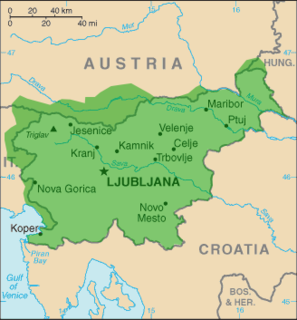
Slovene or Slovenian is a South Slavic language spoken by the Slovenes. It is spoken by about 2.5 million speakers worldwide, the majority of whom live in Slovenia, where it is the only official language. As Slovenia is part of the European Union, Slovene is also one of its 24 official and working languages.
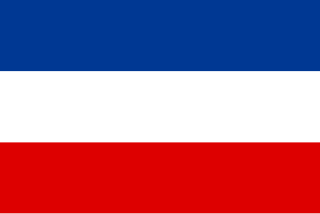
Yugoslavia was a country in Southeastern and Central Europe for most of the 20th century. It came into existence after World War I in 1918 under the name of the Kingdom of Serbs, Croats and Slovenes by the merger of the provisional State of Slovenes, Croats and Serbs with the Kingdom of Serbia, and constituted the first union of the South Slavic people as a sovereign state, following centuries in which the region had been part of the Ottoman Empire and Austria-Hungary. Peter I of Serbia was its first sovereign. The kingdom gained international recognition on 13 July 1922 at the Conference of Ambassadors in Paris. The official name of the state was changed to Kingdom of Yugoslavia on 3 October 1929.
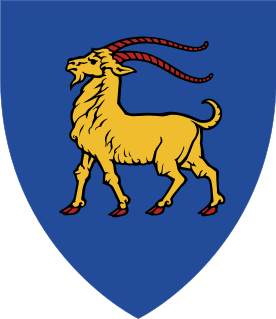
Istria, formerly Histria (Latin), Ίστρια, is the largest peninsula in the Adriatic Sea. The peninsula is located at the head of the Adriatic between the Gulf of Trieste and the Kvarner Gulf. It is shared by three countries: Croatia, Slovenia, and Italy. Croatia encapsulates most of the Istrian peninsula with its Istria County.

The Mur or Mura is a river in Central Europe rising in the Hohe Tauern national park of the Central Eastern Alps in Austria with its source being 1,898 m (6,227 ft) above sea level. It is a tributary of the Drava and subsequently the Danube.

Šibenik-Knin County is a county in southern Croatia, located in the north-central part of Dalmatia. The biggest city in the county is Šibenik, which also serves as county seat. Other notable towns in the county are Knin, Drniš and Skradin.
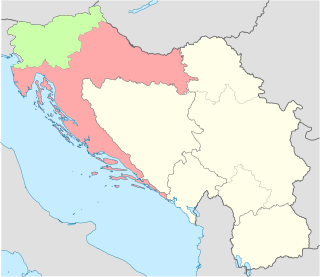
The Brioni Agreement or Brioni Declaration is a document signed by representatives of Slovenia, Croatia, and Yugoslavia under the political sponsorship of the European Community (EC) on the Brijuni Islands on 7 July 1991. The agreement sought to create an environment in which further negotiations on the future of Yugoslavia could take place. However, ultimately it isolated the federal prime minister Ante Marković in his efforts to preserve Yugoslavia, and effectively stopped any form of federal influence over Slovenia. This meant the Yugoslav People's Army (JNA) would focus on combat in Croatia, creating a precedent of redrawing international borders and staking the EC's interest in resolving the Yugoslav crisis.

The Sutla (Croatian) or Sotla (Slovene) is a river flowing through Slovenia and Croatia, mostly forming their border. It is a tributary to the Sava, itself a tributary to the Danube. It is 89 kilometres (55 mi) long and has a watershed area of 584 square kilometres (225 sq mi).

The Kupa or Kolpa river, a right tributary of the Sava, forms a natural border between north-west Croatia and southeast Slovenia. It is 297 kilometres long, with its border part having a length of 118 km (73 mi) and the rest located in Croatia.

The breakup of Yugoslavia occurred as a result of a series of political upheavals and conflicts during the early 1990s. After a period of political and economic crisis in the 1980s, constituent republics of the Socialist Federal Republic of Yugoslavia split apart, but the unresolved issues caused bitter inter-ethnic Yugoslav wars. The wars primarily affected Bosnia and Herzegovina, neighbouring parts of Croatia and, some years later, Kosovo.

The Ten-Day War, or the Slovenian Independence War, was a brief conflict that followed the Slovenian declaration of independence on 25 June 1991. It was fought between the Slovenian Territorial Defence and the Yugoslav People's Army (JNA). It lasted from 27 June 1991 until 7 July 1991, when the Brioni Accords were signed. It marked the beginning of the Yugoslav Wars.

The Greek Catholic Church of Croatia and Serbia is a particular Eastern Catholic Church of the Byzantine Rite which is in full union with the Catholic Church. It consists of the Greek Catholic Eparchy of Križevci, covering Croatia, Slovenia, and Bosnia-Herzegovina, and the Greek Catholic Eparchy of Ruski Krstur, covering Serbia. The Eparchy of Križevci was headed by Bishop Nikola Kekić until his retirement in March 2019, and since then the eparchy is governed by apostolic administrator Milan Stipić. The Eparchy of Ruski Krstur is headed by Bishop Đura Džudžar since his appointment in 2003.

Žirje is an island and a settlement in the Croatian part of the Adriatic Sea. It is situated in the Šibenik archipelago, about 22 kilometres southwest of Šibenik, which makes it the most remote permanently inhabited island in the Šibenik archipelago. Its area is 15.08 km2, and it has a population of 103. Its population is steadily decreasing.
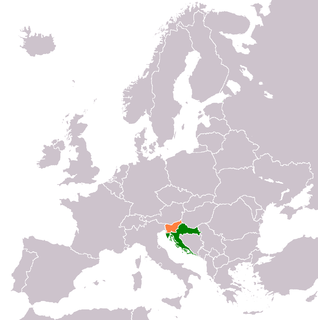
Croatia–Slovenia relations are foreign relations between Croatia and Slovenia. Croatia has an embassy in Ljubljana and two honorary consulates in Maribor and Koper. Slovenia has an embassy in Zagreb and an honorary consulate in Split. The countries share 670 km (420 mi) of common border. Relations between Slovenia and Croatia are generally considered to be friendly, but plagued with a series of unresolved border disputes and other vestiges from the time when both countries were the northernmost part of SFR Yugoslavia.
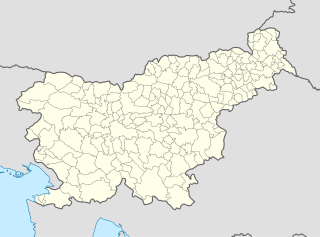
Žirje is a small village northeast of Povir in the Municipality of Sežana in the Littoral region of Slovenia.
Following the breakup of Yugoslavia in 1991, Slovenia and Croatia became independent countries. As the border between the countries had not been determined in detail prior to independence, several parts of the border were disputed, both on land and at the sea, namely in the Gulf of Piran.

D128 is a state road on Žirje Island in Croatia connecting the town of Žirje to Žirje ferry port, from where Jadrolinija ferries fly to the mainland, docking in Šibenik and the D33 state road. The road is 3.8 km (2.4 mi) long.
Mikavica is a bay on isle of Žirje in Croatia. It is connected by the D128 highway.
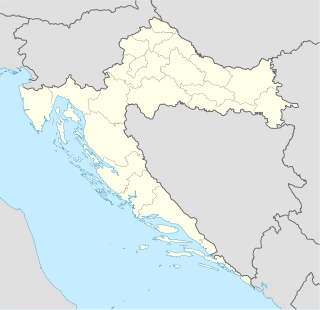
The Battle of Šibenik, also known as the September War, was an armed conflict fought between the Yugoslav People's Army, supported by the Croatian Serb-established Serbian Autonomous Oblast of Krajina, and the Croatian National Guard, supported by the Croatian Police. The battle was fought to the north and west of the city of Šibenik, Croatia on 16–22 September 1991, during the Croatian War of Independence. The JNA's initial orders were to relieve Croatian siege of their barracks in the city and isolate the region of Dalmatia from the rest of Croatia. The JNA's advance was supported by the Yugoslav Air Force and the Yugoslav Navy.

BTC City Ljubljana is a professional cycling team based in Slovenia, which competes in elite road bicycle racing events such as the UCI Women's World Tour.
