The .30-06 Springfield cartridge, 7.62×63mm in metric notation and called ".30 Gov't '06" by Winchester, was introduced to the United States Army in 1906 and later standardized; it remained in use until the early 1980s. The ".30" refers to the caliber of the bullet in inches. The "06" refers to the year the cartridge was adopted—1906. It replaced the .30-03, 6mm Lee Navy, and .30-40 Krag cartridges. The .30-06 remained the U.S. Army's primary rifle and machine gun cartridge for nearly 50 years before being replaced by the 7.62×51mm NATO and 5.56×45mm NATO, both of which remain in current U.S. and NATO service. It remains a very popular sporting round, with ammunition produced by all major manufacturers.

The .308 Winchester is a rimless, bottlenecked rifle cartridge and is the commercial cartridge from which the 7.62×51mm NATO round was derived. The .308 Winchester was introduced in 1952, two years prior to the NATO adoption of the 7.62×51mm NATO T65. Winchester branded the cartridge and introduced it to the commercial hunting market as the .308 Winchester. Winchester's Model 70, model 100 and Model 88 rifles were subsequently chambered for the new cartridge. Since then, the .308 Winchester has become the most popular short-action, big-game hunting cartridge worldwide. It is also commonly used for civilian hunting, target shooting, metallic silhouette, bench rest target shooting, palma, metal matches, military sniping, and police sharpshooting. The relatively short case makes the .308 Winchester especially well-adapted for short-action rifles. When loaded with a bullet that expands, tumbles, or fragments in tissue, this cartridge is capable of high terminal performance.

A wildcat cartridge, often shortened to wildcat, is a custom cartridge for which ammunition and/or firearms are not mass-produced. These cartridges are often created in order to optimize a certain performance characteristic of an existing commercial cartridge.
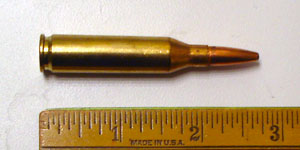
The .243 Winchester (6×52mm) is a popular sporting rifle cartridge. Initially designed as a target/varmint round, it may be used for animals such as coyotes, blacktail deer, whitetail deer, mule deer, pronghorns, and wild hogs. Rounds of at least 90 grains are better suited for hunting the larger of those while rounds less than 90 grains are more suitable for varmints. The .243 is based on a necked down .308 cartridge case. It is very popular with target shooters, metallic silhouette, and long range shooters, because of its accuracy and low recoil.
The .510 Whisper is a subsonic rifle cartridge developed by SSK Industries for use in suppressed rifles. It fires a .51-caliber bullet weighing 750 gr (49 g) at roughly 1,050 ft/s (320 m/s).

The 7mm-08 Remington is a rifle cartridge that is almost a direct copy of a wildcat cartridge developed around 1958 known as the 7mm/308. As these names would suggest, it is the .308 Winchester case necked down to accept 7 mm (.284) bullets with a small increase in case length. Of cartridges based upon the .308, it is the second most popular behind only the .243 Winchester. However, the .308 is more popular than both. In 1980, the Remington Arms company popularized the cartridge by applying its own name and offering it as a chambering for their Model 788 and Model 700 rifles.

The .30-30 Winchester/.30 Winchester Center Fire (7.62×51mmR) cartridge was first marketed in 1895 for the Winchester Model 1894 lever-action rifle. The .30-30 (thirty-thirty), as it is most commonly known, was the USA's first small-bore, sporting rifle cartridge designed for smokeless powder.

The 6mm PPC, or 6 PPC as it is more often called, is a centerfire rifle cartridge used almost exclusively for benchrest shooting. At distances out to 300 meters, it is one of the most accurate cartridges available. This cartridge's accuracy is produced by a combination of its stout posture, being only 31 mm (1.22 in) long, and aggressive shoulder angle of 30 degrees compared to a 30-06's 17 degrees. Today it is commonly used for railgun shooting matches and has been since the 1980s.

The .300 Winchester Magnum (7.62×67mm) is a belted, bottlenecked magnum rifle cartridge that was introduced by Winchester Repeating Arms Company in 1963. The .300 Winchester Magnum is a magnum cartridge designed to fit in a standard rifle action. It is based on the .375 H&H Magnum, which has been blown out, shortened, and necked down to accept a .30 caliber (7.62 mm) bullet.

The 7mm Remington Magnum rifle cartridge was introduced as a commercially available round in 1962, along with the new Remington Model 700 bolt-action rifle. It is a member of the belted magnum family that is directly derived from the venerable .375 H&H Magnum. The original purpose of the belted magnum concept taken from the .300 H&H Magnum and .375 H&H Magnum, was to provide precise headspace control, since the sloping shoulders, while easing cartridge extraction, were unsuitable for this purpose. Improved cartridge extraction reliability is desirable while hunting dangerous game, which would be of concern when needing a fast follow up shot. The 7mm Remington Magnum is based on the commercial Winchester .264 Winchester Magnum, .338 Winchester Magnum, and .458 Winchester Magnum, which were based on the same belted .300 H&H Magnum and .375 H&H Magnum cases, trimmed to nearly the same length as the .270 Weatherby Magnum.
The .260 Remington cartridge was introduced by Remington in 1997. Many wildcat cartridges based on the .308 Winchester case had existed for years before Remington standardized this round. Although loaded to higher pressures, the ballistics of this cartridge are basically similar to the 6.5×55mm when bullet weights do not exceed 140 grains. When loaded with heavier bullets, the 6.5×55mm is capable of greater velocity. Due to its shorter overall length the .260 Remington can be chambered in a shorter length action than the 6.5×55mm.

The .358 Winchester is a .35 caliber rifle cartridge based on a necked up .308 Winchester created by Winchester in 1955. The cartridge is also known in Europe as the 9.1x51mm.
22 caliber, or 5.6mm caliber, refers to a common firearms bore diameter of 0.22 in (5.6 mm). Both .22 Long Rifle and 5.56×45mm NATO are very widely used, and it is also a popular air gun pellet caliber.
The Thompson/Center Ugalde, or TCU family of wildcat cartridges, was developed by Wes Ugalde of Fallon, Nevada, by necking up .223 Remington brass to accept larger bullets. The cartridges were developed for the Thompson Center Arms Contender single shot pistol, and are widely used in handgun metallic silhouette competition and handgun hunting.

The .30 Remington AR cartridge was created in 2008 by Remington Arms to fill a perceived gap in performance on large game between the .223 Remington and larger cartridges such as the .308 Winchester. Design of the cartridge is considered a joint effort between companies under the "Freedom Group" name through a private equity firm and included such companies as Bushmaster, DPMS and Remington itself. It is a rebated rim cartridge designed to fit Remington's R-15 semiautomatic hunting rifle. It was designed to fit the dimensional constraints of the AR-15 magazine and is based on a modification of the .450 Bushmaster, which in turn was based on the .284 Winchester.

The .338 Marlin Express is a new cartridge developed by Marlin Firearms and Hornady. It is based on the .376 Steyr with a goal to duplicate the venerable .30-06 Springfield's performance in a cartridge compatible with lever-action firearms. The cartridge uses a slightly shorter, rimmed case to function in lever action rifles with tubular magazines. As introduced in Hornady's LEVERevolution line of cartridges, it follows the design logic of the .308 Marlin Express which preceded it. The .338MX fires heavier .338 caliber bullets than the .308 Marlin Express at roughly the same velocity. It is chambered in Marlin's Model 338MX and 338MXLR rifles using the Marlin Model 336 action.
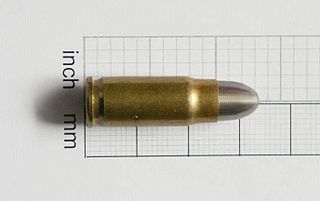
The 7.63×25mm Mauser round was the original cartridge for the Mauser C96 service pistol. This cartridge headspaces on the shoulder of the case. It later served as the basis for the 7.62mm Tokarev cartridge commonly used in Soviet and Eastern Bloc weapons.
The .356 Winchester is a semi-rimmed, bottle-necked, centerfire rifle cartridge which was designed for use in lever-action rifles. It was developed concurrently with the .307 Winchester which acted as the parent cartridge. Both cartridges were introduced in 1982 in the then-new Model 94 XTR lever-action rifle.
The .308×1.5" Barnes is a wildcat cartridge based on the .308 Winchester. The cartridge is similar to the 7.62×39mm Russian (M43) cartridge though it outperforms the Soviet cartridge. It was designed by Frank C. Barnes in March 1961 by shortening the .308 Winchester to 1.5 in (38 mm) and giving it a shoulder angle of 20° (α=40°) similar to the parent cartridge.


