110P/Hartley

Last updated

110P/Hartley
110P 2021-11-20 image ZTF-sso-568-zg-fov-7.0arcmin.png
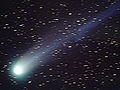
Comet Hartley 3 imaged from the Zwicky Transient Facility on 20 November 2021
Discovery [1]
Discovered by Malcolm Hartley
Discovery site UK Schmidt Telescope
Discovery date19 February 1988
Designations
P/1988 D1
P/1993 M1
  • Hartley 3
  • 1987 XII, 1994 XII
  • 1988d, 1993m
Orbital characteristics [2] [3]
Epoch 25 February 2023 (JD 2460000.5)
Observation arc 35.23 years
Number of
observations
3,998
Aphelion 4.752 AU
Perihelion 2.455 AU
Semi-major axis 3.604 AU
Eccentricity 0.31870
Orbital period 6.841 years
Inclination 11.705°
287.52°
Argument of
periapsis
167.46°
Mean anomaly 71.255°
Last perihelion18 October 2021
Next perihelion28 August 2028 [4]
TJupiter 2.990
Earth MOID 1.483 AU
Jupiter MOID 0.478 AU
Physical characteristics [2] [5] [6]
Mean radius
2.31±0.03 km
Mean density
0.13±0.02 g/cm3
10.153±0.001 hours
(V–R) = 0.67±0.09
Comet total
magnitude
(M1)
4.3
Comet nuclear
magnitude (M2)
13.3

Comet Hartley 3 is a periodic comet with a six-year orbit around the Sun. It is one of ten comets discovered by Australian astronomer, Malcolm Hartley.

Contents

Observational history

Discovery

The comet appeared as a weak trail at magnitude 16.5 on the edge of its discovery plates, which were taken from the UK Schmidt Telescope of the Siding Spring Observatory. [7] By 22 February, Hartley confirmed his discovery using the same telescope, and found a tail about 10 arcminutes in length. [1] From the Palomar Observatory, both Carolyn and Eugene Shoemaker found two precovery images of the comet about 4.8 hours before its official discovery. [8] By then, it was determined that Hartley's find is definitely a short-period comet. [8]

Follow-up observations

Six observatories around the globe made observations of Hartley 3 in March 1988, including those made by Tsutomu Seki, Robert H. McNaught, James V. Scotti, and David H. Levy. [7] By April 1988, revised orbital calculations by Brian G. Marsden indicated that the comet completes an elliptical orbit once every 6.85 years. [9]

Hartley 3 was successfully recovered by James V. Scotti using the Spacewatch telescope of the Kitt Peak Observatory on 23 June 1993. [10]

Physical characteristics

Observations by the Hubble Space Telescope in 2004 and 2011 revealed that the effective radius of its nucleus is around 2.15±0.04 km and a rotation period of 9.4±1.0 hours. [11] [12] Later ground observations from Pan-STARRS and other sky surveys revised the radius and rotation periods to 2.31±0.03 km and 10.153±0.001 hours, respectively. [5]

References

Citations

  1. 1 2 M. Hartley; R. H. McNaught (23 February 1988). D. W. Green (ed.). "Comet Hartley (1988d)". IAU Circular. 4553 (1). Bibcode:1988IAUC.4553....1H.
  2. 1 2 "110P/Hartley 3 – JPL Small-Body Database Lookup". ssd.jpl.nasa.gov. Jet Propulsion Laboratory . Retrieved 21 November 2023.
  3. "110P/Hartley Orbit". Minor Planet Center . Retrieved 28 May 2025.
  4. S. Yoshida. "110P/Hartley". www.aerith.net. Archived from the original on 17 March 2025. Retrieved 28 May 2025.
  5. 1 2 R. Kokotanekova; C. Snodgrass; P. Lacerda; S. F. Green; S. C. Lowry; et al. (2017). "Rotation of Cometary Nuclei: New Lightcurves and an Update of the Ensemble Properties of Jupiter-Family Comets". Monthly Notices of the Royal Astronomical Society. 471 (3): 2974–3007. arXiv: 1707.02133 . Bibcode:2017MNRAS.471.2974K. doi: 10.1093/mnras/stx1716 .
  6. M. M. Knight; R. Kokotanekova; N. H. Samarasinha (2023). "Physical and Surface Properties of Comet Nuclei from Remote Observations". arXiv: 2304.09309 [astro-ph.EP].
  7. 1 2 Kronk, Meyer & Seargent 2017, p. 349.
  8. 1 2 C. S. Shoemaker; E. M. Shoemaker; M. Hartley; R. H. McNaught (1 March 1988). D. W. Green (ed.). "Periodic Comet Hartley (1988d)". IAU Circular. 4558 (1). Bibcode:1988IAUC.4558....1S.
  9. B. G. Marsden (4 April 1988). "Periodic Comet Hartley (1988d)". IAU Circular. 4576 (2). Bibcode:1988IAUC.4576....2M.
  10. J. V. Scotti (29 June 1993). D. W. Green (ed.). "Periodic Comet Hartley (1993m)". IAU Circular. 5826 (1). Bibcode:1993IAUC.5826....1S.
  11. P. L. Lamy; I. Toth; Y. R. Fernández; H. A. Weaver (2004). "The Sizes, Shapes, Albedos, and Colors of Cometary Nuclei" (PDF). Comets II. University of Arizona Press. pp. 223–264. doi:10.2307/j.ctv1v7zdq5.22. ISBN   978-0-8165-2450-1. JSTOR   j.ctv1v7zdq5.22.
  12. P. L. Lamy; I. Toth; H. A. Weaver; M. F. A'Hearn; L. Jorda (2011). "Properties of the nuclei and comae of 10 ecliptic comets from Hubble Space Telescope multi-orbit observations" (PDF). Monthly Notices of the Royal Astronomical Society. 412 (3): 1573–1590. Bibcode:2011MNRAS.412.1573L. doi: 10.1111/j.1365-2966.2010.17934.x .

Bibliography

Numbered comets
Previous
109P/Swift–Tuttle
110P/HartleyNext
111P/Helin–Roman–Crockett