Fort Hamilton is a United States Army installation in the southwestern corner of the New York City borough of Brooklyn, surrounded by the communities of Bay Ridge and Dyker Heights. It is one of several posts that are part of the region which is headquartered by the Military District of Washington. Its mission is to provide the New York metropolitan area with military installation support for the Army National Guard and the United States Army Reserve. The original fort was completed in 1831, with major additions made in the 1870s and 1900s. However, all defenses except about half of the original fort have been demolished or buried.
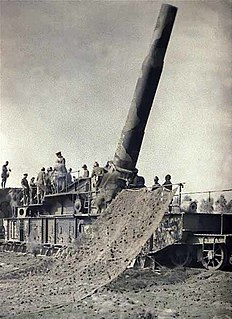
A railway gun, also called a railroad gun, is a large artillery piece, often surplus naval artillery, mounted on, transported by, and fired from a specially designed railway wagon. Many countries have built railway guns, but the best-known are the large Krupp-built pieces used by Germany in World War I and World War II. Smaller guns were often part of an armoured train. Only able to be moved where there were good tracks, which could be destroyed by artillery bombardment or airstrike, railway guns were phased out after World War II.

Fort Totten is a former active United States Army installation in the New York City borough of Queens. It is located on the Willets Point peninsula on the north shore of Long Island. Fort Totten is at the head of Little Neck Bay, where the East River widens to become Long Island Sound. While the U.S. Army Reserve continues to maintain a presence at the fort, the property is now owned by the City of New York.

Fort Worden Historical State Park is located in Port Townsend, Washington, on 433 acres originally known as Fort Worden, a United States Army Coast Artillery Corps base constructed to protect Puget Sound from invasion by sea. Fort Worden was named after U.S. Navy Rear Admiral John Lorimer Worden, commander of USS Monitor during the famous Battle of Hampton Roads during the American Civil War.
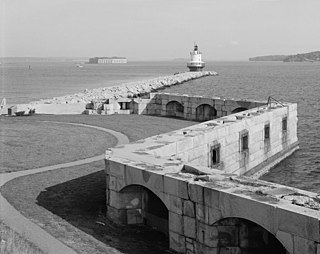
Fort Preble was a military fort in South Portland, Maine, United States, built in 1808 and progressively added to through 1906. It is now on the campus of Southern Maine Community College.

Fort Hancock is a former United States Army fort at Sandy Hook in Middletown Township New Jersey. The coastal artillery base defended the Atlantic coast and the entrance to New York Harbor, with its first gun batteries operational in 1896. Between 1874 and 1919, the adjacent US Army Sandy Hook Proving Ground was operated in conjunction with Fort Hancock. It is now part of Fort Hancock Memorial Park. It was preceded by the Fort at Sandy Hook, built 1857–1867 and demolished beginning in 1885.
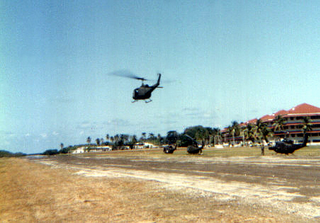
Fort Sherman is a former United States Army base in Panama, located on Toro Point at the Caribbean (northern) end of the Panama Canal, on the western bank of the Canal directly opposite Colón. It was the primary defensive base for the Caribbean sector of the Canal, and was also the center for US jungle warfare training for some time. Its Pacific-side partner was Fort Amador. Both bases were turned over to Panama in 1999.

Several boards have been appointed by US presidents or Congress to evaluate the US defensive fortifications, primarily coastal defenses near strategically important harbors on the US shores, its territories, and its protectorates.
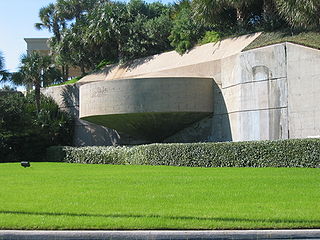
Fort Crockett is a government reservation on Galveston Island overlooking the Gulf of Mexico originally built as a defense installation to protect the city and harbor of Galveston and to secure the entrance to Galveston Bay, thus protecting the commercial and industrial ports of Galveston and Houston and the extensive oil refineries in the bay area. The facility is now managed by the US NOAA National Marine Fisheries Service, and hosts the Bureau of Commercial Fisheries Laboratory, the Texas Institute of Oceanography, as well as some university facilities. The area still contains several historical buildings and military fortifications.
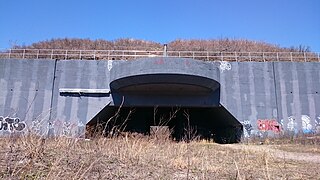
Fort Tilden, also known as Fort Tilden Historic District, is a former United States Army installation on the coast in the New York City borough of Queens. Fort Tilden now forms part of the Gateway National Recreation Area, and is administered by the National Park Service.

Fort H. G. Wright was a United States military installation on Fishers Island in the town of Southold, New York, just two miles off the coast of southeastern Connecticut, but technically in New York. It was part of the Harbor Defenses of Long Island Sound, along with Fort Terry, Fort Michie, and Camp Hero. These forts defended the eastern entrance of Long Island Sound and thus Connecticut's ports and the north shore of Long Island. The fort was named for Union General Horatio G. Wright, a former Chief of Engineers who was born in Clinton, Connecticut.

The 240 mm Trench Mortar, or Mortier de 240 mm, was a large calibre mortar of World War I. An original French design, it was developed by Batignolles Company of Paris and introduced in 1915.
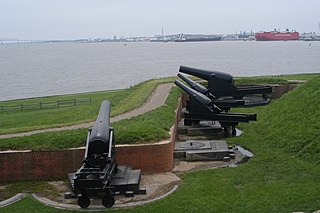
Seacoast defense was a major concern for the United States from its independence until World War II. Before airplanes, many of America's enemies could only reach it from the sea, making coastal forts an economical alternative to standing armies or a large navy. After the 1940s, it was recognized that fixed fortifications were obsolete and ineffective against aircraft and missiles. However, in prior eras foreign fleets were a realistic threat, and substantial fortifications were built at key locations, especially protecting major harbors.

Fort Andrews was created in 1897 as part of the Coast Defenses of Boston, Massachusetts. Construction began in 1898 and the fort was substantially complete by 1904. The fort was named after Major General George Leonard Andrews, an engineer and Civil War commander, who assisted in the construction of nearby Fort Warren in Boston Harbor. It occupies the entire northeast end of Peddocks Island in Boston Harbor, and was originally called the Peddocks Island Military Reservation. Once an active Coast Artillery post, it was manned by hundreds of soldiers and bristled with mortars and guns that controlled the southern approaches to Boston and Quincy Bay. The fort also served as a prisoner-of-war camp for Italian prisoners during World War II, who were employed as laborers following the Italian surrender to the Allies in 1943. Today, the fort is abandoned, and is managed by the Massachusetts Department of Conservation and Recreation, as part of the Boston Harbor Islands National Recreation Area.

Fort Banks was a U.S. Coast Artillery fort located in Winthrop, Massachusetts. It served to defend Boston Harbor from enemy attack from the sea and was built in the 1890s during what is known as the Endicott period, a time in which the coast defenses of the United States were seriously expanded and upgraded with new technology. Today, the Fort Banks Mortar Battery is on the National Register of Historic Places.

Fort Heath was a US seacoast military installation for defense of the Boston and Winthrop Harbors with an early 20th-century Coast Artillery fort, a 1930s USCG radio station, prewar naval research facilities, World War II batteries, and a Cold War radar station. The fort was part of the Harbor Defenses of Boston and was garrisoned by the United States Army Coast Artillery Corps. The fort's military structures have been replaced by a residential complex, including the luxurious Forth Heath Apartments, and recreation facilities of Small Park, which has both a commemorative wall and an historical marker for Fort Heath.

The 12-inch coast defense mortar was a weapon of 12-inch (305 mm) caliber emplaced during the 1890s and early 20th century to defend US harbors from seaborne attack. In 1886, when the Endicott Board set forth its initial plan for upgrading the coast defenses of the United States, it relied primarily on mortars, not guns, to defend American harbors. Over the years, provision was made for fortifications that would mount some 476 of these weapons, although not all of these tubes were installed. Ninety-one of these weapons were remounted as railway artillery in 1918-1919, but this was too late to see action in World War I. The railway mortars were only deployed in small quantities, and none overseas. The fixed mortars in the Philippines saw action in the Japanese invasion in World War II. All of the fixed mortars in the United States were scrapped by 1944, as new weapons replaced them, and the railway mortars were scrapped after the war. Today, the only remaining mortars of this type in the 50 states are four at Battery Laidley, part of Fort Desoto near St. Petersburg, Florida, but the remains of coast defense mortar emplacements can be seen at many former Coast Artillery forts across the United States and its former territories. Additional 12-inch mortars and other large-caliber weapons remain in the Philippines.

The 8-inch gun M1888 (203 mm) was a U.S. Army Coast Artillery Corps gun, initially deployed 1898–1908 in about 75 fixed emplacements, usually on a disappearing carriage. During World War I, 37 or 47 of these weapons were removed from fixed emplacements or from storage to create a railway gun version, the 8-inch Gun M1888MIA1 Barbette carriage M1918 on railway car M1918MI, converted from the fixed coast defense mountings and used during World War I and World War II.

The U.S. Army Coast Artillery Corps (CAC) was an administrative corps responsible for coastal, harbor, and anti-aircraft defense of the United States and its possessions between 1901 and 1950. The CAC also operated heavy and railway artillery during World War I.
