This page is based on this
Wikipedia article Text is available under the
CC BY-SA 4.0 license; additional terms may apply.
Images, videos and audio are available under their respective licenses.

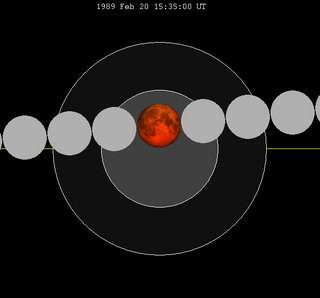
A lunar eclipse occurs when the Moon passes directly behind Earth and into its shadow. This can occur only when the Sun, Earth, and Moon are exactly or very closely aligned, with Earth between the other two. A lunar eclipse can occur only on the night of a full moon. The type and length of a lunar eclipse depend on the Moon's proximity to either node of its orbit.

A total lunar eclipse took place on March 3, 2007, the first of two eclipses in 2007. The moon entered the penumbral shadow at 20:18 UTC, and the umbral shadow at 21:30 UTC. The total phase lasted between 22:44 UTC and 23:58 UTC with a distinctive brick-red shade. The moon left the umbra shadow at 01:11 UTC and left the penumbra shadow at 02:24 UTC 2007-03-04. The second lunar eclipse of 2007 occurred on August 28.
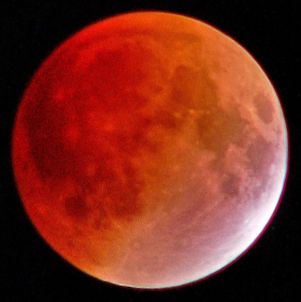
A total lunar eclipse occurred on August 28, 2007, lasting just over 90 minutes. The Moon entered the Earth's penumbra at 7:53:40 UTC. The first partial phase began in earnest at 8:51:16 UTC when the Moon entered the Earth's umbra. It exited the penumbra at 13:20:57 UTC.
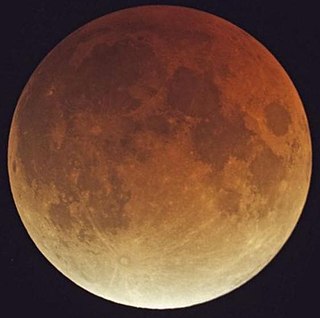
A total lunar eclipse occurred on the evening of Wednesday, February 20, and morning of Thursday, February 21, 2008. It was visible in the eastern evening sky on February 20 for all of North and South America, and on February 21 in the predawn western sky from most of Africa and Europe.

A total lunar eclipse took place on February 9, 1990, the first of two lunar eclipses in 1990.

A partial lunar eclipse took place on April 25, 2013, the first of three lunar eclipses in 2013. Only a tiny sliver of the Moon was covered by the Earth's umbral shadow at maximum eclipse, but the entire northern half of the Moon was darkened from being inside the penumbral shadow. This was one of the shortest partial eclipses of the Moon for the 21st century, lasting 27 minutes.

A total lunar eclipse took place on August 6, 1971. The moon passed through the center of the Earth's shadow.

A total lunar eclipse took place on February 10, 1971. The moon passed through the center of the Earth's shadow.

A total lunar eclipse took place on April 24, 1986, the first of two total lunar eclipses in 1986, the second being on October 17, 1986.
A penumbral lunar eclipse took place on January 20, 1981.
A penumbral lunar eclipse will take place on 10 January 2020. It will be the first of four penumbral lunar eclipses in 2020.

A total lunar eclipse will take place on September 7, 2025.

A partial lunar eclipse took place on April 4, 1977.

A partial lunar eclipse took place on March 24, 1959.

A total lunar eclipse took place on July 26, 1953.
A total lunar eclipse will take place on September 19, 2043.
Saros cycle series 128 for lunar eclipses occurs at the moon's ascending node, repeating every 18 years 11 and 1/3 days. It contains 71 events.