See also
 | This disambiguation page lists articles associated with the title A Way Out. If an internal link led you here, you may wish to change the link to point directly to the intended article. |
A Way Out may refer to:
| | This disambiguation page lists articles associated with the title A Way Out. If an internal link led you here, you may wish to change the link to point directly to the intended article. |

Beavis and Butt-Head is an American adult animated sitcom created by Mike Judge. The series originated from Frog Baseball, a 1992 short film by Judge originally aired on Liquid Television. After seeing the short, MTV signed Judge to develop the short into a full series. The series originally ran for seven seasons from March 8, 1993 to November 28, 1997.
Kingdom may refer to:

Teenage Mutant Ninja Turtles are four fictional teenaged anthropomorphic turtles named after Italian Renaissance artists. They were trained by their anthropomorphic rat sensei in the art of ninjutsu. From their home in the sewers of New York City, they battle petty criminals, evil overlords, mutated creatures, and alien invaders while attempting to remain hidden from society. They were created by Kevin Eastman and Peter Laird.

X-Play was a TV program about video games that ran between July 4, 1998, and January 23, 2013. The program, known for its reviews and comedy skits, aired on G4 in the United States, G4 Canada in Canada, FUEL TV in Australia, Ego in Israel, GXT in Italy, MTV Россия in Russia and Solar Sports in the Philippines.
A tie-in work is a work of fiction or other product based on a media property such as a film, video game, television series, board game, web site, role-playing game or literary property. Tie-ins are authorized by the owners of the original property, and are a form of cross-promotion used primarily to generate additional income from that property and to promote its visibility.

Pokémon, abbreviated from the Japanese title of Pocket Monsters and currently advertised in English as Pokémon the Series, is a Japanese anime television series, part of The Pokémon Company's Pokémon media franchise, which premiered in Japan on April 1, 1997, on TV Tokyo.
A cult following comprises a group of fans who are highly dedicated to a piece of artwork in various mediums, often referred to as a cult classic. A film, book, musical artist, television series or video game, among other things, is said to have a cult following when it has a small but very passionate fanbase. A common component of cult followings is the emotional attachment the fans have to the object of the cult following, often identifying themselves and other fans as members of a community. Cult followings are also commonly associated with niche markets. Cult media are often associated with underground culture, and are considered too eccentric or subversive to be appreciated by the general public or to be commercially successful.
Play most commonly refers to:
Avenger, Avengers, The Avenger or The Avengers may refer to:
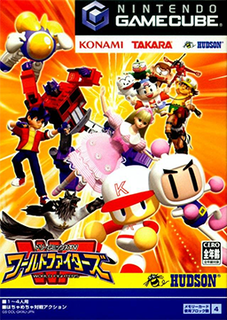
DreamMix TV World Fighters is a crossover fighting video game developed by Bitstep and published by Hudson for the Nintendo GameCube and PlayStation 2 in Japan on December 18, 2003. The game crosses over characters from Hudson and Konami's video game series and Takara's toy lines.
In the history of video games, the first-generation era refers to the video games, video game consoles, and handheld video game consoles available from 1972 to 1983. Notable consoles of the first generation include the Odyssey series, the Atari Home Pong, the Coleco Telstar series and the Color TV-Game series. The generation ended with the Computer TV-Game in 1980, but many manufacturers had left the market prior due to the market decline in 1977 and the start of second generation of video game consoles.
Video game culture is a worldwide new media subculture formed by video games. As computer and video games have exponentially increased in popularity over time, they have had a significant influence on popular culture. Video game culture has also evolved over time, hand in hand with internet culture and the increasing popularity of mobile games. Many people who play video games identify as gamers, which can mean anything from someone who enjoys games to someone who is passionate about it. As video games become more social with multiplayer and online capability, gamers find themselves in growing social networks. Playing video games can both be entertainment as well as competition, as a new trend known as electronic sports is becoming more widely accepted. Today, video games can be seen in social media, politics, television, film, music and YouTube.
PaRappa the Rapper is a 2001 Japanese anime television series based on NanaOn-Sha's PaRappa the Rapper video game series created by Masaya Matsuura and Rodney Greenblat. The series was produced by J.C.Staff and aired in Japan on Fuji TV between April 2001 and January 2002, running for thirty episodes. Episodes 29 and 30 aired together as a 1-hour special.
Carlos Carrasco is an American actor who has appeared in film, television and video games.

Cash Cab is an American game show that aired new episodes on the Discovery Channel from 2005 to 2012, with new seasons also in 2017 and 2018. It began airing on December 5, 2005, hosted by stand-up comedian Ben Bailey, and aired its last episode on September 28, 2012. The show was revived on December 4, 2017. It is part of the global Cash Cab franchise that originated in the United Kingdom.

Durarara!! (デュラララ!!), often shortened to DRRR!!, is a Japanese light novel series written by Ryohgo Narita, with illustrations by Suzuhito Yasuda, that has also been adapted into a Japanese anime series. Durarara!! tells the story of a dullahan working as an underworld courier in Ikebukuro, an internet-based anonymous gang called the Dollars, and the chaos that unfolds around the most dangerous people in Ikebukuro. The series ran for thirteen volumes, published by ASCII Media Works under their Dengeki Bunko imprint.
Kenneth Choi is an American actor. He is best known for playing Henry Lin on the television series Sons of Anarchy (2008–2014), Chester Ming in Martin Scorsese's The Wolf of Wall Street (2013), and Judge Lance Ito in The People v. O. J. Simpson: American Crime Story (2016). He is also known for his roles as Jim Morita and Principal Morita in the Marvel Cinematic Universe films Captain America: The First Avenger (2011) and Spider-Man: Homecoming respectively, and Lewis on the FOX comedy series The Last Man on Earth. He is currently starring in FOX first responder drama series 9-1-1, playing LAFD firefighter Howie "Chimney" Han.

Persona 4: The Animation is an anime television series based on Atlus' PlayStation 2 video game, Persona 4. The story revolves around Yu Narukami, a young teenager who moves to the town of Inaba, where a mysterious string of murders is taking place. Upon discovering a distorted TV World and acquiring a mysterious power known as "Persona", Yu and his friends decide to investigate the murders and save others from being killed.
Way Out may refer to:

Regular Show: Mordecai and Rigby in 8-Bit Land is an action-adventure, space shooter, top down shooter, platform, shoot 'em up video game based on the Cartoon Network series Regular Show. It was developed by WayForward Technologies, and was released in North America on October 29, 2013, Europe on November 8, 2013, and Australia on November 12, 2013 exclusively for the Nintendo 3DS.