 | Look up accretion in Wiktionary, the free dictionary. |
Accretion may refer to:
| Look up accretion in Wiktionary, the free dictionary. |
Accretion may refer to:

In astrophysics, accretion is the accumulation of particles into a massive object by gravitationally attracting more matter, typically gaseous matter, in an accretion disk. Most astronomical objects, such as galaxies, stars, and planets, are formed by accretion processes.
Accretion is defined as the gradual collection of something over time. In meteorology or atmospheric science it is the process of accumulation of frozen water as precipitation over time as it descends through the atmosphere, in particular when an ice crystal or snowflake hits a supercooled liquid droplet, which then freeze together, increasing the size of the water particle. The collection of these particles eventually forms snow or hail in clouds and depending on lower atmosphere temperatures may become rain, sleet, or graupel. Accretion is the basis for cloud formation and can also be seen as water accumulates on the particulate matter and form jet contrails. This is because water vapor in the air requires condensation nuclei to form large droplets of solid or liquid water.

Accretion is the process of coastal sediment returning to the visible portion of a beach or foreshore following a submersion event. A sustainable beach or foreshore often goes through a cycle of submersion during rough weather then accretion during calmer periods. If a coastline is not in a healthy sustainable state, then erosion can be more serious and accretion does not fully restore the original volume of the visible beach or foreshore leading to permanent beach loss.
In finance, accretion is the change in the price of a bond bought at a discount to the par value of the bond. Accretion can be thought of as the antonym of amortization.
 | This disambiguation page lists articles associated with the title Accretion. If an internal link led you here, you may wish to change the link to point directly to the intended article. |

A lagoon is a shallow body of water separated from a larger body of water by barrier islands or reefs. Lagoons are commonly divided into coastal lagoons and atoll lagoons. They have also been identified as occurring on mixed-sand and gravel coastlines. There is an overlap between bodies of water classified as coastal lagoons and bodies of water classified as estuaries. Lagoons are common coastal features around many parts of the world.

There are two common definitions of coastal erosion. First, coastal erosion is often defined as the loss or displacement of land along the coastline due to the action of waves, currents, tides, wind-driven water, waterborne ice, or other impacts of storms. This landward retreat of the shoreline is measured to a given datum over a temporal scale of tides, seasons, and other short-term cyclic processes. Finally, coastal erosion is also defined as the process of long-term removal of sediment and rocks at the coastline, leading to loss of land and retreat of the coastline landward. It may be caused by hydraulic action, abrasion, impact and corrosion by wind, water, and other forces, natural or unnatural.

The nebular hypothesis is the most widely accepted model in the field of cosmogony to explain the formation and evolution of the Solar System. It suggests that the Solar System is formed from the nebulous material. The theory was developed by Immanuel Kant and published in his Allgemeine Naturgeschichte und Theorie des Himmels, published in 1755. Originally applied to the Solar System, the process of planetary system formation is now thought to be at work throughout the Universe. The widely accepted modern variant of the nebular hypothesis is the solar nebular disk model (SNDM) or solar nebular model. It offered explanations for a variety of properties of the Solar System, including the nearly circular and coplanar orbits of the planets, and their motion in the same direction as the Sun's rotation. Some elements of the original nebular hypothesis are echoed in modern theories of planetary formation, but most elements have been superseded.

A salt marsh or saltmarsh, also known as a coastal salt marsh or a tidal marsh, is a coastal ecosystem in the upper coastal intertidal zone between land and open saltwater or brackish water that is regularly flooded by the tides. It is dominated by dense stands of salt-tolerant plants such as herbs, grasses, or low shrubs. These plants are terrestrial in origin and are essential to the stability of the salt marsh in trapping and binding sediments. Salt marshes play a large role in the aquatic food web and the delivery of nutrients to coastal waters. They also support terrestrial animals and provide coastal protection.
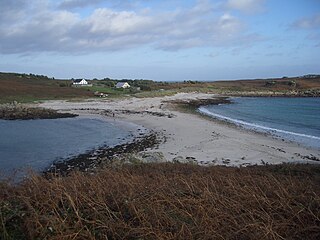
In oceanography, geomorphology, and earth sciences, a shoal is a natural submerged ridge, bank, or bar that consists of, or is covered by, sand or other unconsolidated material, and rises from the bed of a body of water to near the surface. Often it refers to those submerged ridges, banks, or bars that rise near enough to the surface of a body of water as to constitute a danger to navigation. Shoals are also known as sandbanks, sandbars, or gravelbars. Two or more shoals that are either separated by shared troughs or interconnected by past or present sedimentary and hydrographic processes are referred to as a shoal complex.
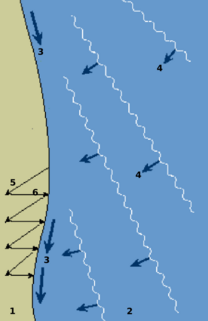
Longshore drift from longshore current is a geological process that consists of the transportation of sediments along a coast parallel to the shoreline, which is dependent on oblique incoming wind direction. Oblique incoming wind squeezes water along the coast, and so generates a water current which moves parallel to the coast. Longshore drift is simply the sediment moved by the longshore current. This current and sediment movement occur within the surf zone.

Deposition is the geological process in which sediments, soil and rocks are added to a landform or land mass. Wind, ice, water, and gravity transport previously weathered surface material, which, at the loss of enough kinetic energy in the fluid, is deposited, building up layers of sediment.

Breakwaters are structures constructed near the coasts as part of coastal management or to protect an anchorage from the effects of both weather and longshore drift.
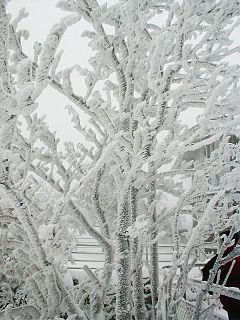
Rime ice forms when supercooled water liquid droplets freeze onto surfaces. Meteorologists distinguish between three basic types of ice forming on vertical and horizontal surfaces by deposition of supercooled water droplets. There are also intermediate formations.
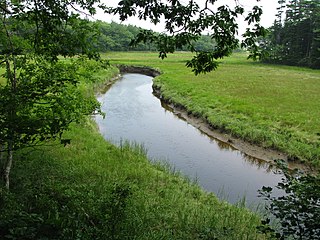
A tidal marsh is a marsh found along rivers, coasts and estuaries which floods and drains by the tidal movement of the adjacent estuary, sea or ocean. Tidal marshes experience many overlapping persistent cycles, including diurnal and semi-diurnal tides, day-night temperature fluctuations, spring-neap tides, seasonal vegetation growth and decay, upland runoff, decadal climate variations, and centennial to millennial trends in sea level and climate. They are also impacted by transient disturbances such as hurricanes, floods, storms, and upland fires.
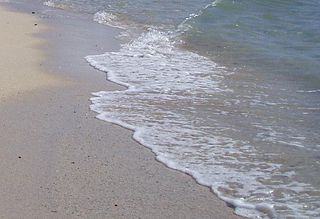
Swash, or forewash in geography, is a turbulent layer of water that washes up on the beach after an incoming wave has broken. The swash action can move beach materials up and down the beach, which results in the cross-shore sediment exchange. The time-scale of swash motion varies from seconds to minutes depending on the type of beach. Greater swash generally occurs on flatter beaches. The swash motion plays the primary role in the formation of morphological features and their changes in the swash zone. The swash action also plays an important role as one of the instantaneous processes in wider coastal morphodynamics.

Accretion, in geology, is a process by which material is added to a tectonic plate or a landmass. This material may be sediment, volcanic arcs, seamounts, or other igneous features.

Cuspate forelands, also known as cuspate barriers or nesses in Britain, are geographical features found on coastlines and lakeshores that are created primarily by longshore drift. Formed by accretion and progradation of sand and shingle, they extend outwards from the shoreline in a triangular shape. Some cuspate forelands may be stabilised by vegetation, while others may migrate down the shoreline. Because some cuspate forelands provide an important habitat for many flora and fauna, effective management is required to reduce the impacts from both human activities and physical factors such as climate change and sea level rise.
The shoreline is where the land meets the sea and it is continually changing. Over the long term, the water is eroding the land. Beaches represent a special case, in that they exist where sand accumulated from the same processes that strip away rocky and sedimentary material. That is, they can grow as well as erode. River deltas are another exception, in that silt that erodes up river can accrete at the river's outlet and extend ocean shorelines. Catastrophic events such as tsunamis, hurricanes and storm surges accelerate beach erosion, potentially carrying away the entire sand load. Human activities can be as catastrophic as hurricanes, albeit usually over a longer time interval.
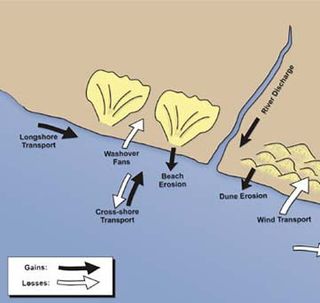
Sedimentary budgets are a coastal management tool used to analyze and describe the different sediment inputs (sources) and outputs (sinks) on the coasts, which is used to predict morphological change in any particular coastline over time. Within a coastal environment the rate of change of sediment is dependent on the amount of sediment brought into the system versus the amount of sediment that leaves the system. These inputs and outputs of sediment then equate to the total balance of the system and more than often reflect the amounts of erosion or accretion affecting the morphology of the coast.
Submersion is the sustainable cyclic portion of coastal erosion where coastal sediments move from the visible portion of a beach to the submerged nearshore region, and later return to the original visible portion of the beach. The recovery portion of the sustainable cycle of sediment behaviour is (accretion).
Biorock, also known as Seacrete or Seament, is a trademark name used by Biorock, Inc. to refer to the substance formed by electro-accumulation of minerals dissolved in seawater. Wolf Hilbertz developed the process and patented it in 1979. The building process, popularly called accretion, is not to be confused with Biorock sewage treatment. The biorock building process grows cement-like engineering structures and marine ecosystems, often for mariculture of corals, oysters, clams, lobsters and fish in salt water. It works by passing a small electric current through electrodes in the water. The structure grows more or less without limit as long as current flows.
Coastal sediment supply is the transport of sediment to the beach environment by both fluvial and aeolian transport. While aeolian transport plays a role in the overall sedimentary budget for the coastal environment, it is paled in comparison to the fluvial supply which makes up 95% of sediment entering the ocean. When sediment reaches the coast it is then entrained by longshore drift and littoral cells until it is accreted upon the beach or dunes.