Related Research Articles

In macroeconomics, an industry is a sector that produces goods or related services within an economy. The major source of revenue of a group or company is an indicator of what industry it should be classified in. When a large corporate group has multiple sources of revenue generation, it is considered to be working in different industries. The manufacturing industry became a key sector of production and labour in European and North American countries during the Industrial Revolution, upsetting previous mercantile and feudal economies. This came through many successive rapid advances in technology, such as the development of steam power and the production of steel and coal.
In macroeconomics, the secondary sector of the economy is an economic sector in the three-sector theory which describes the role of manufacturing. It encompasses the industries which produce a finished, usable product or are involved in construction.
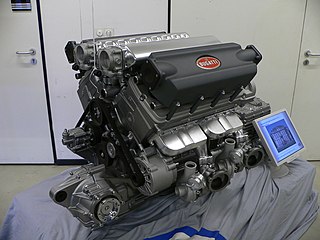
Mechanical engineering is an engineering branch that combines engineering physics and mathematics principles with materials science to design, analyze, manufacture, and maintain mechanical systems. It is one of the oldest and broadest of the engineering branches.
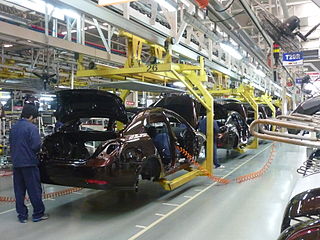
Manufacturing is the production of products for use or sale, using labor and machines, tools, and chemical or biological processing or formulation. It is the essence of secondary industry. The term may refer to a range of human activity, from handicraft to high-tech, but is most commonly applied to industrial design, in which raw materials from primary industry are transformed into finished goods on a large scale. Such goods may be sold to other manufacturers for the production of other more complex products, or distributed via the tertiary industry to end users and consumers.

Dobro is an American brand of resonator guitars, currently owned by Gibson and manufactured by its subsidiary Epiphone. The term "dobro" is also used as a generic trademark for any wood-bodied, single-cone resonator guitar.

Methaqualone is a sedative and hypnotic medication. It was sold under the brand names Quaalude and Sopor among others, and sold as a combination drug under the brand name Mandrax which contained 250mg methaqualone and 25mg diphenhydramine within the same tablet. Commercial production of methaqualone was halted due to widespread abuse and addictiveness. It is a member of the quinazolinone class.
Automation, or Labor-saving technology is the technology by which a process or procedure is performed with minimal human assistance. Automation or automatic control is the use of various control systems for operating equipment such as machinery, processes in factories, boilers and heat treating ovens, switching on telephone networks, steering and stabilization of ships, aircraft and other applications and vehicles with minimal or reduced human intervention.
Lean manufacturing, or lean production, is a production method derived from Toyota's 1930 operating model "The Toyota Way". The term "Lean" was coined in 1988 by John Krafcik, and defined in 1996 by James Womack and Daniel Jones to consist of five key principles; 'Precisely specify value by specific product, identify the value stream for each product, make value flow without interruptions, let customer pull value from the producer, and pursue perfection.'

Good manufacturing practices (GMP) are the practices required in order to conform to the guidelines recommended by agencies that control the authorization and licensing of the manufacture and sale of food and beverages, cosmetics, pharmaceutical products, dietary supplements, and medical devices. These guidelines provide minimum requirements that a manufacturer must meet to assure that their products are consistently high in quality, from batch to batch, for their intended use. The rules that govern each industry may differ significantly; however, the main purpose of GMP is always to prevent harm from occurring to the end user. Additional tenets include ensuring the end product is free from contamination, that it is consistent in its manufacture, that its manufacture has been well documented, that personnel are well trained, and that the product has been checked for quality more than just at the end phase. GMP is typically ensured through the effective use of a quality management system (QMS).
Tata Motors Limited, formerly Tata Engineering and Locomotive Company(TELCO), is an Indian multinational automotive manufacturing company headquartered in Mumbai, Maharashtra, India. It is a part of Tata Group, an Indian conglomerate. Its products include passenger cars, trucks, vans, coaches, buses, sports cars, construction equipment and military vehicles.

"Rust Belt" is an informal term for a region of the United States that has been experiencing industrial decline starting around 1980. It is made up largely of the Great Lakes Megalopolis, though definitions vary. Rust refers to the deindustrialization, or economic decline, population loss, and urban decay due to the shrinking of its once-powerful industrial sector. The term gained popularity in the U.S. in the 1980s.

3D printing, or additive manufacturing, is the construction of a three-dimensional object from a CAD model or a digital 3D model. The term "3D printing" can refer to a variety of processes in which material is deposited, joined or solidified under computer control to create a three-dimensional object, with material being added together, typically layer by layer.

Dunlop is a brand of tyres owned by various companies around the world. Founded by pneumatic tyre pioneer John Boyd Dunlop in Dublin, Ireland in 1890, it is owned and operated by Goodyear Tire and Rubber Company in North America, Europe, Australia and New Zealand. In India, the brand is owned by Dunlop India Ltd. whose parent company is the Ruia Group. In several other Asian countries, Africa and Latin America it is operated by Sumitomo Rubber Industries. In Malaysia, the Dunlop Tyre brand has, since 2012, been wholly owned by Continental AG, which manufactures Dunlop branded tyres for sale in Malaysia, Singapore and Brunei.
Hon Hai Precision Industry Co., Ltd., trading as Foxconn Technology Group and better known as Foxconn, is a Taiwanese multinational electronics contract manufacturer with its headquarters in Tucheng, New Taipei City. Today, it is the world's largest provider of electronics manufacturing services and the third-largest technology company by revenue. The company is the largest private employer in Taiwan and one of the largest employers worldwide. Its founder and chairman is Terry Gou.

MRF Limited (MRF) is an Indian multinational and the largest manufacturer of tires in India and the fourteenth largest manufacturer in the world. It is headquartered in Chennai, India. The company manufactures rubber products including tyres, treads, tubes and conveyor belts, paints and toys. MRF also runs the MRF Pace Foundation, Chennai and MRF Challenge in motorsport.

Industrial engineering is an engineering profession that is concerned with the optimization of complex processes, systems, or organizations by developing, improving and implementing integrated systems of people, money, knowledge, information, equipment, energy and materials.
The United Kingdom, where the Industrial Revolution began in the late 18th century, has a long history of manufacturing, which contributed to Britain's early economic growth. During the second half of the 20th century, there was a steady decline in the importance of manufacturing and the economy of the United Kingdom shifted toward services. Manufacturing, however, remains important for overseas trade and accounted for 44% of goods exports in 2014. In June 2010, manufacturing in the United Kingdom accounted for 8.2% of the workforce and 12% of the country's national output. The East Midlands and West Midlands were the regions with the highest proportion of employees in manufacturing. London had the lowest at 2.8%.

Manufacturing in the United States is a vital sector. The United States is the world's third largest manufacturer with a record high real output in Q1 2018 of $2.00 trillion well above the 2007 peak before the Great Recession of $1.95 trillion. The U.S. manufacturing industry employed 12.35 million people in December 2016 and 12.56 million in December 2017, an increase of 207,000 or 1.7%. Though still a large part of the US economy, in Q1 2018 manufacturing contributed less to GDP than the 'Finance, insurance, real estate, rental, and leasing' sector, the 'Government' sector, or 'Professional and business services' sector.

Make in India was launched by the Government of India on 25 September 2014 to encourage companies to manufacture their products in India and incentivize with dedicated investments into manufacturing.The policy approach was to create a conducive environment for investments, develop modern and efficient infrastructure, and open up new sectors for foreign capital. The initiative targeted 25 economic sectors for job creation and skill enhancement, and aimed "to transform India into a global design and manufacturing hub".

Infinix Mobile is a Hong Kong based smartphone company founded in 2013. The brand was born after the French mobile manufacturer Sagem Wireless was acquired in 2011. The company has research and development centres sprawling between France and Korea and designs its phones in France. Infinix mobile phones are manufactured in France, Bangladesh, Korea, Hong Kong, China and India and are available in Asia and in about 30 countries in the Middle East and Africa, including Morocco, Bangladesh, Kenya, Nigeria, Egypt, Pakistan and Algeria.
References
- ↑ Erwin Tragatsch, “The New Illustrated Encyclopedia of Motorcycles, Quantum Publishing, London, 2000 ISBN 1-86160-342-8
  | This article related to the history of England is a stub. You can help Wikipedia by expanding it. |