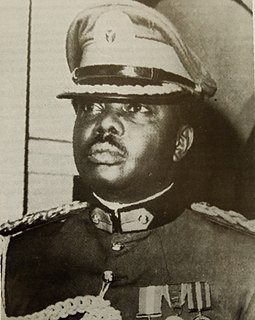
Murtala Ramat Muhammed was a Nigerian general who led the 1966 Nigerian counter-coup in overthrowing the Johnson Aguiyi-Ironsi military regime and featured prominently during the Nigerian Civil War and thereafter ruled over Nigeria from 30 July 1975 until his assassination on 13 February 1976. This period in Nigerian history, from the Northern counter-coup victory to Murtala's death, is commonly associated with the institutionalization of the military in politics.
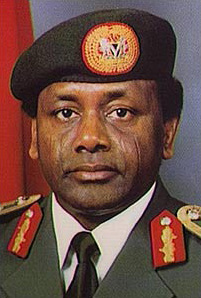
Sani Abacha was a Nigerian general who ruled as the military head of state of Nigeria from 1993 until his death in 1998. He seized power on 17 November 1993 in the last successful coup d'etat in the military history of Nigeria. He was the Chief of Army Staff between 1985 to 1990; Chief of Defence Staff between 1990 to 1993; and Minister of Defence. Abacha became the first Nigerian Army officer to attain the rank of a full military general without skipping a single rank.
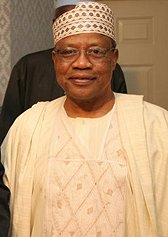
Ibrahim Badamasi Babangida is a retired Nigerian Army general and politician. He served as military president of Nigeria from 1985 until his resignation in 1993. He rose through the ranks to serve from 1984 to 1985 as Chief of Army Staff; going on to orchestrate his seizure of power in a palace coup d'état against Muhammadu Buhari.
Abubakar Dangiwa Umar was governor of Kaduna state in Nigeria from August 1985 to June 1988 during the military regime of General Ibrahim Babangida. After retiring from the army in 1993, he became a social critic and the founder of Movement for Unity and Progress, a political party.
Adetunji Idowu Ishola Olurin mni was a Nigerian one-star general in the national army, who served as the military Governor of Oyo State and Field Commander of ECOMOG Peacekeeping Force in Liberia from 1992 to 1993 during the First Liberian Civil War. Olurin retired from service in 1993, and was a member of People's Democratic Party (PDP) in Nigeria. He was administrator of Ekiti State from 8 October 2006 until 27 April 2007.

The military dictatorship in Nigeria was a period when members of the Nigerian Armed Forces held power in Nigeria from 1966 to 1999 with an interregnum from 1979 to 1983. The military was able to rise to power often with the tacit support of the elite through coup d'ètats. Since the country became a republic in 1963, there has been a series of military coups in Nigeria.
Donaldson Oladipo Diya is a Nigerian general who served as Chief of the General Staff, under military head of state General Sani Abacha from 1994 until his arrest for treason in 1997. He previously served as Chief of Defence Staff and was Military Governor of Ogun State from January 1984 to August 1985.
John Nanzip Shagaya was a Nigerian senator and former senior military officer who was elected in April 2007 to represent the People's Democratic Party (PDP) in Plateau State as member of the Nigerian Senate for Plateau South. He ran for reelection in April 2011 on the Labour Party (LP) platform, but was defeated by Victor Lar of the PDP. As a non commissioned officer (NCO) with the 2nd Reconnaissance Squadron in Abeokuta, he participated in the Nigerian counter-coup of 1966.
Ahmed Muhammad Daku is a retired Nigerian Army brigadier general who was the military Governor of Kano State from August 1985 to December 1987. He later became military Governor of Sokoto State from December 1987 to August 1990.
Lawan Gwadabe is a Nigerian military officer, he was Military Administrator of Niger State in Nigeria from December 1987 to January 1992 during the military regime of General Ibrahim Babangida. He was accused of planning a coup against General Sani Abacha in 1995, for which he was jailed, tortured and convicted of treason. After Abacha's death he was granted a state pardon.
Suleiman Saidu is a retired Nigerian Navy Rear Admiral who served as Chief of Naval Staff from September to November 1993.
Mohammed Chris Alli is a retired Nigerian Army major general who served as Chief of Army Staff from 1993 to 1994 under General Sani Abacha's regime and was military governor of Plateau State Nigeria from August 1985 to 1986 during the military regime of General Ibrahim Babangida. Many years later, he was appointed interim administrator of the state during a 2004 crisis in the state following ethno-religious killings in Shendam, Yelwa Local Government.
Aliyu Mohammed Gusau is a Nigerian general and statesman. He has held several high level national security, military and intelligence offices, and has participated in several military coups, playing a central role in founding the Fourth Nigerian Republic.
Patrick Aziza was the first military Governor of Kebbi State, Nigeria after it was split off from Sokoto State on 27 August 1991 during the military regime of General Ibrahim Babangida.
Salihu Ibrahim FSS, FHWC was a Nigerian army general who was Chief of Army Staff from August 1990 until September 1993 during the military regime of General Ibrahim Babangida.
Since Nigerian independence in 1960, there have been five military coup d'états in Nigeria. Between 1966 and 1999, Nigeria was ruled by a military government without interruption, apart from a short-lived return to democracy under the Second Nigerian Republic of 1979 to 1983. However, the most recent coup occurred in 1993, and there have been no significant further attempts under the Fourth Nigerian Republic, which restored multi-party democracy in 1999.
Ibrahim Bako was a senior officer in the Nigerian Army who played a principal role in two Nigerian military coups: the July 1966 counter-coup and the December 1983 coup. The 1983 coup ousted the democratic government of Shehu Shagari while the July 1966 coup ousted the military government of General Ironsi. Bako was killed while attempting to arrest President Shehu Shagari during the December 1983 coup d'état.

The Nigerian military coup of 1983 took place on 31 December that year. It was coordinated by key officers of the Nigerian military and led to the ousting of the democratically elected government of President Shehu Shagari and the installation of Major General Muhammadu Buhari as head of state.
The 1985 Nigerian coup d'état was a military coup which took place in Nigeria on 27 August 1985 when a faction of mid-level Armed Forces officers, led by the Chief of Army Staff Major-General Ibrahim Babangida, overthrew the government of Major General Muhammadu Buhari. Buhari was then detained in Benin City until 1988. Babangida justified the coup by saying that Buhari failed to deal with the country's economic problems by implementing Buharism, and promised "to rejuvenate the economy ravaged by decades of government mismanagement and corruption". Babangida then replaced the ruling Supreme Military Council (SMC) with a new Armed Forces Ruling Council (AFRC), which lasted until 1993. The regime survived a coup attempt in 1986 and 1990.
 Nigerian