
A cruise missile is a guided missile used against terrestrial targets, that remains in the atmosphere and flies the major portion of its flight path at approximately constant speed. Cruise missiles are designed to deliver a large warhead over long distances with high precision. Modern cruise missiles are capable of travelling at supersonic, high subsonic or hypersonic speeds, are self-navigating, and are able to fly on a non-ballistic, extremely low-altitude trajectory.

The Korean War was a war fought between North Korea and South Korea from 25 June 1950 to 27 July 1953. The war began on 25 June 1950 when North Korea invaded South Korea following clashes along the border and rebellions in South Korea. North Korea was supported by China and the Soviet Union while South Korea was supported by the United Nations, principally the United States. The fighting ended with an armistice on 27 July 1953.
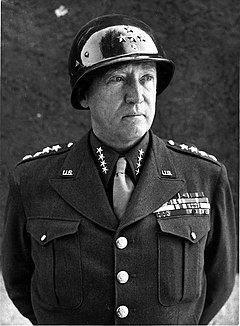
A general officer is an officer of high rank in the armies, and in some nations' air forces, space forces, or marines.
This list of military installations consists of a collection of military related lists worldwide:
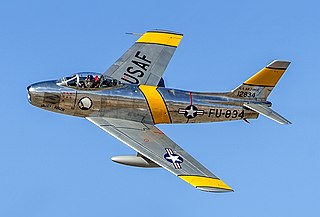
The North American F-86 Sabre, sometimes called the Sabrejet, is a transonic jet fighter aircraft. Produced by North American Aviation, the Sabre is best known as the United States' first swept-wing fighter that could counter the swept-wing Soviet MiG-15 in high-speed dogfights in the skies of the Korean War (1950–1953), fighting some of the earliest jet-to-jet battles in history. Considered one of the best and most important fighter aircraft in that war, the F-86 is also rated highly in comparison with fighters of other eras. Although it was developed in the late 1940s and was outdated by the end of the 1950s, the Sabre proved versatile and adaptable and continued as a front-line fighter in numerous air forces.

The Cessna T-37 Tweet is a small, economical twin-engined jet trainer type which flew for decades as a primary trainer for the United States Air Force (USAF) and in the air forces of several other nations. The T-37C was also capable of light attack. The A-37 Dragonfly variant served in the light attack role during the Vietnam War and continues to serve in the air forces of several South American nations.
7th Division may refer to:

The Indo-Pakistani War of 1965 or the Second Kashmir War was a culmination of skirmishes that took place between April 1965 and September 1965 between Pakistan and India. The conflict began following Pakistan's Operation Gibraltar, which was designed to infiltrate forces into Jammu and Kashmir to precipitate an insurgency against Indian rule. India retaliated by launching a full-scale military attack on West Pakistan. The seventeen-day war caused thousands of casualties on both sides and witnessed the largest engagement of armored vehicles and the largest tank battle since World War II. Hostilities between the two countries ended after a ceasefire was declared through UNSC Resolution 211 following a diplomatic intervention by the Soviet Union and the United States, and the subsequent issuance of the Tashkent Declaration. Much of the war was fought by the countries' land forces in Kashmir and along the border between India and Pakistan. This war saw the largest amassing of troops in Kashmir since the Partition of India in 1947, a number that was overshadowed only during the 2001–2002 military standoff between India and Pakistan. Most of the battles were fought by opposing infantry and armoured units, with substantial backing from air forces, and naval operations.
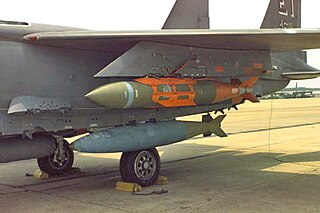
The BLU-109/B is a hardened penetration bomb used by the United States Air Force. As with other "bunker busters", it is intended to smash through concrete shelters and other hardened structures before exploding. In addition to the US, it is part of the armament of the air forces of Australia, Belgium, Canada, Denmark, France, Germany, Greece, Italy, Israel, Netherlands, Norway, Saudi Arabia, United Kingdom and United Arab Emirates.

The army rank of captain is a commissioned officer rank historically corresponding to the command of a company of soldiers. The rank is also used by some air forces and marine forces. Today, a captain is typically either the commander or second-in-command of a company or artillery battery. In the Chinese People's Liberation Army, a captain may also command a company, or be the second-in-command of a battalion.
Events from the year 2007 in Afghanistan.

The South Dakota Air National Guard is the aerial militia of the State of South Dakota, United States of America. It is, along with the South Dakota Army National Guard, an element of the South Dakota National Guard.
16 Squadron or 16th Squadron may refer to:

The Harpoon is an all-weather, over-the-horizon, anti-ship missile, developed and manufactured by McDonnell Douglas. The AGM-84E Standoff Land Attack Missile (SLAM) is a land-attack variant.

Air-to-air combat is the engagement of flying machines in warfare in which one or more aircraft tries to destroy one or more other aircraft. The Korean War saw the greatest amount of air-to-air combat since World War II. During the war the United States claimed to have shot down around 700 fighters. After the war the U.S. Air Force reviewed its figures in an investigation code-named Sabre Measure Charlie and downgraded the kill ratio of the North American F-86 Sabre against the Mikoyan-Gurevich MiG-15 by half from 14:1 to 7:1. One of the factors inflating US numbers was that most dogfights took place over enemy-controlled area. The only way to confirm kills was through gun camera photography. USAF pilots were credited with a kill if the gun camera showed their guns striking the enemy aircraft even if no one actually saw it go down. However, Soviet Air Force kill claims were also highly exaggerated, based upon inherent flaws in their film grading procedures. For instance, the S-13 gun camera was not aligned with either the gunsight or either cannons' ballistics. It ran only while the firing buttons were depressed. Film graders commonly included unit commanders and political commisars who would confirm a "kill"—sometimes even if one had not been claimed by a pilot—when the camera's crosshairs touched the target for two movie frames. During the first 16 months of combat Soviet V-VS units claimed 218 F-86s destroyed when only 36 had been lost. This results in a 600 per cent inflation rate in victory credits over actual Sabres destroyed. However, these figures are complicated by the fact that the Americans routinely attributed combat losses to landing accidents and other causes.
Lieutenant colonel is a rank of commissioned officer in the armies, most marine forces and some air forces of the world, above a major and below a colonel. Several police forces in the United States use the rank of lieutenant colonel. The rank of lieutenant colonel is often shortened to simply "colonel" in conversation and in unofficial correspondence. Sometimes, the term 'half-colonel' is used in casual conversation in the British Army. In the United States Air Force, the term 'light bird' or 'light bird colonel' is an acceptable casual reference to the rank but is never used directly towards the rank holder. A lieutenant colonel is typically in charge of a battalion or regiment in the army.
This page is based on this
Wikipedia article Text is available under the
CC BY-SA 4.0 license; additional terms may apply.
Images, videos and audio are available under their respective licenses.
