
The Liquor Control Board of Ontario (LCBO) is a Crown agency that retails and distributes alcoholic beverages throughout the Canadian province of Ontario. It is accountable to the Legislative Assembly through the minister of finance. It was established in 1927 by the government of Premier George Howard Ferguson to sell liquor, wine, and beer. Such sales were banned outright in 1916 as part of prohibition in Canada. The creation of the LCBO marked an easing of the province's temperance regime. By September 2017, the LCBO was operating 651 liquor stores.
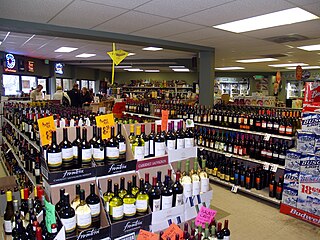
A liquor store is a retail business that predominantly sells prepackaged alcoholic beverages, including liquors, wine or beer, usually intended to be consumed off the store's premises. Depending on region and local idiom, they may also be called an off-licence, off-sale, bottle shop, bottle store or, colloquially, bottle-o, liquor store or other similar terms. A very limited number of jurisdictions have an alcohol monopoly. In US states that are alcoholic beverage control (ABC) states, the term ABC store may be used.

The Oregon Liquor and Cannabis Commission (OLCC), formerly known as the Oregon Liquor Control Commission, is a government agency of the U.S. state of Oregon. The OLCC was created by an act of the Oregon Legislative Assembly in 1933, days after the repeal of prohibition, as a means of providing control over the distribution, sales and consumption of alcoholic beverages. To this end, the agency was given the authority to regulate and license those who manufacture, sell or serve alcohol.
An open-container law is a law which regulates or prohibits drinking alcohol in public by limiting the existence of open alcoholic beverage containers in certain areas, as well as the active consumption of alcohol in those areas. "Public places" in this context refers to openly public places such as sidewalks, parks and vehicles. It does not include nominally private spaces which are open to the public, such as bars, restaurants and stadiums.

Alcoholic beverage control states, generally called control states, less often ABC states, are 17 states in the United States that have state monopoly over the wholesaling or retailing of some or all categories of alcoholic beverages, such as beer, wine, and distilled spirits.

The Alberta Gaming, Liquor and Cannabis Commission (AGLC) is an agency of the government of the Canadian province of Alberta, and regulates alcoholic beverages, recreational cannabis, and gaming-related activities. References to cannabis were added to AGLC's name and governing legislation as cannabis in Canada moved towards legalization in 2018. AGLC was created in 1996 as the Alberta Gaming and Liquor Commission by combining the responsibilities and operations of the Alberta Liquor Control Board (ALCB), Alberta Lotteries, the Alberta Gaming Commission, Alberta Lotteries and Gaming and the Gaming Control Branch. The current Chief Executive Officer as of 2020 is Kandice Machado.
The New Jersey Division of Alcoholic Beverage Control is an agency of the government of the state of New Jersey that regulates commerce in alcoholic beverages in that state.
The Washington State Liquor and Cannabis Board, formerly the Washington State Liquor Control Board, is an administrative agency of the State of Washington. The Liquor and Cannabis Board is part of the executive branch and reports to the Governor. The board's primary function is the licensing of on and off premises establishments which sell any type of alcohol, and the enforcement and education of the state's alcohol, tobacco, and cannabis laws.

A liquor license is a governmentally issued permit for businesses to sell, manufacture, store, or otherwise use alcoholic beverages.

The Nova Scotia Liquor Corporation (NSLC) is the Crown corporation which controls sales of alcoholic beverages and recreational cannabis in Nova Scotia, Canada. It is the sole distributor for these products and runs all retail outlets selling alcohol and cannabis products. The exceptions are for four private retailers in urban HRM offering beer, wine, and spirits, and, in rural areas where there is not an NSLC location, 65 "agency" liquor stores operated by private retailers on NSLC's behalf.

The Delaware Division of Alcohol and Tobacco Enforcement (DATE) is a law enforcement agency of the State of Delaware and is a division of the Delaware Department of Safety and Homeland Security (DSHS).
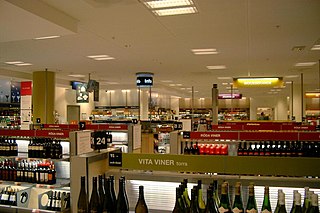
An alcohol monopoly is a government monopoly on manufacturing and/or retailing of some or all alcoholic beverages, such as beer, wine and spirits. It can be used as an alternative for total prohibition of alcohol. They exist in all Nordic countries except Denmark proper, and in all provinces and territories in Canada except Alberta. In the United States, there are some alcoholic beverage control states, where alcohol wholesale is controlled by a state government operation and retail sales are offered by either state or private retailers.
The Virginia Alcoholic Beverage Control Authority is one of the eleven public safety agencies under the Secretariat of Public Safety and Homeland Security for the Commonwealth. The agency administers the state's ABC laws. ABC stores are the only retail outlets in Virginia where customers may purchase distilled spirits. The profits that Virginia ABC contributes are collected from sales of distilled spirits at ABC stores, taxes collected on beer and wine sales, violation penalties and license fees. Since its establishment in 1934, Virginia ABC has contributed more than $9 billion to the Commonwealth's general fund. Virginia ABC employs more than 4,000 people statewide.

Alcohol laws of New York are a set of laws specific to manufacturing, purchasing, serving, selling, and consuming alcohol in the state of New York. Combined with federal and local laws, as well as vendor policies, alcohol laws of New York determine the state's legal drinking age, the driving under the influence limit, liquor license requirements, server training, and more.
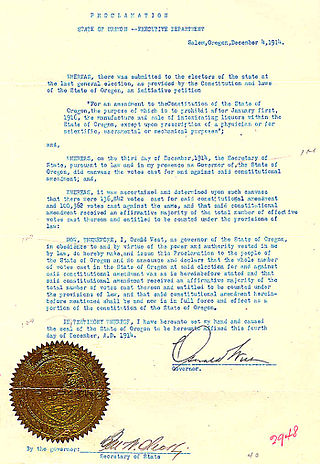
The U.S. state of Oregon has an extensive history of laws regulating the sale and consumption of alcoholic beverages, dating back to 1844. It has been an alcoholic beverage control state, with the Oregon Liquor and Cannabis Commission holding a monopoly over the sale of all distilled beverages, since Prohibition. Today, there are thriving industries producing beer, wine, and liquor in the state. Alcohol may be purchased between 7 a.m. and 2:30 a.m for consumption at the premise it was sold at, or between 6 a.m. and 2:30 a.m. if it is bought and taken off premise. In 2020, Oregon began allowing the sale of alcohol via home delivery services. As of 2007, consumption of spirits was on the rise while beer consumption held steady. That same year, 11% of beer sold in Oregon was brewed in-state, the highest figure in the United States.
The New York State Executive Department of the New York state government serves as the administrative department of the Governor of New York. This department has no central operating structure; it consists of a number of divisions, offices, boards, commissions, councils, and other independent agencies that provide policy advice and assistance to the governor and conduct activities according to statute or executive order. Its regulations are compiled in title 9 of the New York Codes, Rules and Regulations.

The production of distilled spirits in New Jersey has not been a large industry in the state. Strict alcoholic beverage control laws in place during and after Prohibition (1919–1933) prevented the industry from growing for almost a century. In 2013, the state passed a law creating a craft distillery license. and issued the first new distillery license since Prohibition to Jersey Artisan Distilling.
