
The Crimean campaigns of 1687 and 1689 were two military campaigns of the Tsardom of Russia against the Crimean Khanate. They were a part of the Russo-Turkish War (1686–1700) and Russo-Crimean Wars. These were the first Russian forces to come close to Crimea since 1569. They failed due to poor planning and the practical problem of moving such a large force across the steppe but nonetheless played a key role in halting the Ottoman expansion in Europe. The campaigns came as a surprise for the Ottoman leadership, spoiled its plans to invade Poland and Hungary and forced it to move significant forces from Europe to the east, which greatly helped the League in its struggle against the Ottomans.
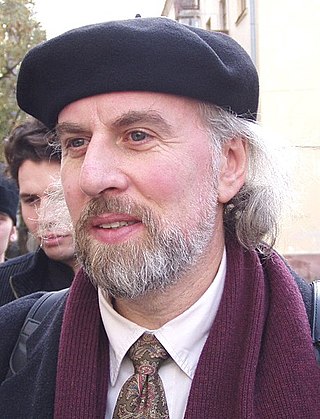
Alexander Leonidovich Dvorkin is a Russian anti-cult activist. From 1999 to 2012 he was professor and head of the department of the study of new religious movements (cults) at Saint Tikhon's Orthodox University. He is currently professor of department of missiology at that university.

Alexander Nikolayevich Samokhvalov was a Soviet Russian painter, watercolorist, graphic artist, illustrator, art teacher and Honored Arts Worker of the RSFSR, who lived and worked in Leningrad. He was a member of the Leningrad branch of Union of Artists of Russian Federation, and was regarded as one of the founders and brightest representatives of the Leningrad school of painting, most famous for his genre and portrait painting.

Alexander Petrovich Koroviakov was a Soviet, Russian painter and art teacher, lived and worked in Leningrad – Saint Petersburg, a member of the Saint Petersburg Union of Artists, regarded as a representative of the Leningrad school of painting.
German Pavlovich Yegoshin was a Russian and Soviet painter and art educator, an Honored Artist of the Russian Federation, who lived and worked in Saint Petersburg. He was a member of the Leningrad Union of Soviet Artists, and was regarded as one of the representatives of the Leningrad School of Painting.

Freemasonry in Russia started in the 18th century and has continued to the present day. Russian Freemasonry pursue humanistic and educational purposes, but more attention is given to ethical issues. It was a spiritual community of people united in an effort to contribute to the prosperity of the Motherland and the enlightenment of the people living in it.
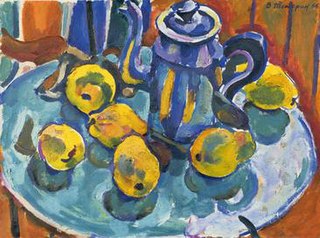
Quince and Teapot is a decorative still life of Russian painter Victor Kuzmich Teterin, which depicts the quince fruit and teapot on a silver tray.
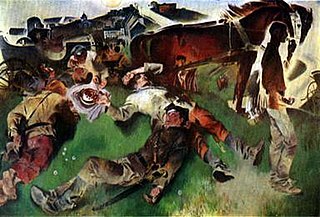
Cherry is an oil painting on canvas painted in 1969 by Russian artist Yevsey Moiseyenko (1916–1988).

Vasily Pavlovich Kravkov was an Imperial Russian Army medical officer, Privy Councilor (1917), and author of diaries of the Russo-Japanese War and World War I.
The House of Creativity "Staraya Ladoga" was an all-Russian centre for artistic creativity, which existed in the Volkhovsky District of Leningrad Oblast from the mid-20th century up to the 1990s. It was located opposite the ancient village of Staraya Ladoga on the right bank of the Volkhov River.

Pyotr Pavlovich Albedinsky (1826–1883) was a Russian military officer and politician.

Nikolai Alexandrovich Chayev was a Russian writer, poet and playwright.

Andrey Nikolayevich Beketov was a prominent Russian Imperial botanist, an Honourable member of the Saint Petersburg Academy of Sciences.

Prince Nikolai Nikolayevich Obolensky was an Imperial Russian division commander. He was born in what is now Ulyanovsk, Ulyanovsk Oblast. He fought in wars in the Crimea, Poland and against the Ottoman Empire. He had two sons, Vladimir and Alexander.
"An Enigmatic Nature" is an 1883 short story by Anton Chekhov.

"Fat and Thin" is a satirical short story by Anton Chekhov, first published in the No. 40, 1 October 1883 issue of Oskolki magazine, signed A. Chekhonte. It was included into Chekhov's 1886 collection Motley Stories published in Saint Petersburg and later in the Volume 1 of the Adolf Marks's Chekhov's Collected Works (1899).

Numan Yunusovich Satimov was a Soviet and Uzbek mathematician, Doktor Nauk in Physical and Mathematical Sciences, academician of the Academy of Sciences of Uzbekistan (2000), and corresponding member of the Academy of Sciences of UzSSR from 1979 to 2006, and a laureate of the Biruni State Prize (1985). He was a specialist in the theory of differential equations, control theory and their applications.

Chaitanya Chandra Charan Das is a Russian Hindu Vaishnavite religious figure and preacher; guru and member of the Governing Council of the International Society for Krishna Consciousness (ISKCON).
Seraphim was a metropolitan of the Russian Orthodox Church Outside Russia. During World War II, he supported the invasion of the USSR, but he also saved the life of Alexander (Nyemolovsky), the bishop of Brussels and Belgium, imprisoned by the Gestapo due to his anti-Nazi views.

"And now I will show you, where they were preparing the attack on Belarus from" is a phrase widely spread on Russophone internet communities said by Alexander Lukashenko, which attempts to justify Russia's invasion of Ukraine in regards to Belarus. The phrase subsequently became very popular in many countries of the former Soviet Union and started being used as a meme in various videos from mid-March 2022.


