
Look up Algeciras in Wiktionary, the free dictionary.
Algeciras is a port city in the south of Spain.
Contents
Algeciras may also refer to:
Algeciras is a port city in the south of Spain.
Algeciras may also refer to:

Gibraltar has a limited public transport system, due to the compact size of the territory.
Algeciras is a city and a municipality of Spain belonging to the province of Cádiz, Andalusia. Located in the southern end of the Iberian Peninsula, near the Strait of Gibraltar, it is the largest city on the Bay of Gibraltar.

Operation Algeciras was a failed Argentine plan to sabotage a Royal Navy warship in Gibraltar during the Falklands War. The Argentine reasoning was that if the British military felt vulnerable in Europe, they would decide to keep some vessels in European waters rather than send them to the Falklands.
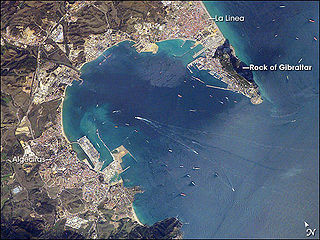
The Bay of Gibraltar is a bay at the southern end of the Iberian Peninsula. It is around 10 km (6.2 mi) long by 8 km (5.0 mi) wide, covering an area of some 75 km2 (29 sq mi), with a depth of up to 400 m (1,300 ft) in the centre of the bay. It opens to the south into the Strait of Gibraltar and the Mediterranean Sea.

HMM Company Limited, formerly known as Hyundai Merchant Marine, is a South Korean container transportation and shipping company.
The Port of Algeciras is the port and harbour of Algeciras, a city located in the province of Cádiz in the autonomous community of Andalusia, Spain. It is a commercial, fishing and passenger port. Primarily a transshipment port, its position near the Strait of Gibraltar and key east–west shipping routes establishes it as one of the busiest transshipment hubs in the world. It competes with Tanger-Med for the local transshipment market. It consists of numerous maritime infrastructures scattered throughout the Bay of Gibraltar. Although only the town of Algeciras and La Línea de la Concepción overlook the bay, there are port facilities in the rest of the bank, also belonging to the municipalities of San Roque and Los Barrios. It is managed along the port of Tarifa by the Port Authority of Algeciras Bay.
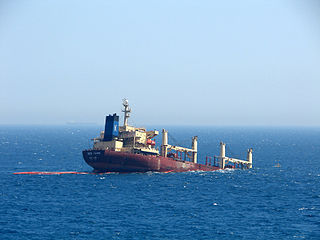
MV New Flame was a Panamanian bulk-carrier cargo ship. It collided with an oil tanker off Europa Point, the southernmost tip of Gibraltar on 12 August 2007, and ended up partially submerged in the Strait of Gibraltar. The vessel broke into two in December 2007 amid numerous unsuccessful recovery efforts. The cargo was salvaged and the stern section removed for scrap. Following the crew's rescue, the captain was arrested for having departed without authorisation. Charges of endangering shipping were later dropped.

The Taifa of Algeciras was a medieval Muslim taifa kingdom in what is now southern Spain and Gibraltar, that existed from 1035 to 1058.

The auxiliary ship Olterra was a 5,000 ton Italian tanker scuttled by her own crew at Algeciras in the Bay of Gibraltar on 10 June 1940, after the entry of Italy in World War II. She was recovered in 1942 by a special unit of the Decima Flottiglia MAS to be used as an undercover base for manned torpedoes in order to attack Allied shipping at Gibraltar.

The history of Gibraltar, a small peninsula on the southern Iberian coast near the entrance of the Mediterranean Sea, spans over 2,900 years. The peninsula has evolved from a place of reverence in ancient times into "one of the most densely fortified and fought-over places in Europe", as one historian has put it. Gibraltar's location has given it an outsized significance in the history of Europe and its fortified town, established in the Middle Ages, has hosted garrisons that sustained numerous sieges and battles over the centuries.

The Algeciras campaign was an attempt by a French naval squadron from Toulon under Contre-Admiral Charles Linois to join a French and Spanish fleet at Cadiz during June and July 1801 during the French Revolutionary Wars prior to a planned operation against either Egypt or Portugal. To reach Cadiz, the French squadron had to pass the British naval base at Gibraltar, which housed the squadron tasked with blockading Cadiz. The British squadron was commanded by Rear-Admiral Sir James Saumarez. After a successful voyage between Toulon and Gibraltar in which a number of British vessels were captured, the squadron anchored at Algeciras, a fortified port city within sight of Gibraltar across Gibraltar Bay. On 6 July 1801, Saumarez attacked the anchored squadron, in the First Battle of Algeciras. Although severe damage was inflicted on all three French ships of the line, none could be successfully captured and the British were forced to withdraw without HMS Hannibal, which had grounded and was subsequently seized by the French.
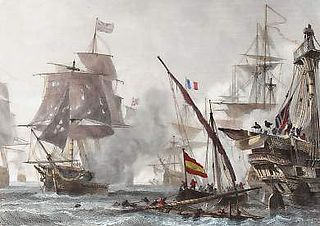
The First Battle of Algeciras was a naval battle fought on 6 July 1801 between a squadron of British Royal Navy ships of the line and a smaller French Navy squadron at anchor in the fortified Spanish port of Algeciras in the Strait of Gibraltar. The British outnumbered their opponents, but the French position was protected by Spanish gun batteries and the complicated shoals that obscured the entrance to Algeciras Bay. The French squadron, under Contre-Amiral Charles Linois, had stopped at Algeciras en route to the major Spanish naval base at Cadiz, where they were to form a combined French and Spanish fleet for operations against Britain and its allies in the French Revolutionary Wars. The British, under Rear-Admiral Sir James Saumarez, sought to eliminate the French squadron before it could reach Cadiz and form a force powerful enough to overwhelm Saumarez and launch attacks against British forces in the Mediterranean Sea.

The Convoy de la Victoria was a Spanish naval battle on 5 August 1936 in the Strait of Gibraltar during the Spanish Civil War, between the escort of a Nationalist convoy and the Republican Navy destroyer Alcalá Galiano.

The Second Battle of Algeciras was a naval battle fought on the night of 12 July 1801 between a squadron of British Royal Navy ships of the line and a larger squadron of ships from the Spanish Navy and French Navy in the Gut of Gibraltar.

The siege of Algeciras was the first of many sieges of the city by Christian forces in the lengthy period of the Spanish Reconquista. The siege, ordered by King Alfonso X of Castile also known as "el Sabio", was a fruitless military campaign initiated by the Kingdom of Castile with the objective of removing the Benimerins from Algeciras. The siege on Algeciras, then known to the Muslims as Al-Jazira Al-Khadra, was strategically important because Algeciras had been at the time the main fortress and landing place for African reinforcement troops in the Iberian Peninsula. Castile, which had a powerful armada of ships anchored in the Bay of Gibraltar to blockade such reinforcement, had a few days previously to the siege, seen that fleet obliterated by the Muslim admiral, Abu Yusuf Yaqub at the Naval Battle of Algeciras.

The Gibraltar Port Authority develops and manages the Port of Gibraltar.

The history of Moorish Gibraltar began with the landing of the Muslims in Hispania and the fall of the Visigothic Kingdom of Toledo in 711 and ended with the fall of Gibraltar to Christian hands 751 years later, in 1462, with an interregnum during the early 14th century.
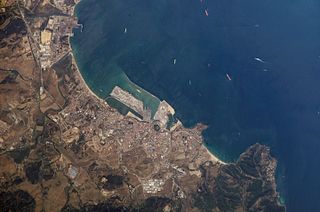
The siege of Algeciras (1342–1344) was undertaken during the Reconquest of Spain by the Castillian forces of Alfonso XI assisted by the fleets of the Kingdom of Aragon and the Republic of Genoa. The objective was to capture the Muslim city of Al-Jazeera Al-Khadra, called Algeciras by Christians. The city was the capital and the main port of the European territory of the Marinid Empire.
The Battle of the Strait was a military conflict contesting the ports in the Straits of Gibraltar taking place in the late thirteenth century and the first half of the fourteenth. The conflict involves principally the Spanish Muslim Emirate of Granada, the Spanish Christian Crown of Castile and the North African Muslim Marinid state. The ports' strategic value came from their position linking Spain and North Africa, thus connecting Muslims in Spain with the rest of the Islamic world. The campaign had mixed results. Castile gained Tarifa permanently, and managed to take Gibraltar and Algeciras but both would revert to Muslim rule. Castile also failed to gain any port in the African side of the strait.

The history of Algeciras, a Spanish region, can be traced back to initial Paleolithic outdoor settlements. In antiquity, Algeciras was home to two significant settlements: the Roman city of Iulia Traducta, which served as an important commercial hub, and the city of Al-Yazira al-Jadra, the first Arab settlement established in the peninsula. Following a three-century period of abandonment, a new city of Algeciras was re-founded in 1704.