See also
 | This article related to Nazi Germany is a stub. You can help Wikipedia by expanding it. |
The Alliance of German Organizations Abroad (German : Verband deutscher Vereine im Ausland, or VdV) was a National Socialist umbrella organization founded in 1934 to unite all foreign Germans outside of the Reich. Its headquarters was in Berlin. The VdV was supposed to organize these Germans and to influence and win them over with Nazi propaganda, insofar as they were not yet part of the Foreign Organization of the NSDAP (NSDAP/AO). Its journal was the Heimatbrief (Letter from Home).
| | This article related to Nazi Germany is a stub. You can help Wikipedia by expanding it. |
This is a list of words, terms, concepts and slogans of Nazi Germany used in the historiography covering the Nazi regime. Some words were coined by Adolf Hitler and other Nazi Party members. Other words and concepts were borrowed and appropriated, and other terms were already in use during the Weimar Republic. Finally, some are taken from Germany's cultural tradition.
In the fourteen years the Weimar Republic was in existence, some forty parties were represented in the Reichstag. This fragmentation of political power was in part due to the use of a peculiar proportional representation electoral system that encouraged regional or small special interest parties and in part due to the many challenges facing the nascent German democracy in this period.

Standartenführer was a Nazi Party (NSDAP) paramilitary rank that was used in several NSDAP organizations, such as the SA, SS, NSKK and the NSFK. First founded as a title in 1925, in 1928 it became one of the first commissioned NSDAP ranks and was bestowed upon those SA and SS officers who commanded a unit known as a Standarte, a unit equivalent to an army battalion and comprising 300–500 personnel.
Reichsleiter was the second-highest political rank in the Nazi Party (NSDAP), subordinate only to the office of Führer. Reichsleiter also functioned as a paramilitary rank within the NSDAP and was the highest rank attainable in any Nazi organisation.

The National Socialist Flyers Corps was a paramilitary aviation organization of the Nazi Party.

The Nazi Party/Foreign Organization was a branch of the Nazi Party and the 43rd and only non-territorial Gau ("region") of the Party. In German, the organization is referred to as NSDAP/AO, "AO" being the abbreviation of the German compound word Auslands-Organisation. Although Auslands-Organisation would be correctly written as one word, the Nazis chose an obsolete spelling with a hyphen.

Ernst Wilhelm Bohle was the Gauleiter of the Foreign Organization of the National Socialist German Workers' Party from 1934 until 1945. Bohle was the only defendant in the Subsequent Nuremberg trials of 1946-1949 to plead guilty to any charge.

Hans Nieland was a politician of the German Nazi-Party (NSDAP) and Lord Mayor of Dresden from 1940 until 1945.

Hans Krüger was a former member of the NSDAP party and other Nazi organizations who served as an SS judge in occupied Poland during the Second World War. After the war he became West German politician of the Christian Democratic Union (CDU). He served as Federal Minister for Displaced Persons, Refugees and War Victims of the Federal Republic of Germany from 17 October 1963 to 7 February 1964, in the First Cabinet of Chancellor Ludwig Erhard, as President of the Federation of Expellees from 1959 to 1964, and as a Member of Parliament from 1957 to 1965. He stepped down from cabinet amid controversy about his war-time background.

The National Socialist Women's League was the women's wing of the Nazi Party. It was founded in October 1931 as a fusion of several nationalist and Nazi women's associations, such as the German Women's Order which had been founded in 1926. From then on, women were subordinate to the NSDAP Reich leadership. Guida Diehl was its first speaker (Kulturreferentin).
Friends of New Germany, sometimes called Friends of the New Germany, was an organization founded in the United States by German immigrants to support Nazism and the Third Reich.
The National Socialist German Students' Union was founded in 1926 as a division of the Nazi Party with the mission of integrating University-level education and academic life within the framework of the Nazi worldview. Organized strictly in accord with the Führerprinzip as well as the principle of Machtdistanz, the NSDStB housed its members in so-called Kameradschaftshäusern, and had its members decked out in classic brown shirts and its own distinctive Swastika emblems.

The National Socialist League of the Reich for Physical Exercise was the umbrella organization for sports and physical education in Nazi Germany. The NSRL was known as the German League of the Reich for Physical Exercise until 1938. The organization was expanded to Austria after that country's annexation by Nazi Germany.

The Verein für Deutsche Kulturbeziehungen im Ausland, abbreviated VDA, is a German cultural organisation. During the Nazi era it was engaged in spying across the whole world, using German minorities living in other countries. Its other goals included preservation of German culture among "racial Germans".
The NSDAP Office of Colonial Policy was a Nazi Party office formed in 1934. Its stated objective was to formulate plans for the re-taking of the former German colonies. The office lost much of its meaning after the start of World War II, and was dissolved after the reversal of Nazi Germany's military victories in 1943.
Amt Rosenberg was an official body for cultural policy and surveillance within the Nazi party, headed by Alfred Rosenberg. It was established in 1934 under the name of Dienststelle Rosenberg, with offices at Margarethenstraße 17 in Berlin, to the west of Potsdamer Platz. Due to the long official name of Rosenberg's function, Beauftragter des Führers für die gesamte geistige und weltanschauliche Erziehung der NSDAP, the short description Reichsüberwachungsamt "Reich surveillance office" was used alongside, also shortened simply to Überwachungsamt "surveillance office".
The NSDAP Office of Foreign Affairs was a Nazi Party organization. It was set up in April 1933 in the Hotel Adlon in Berlin immediately after the Nazi Machtergreifung. It was led by Alfred Rosenberg. It was one of the central authorities for the foreign policy of Nazi Germany, alongside the Foreign Office (AA) under the leadership of Neurath, the Nazi Party's Auslandsorganisation (NSDAP/AO) of Ernst Wilhelm Bohle, Joachim von Ribbentrop's special bureau and part of the Ministry of Public Enlightenment and Propaganda (RMVP) under Joseph Goebbels.
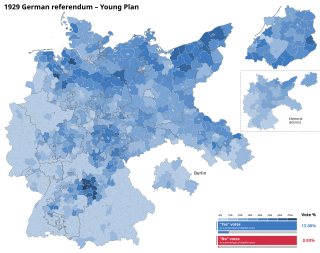
The 1929 German Referendum was an attempt during the Weimar Republic to use popular legislation to annul the agreement in the Young Plan between the German government and the World War I opponents of the German Reich regarding the amount and conditions of reparations payments. The referendum was the result of the initiative "Against the Enslavement of the German People " launched in 1929 by right-wing parties and organizations. It called for an overall revision of the Treaty of Versailles and stipulated that government officials who accepted new reparation obligations would be committing treason.
The Association of German Transport Companies is the umbrella organization of organizations of transit authorities and other public transport companies. The membership fluctuates in the range of about 600 transport companies. It is a member of the International Association of Public Transport.
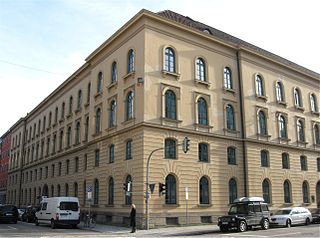
The National Socialist German Doctors' League was a division of the Nazi Party with the mission of integrating the German medical profession within the framework of the Nazi worldview. The organisation was headquartered in Munich. The League was organized strictly in accord with the Führerprinzip as well as the principle of Machtdistanz. The League was led by the Reich Health Leader (Reichsärzteführer).