Amati is the last name of a family of Italian violin makers who lived at Cremona from about 1538 to 1740. Their importance is considered equal to those of the Bergonzi, Guarneri, and Stradivari families. Today, violins created by Nicolò Amati are valued at around $600,000. Because of their age and rarity, Amati instruments are mostly kept in museum or private collections and are seldom played in public.

The Sienese School of painting flourished in Siena, Italy, between the 13th and 15th centuries. Its most important artists include Duccio, whose work shows Byzantine influence, his pupil Simone Martini, the brothers Pietro and Ambrogio Lorenzetti and Domenico and Taddeo di Bartolo, Sassetta, and Matteo di Giovanni.

Cremona is a city and comune in northern Italy, situated in Lombardy, on the left bank of the Po river in the middle of the Pianura Padana. It is the capital of the province of Cremona and the seat of the local city and province governments. The city of Cremona is especially noted for its musical history and traditions, including some of the earliest and most renowned luthiers, such as Giuseppe Guarneri, Antonio Stradivari, Francesco Rugeri, Vincenzo Rugeri, and several members of the Amati family.
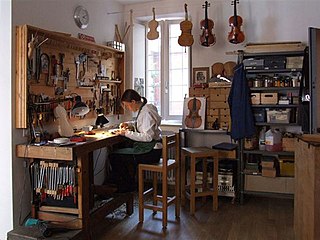
A luthier( LOO-ti-ər) is a craftsperson who builds or repairs string instruments that have a neck and a sound box. The word "luthier" is originally French and comes from the French word for lute. The term was originally used for makers of lutes, but it came to be used already in French for makers of most bowed and plucked stringed instruments such as members of the violin family and guitars. Luthiers, however, do not make harps or pianos; these require different skills and construction methods because their strings are secured to a frame.
The Guarneri, often referred to in the Latinized form Guarnerius, is the family name of a group of distinguished luthiers from Cremona in Italy in the 17th and 18th centuries, whose standing is considered comparable to those of the Amati and Stradivari families.
The Amati Quartet was a string quartet, associated with the University of Saskatchewan in Saskatoon, Canada.The ensemble performed with four instruments made by the Amati family of luthiers, of Cremona Italy.
Marini is a surname of Roman/Italian Catholic origin; closely associated with the last names: Marino and Mariani with the three patronymic forms emerging from the same region at approximately the same time. Migrations branching from Italy ca.1600 gave rise to their modern forms as surnames. The Marinid dynasty was a Sunni Muslim dynasty of Zenata Berber descent that ruled Morocco from the 13th to the 15th century.
Andrea Guarneri was an Italian luthier, musician and founder of the Casa Guarneri. He is the most important student of Nicola Amati and grandfather of one of the best luthiers, Bartolomeo Giuseppe Guarneri, del Gesù.

The Lives of the Most Excellent Painters, Sculptors, and Architects, often simply known as The Lives, is a series of artist biographies written by 16th-century Italian painter and architect Giorgio Vasari, which is considered "perhaps the most famous, and even today the most-read work of the older literature of art", "some of the Italian Renaissance's most influential writing on art", and "the first important book on art history".
Papadopoli is the Italian form of the common Greek name Papadopoulos. It may refer to:
Giuseppe Giovanni Battista Guarneri, better known as Giuseppe filius Andrea Guarneri was a violin maker from the prominent Guarneri family of luthiers who lived in Cremona, Italy.

Nicola Amati, Nicolò Amati or Nicolao Amati was an Italian Master Luthier from Cremona, Italy. Amati is one of the most well known luthier from the Casa Amati. Nicola was the teacher of illustrious Cremonese School luthiers such as Andrea Guarneri and Giovanni Battista Rogeri. While no clear documentation exists for being apprentices in his shop, Amati may have also apprenticed Antonio Stradivari, Francesco Rugeri, and Jacob Stainer as their work is heavily influenced by Amati.
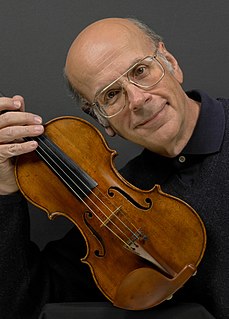
David L. Fulton is a private collector of Cremonese instruments. Born in 1944, he grew up in Eugene, Oregon, playing the violin from an early age. He studied mathematics at the University of Chicago, and was concertmaster of the University of Chicago Symphony while he was there.

Andrea Amati was a luthier, from Cremona, Italy. Amati is credited with making the first instruments of the violin family that are in the form we use today. Several of his instruments survive to the present day, and some of them can still be played. Many of the surviving instruments were among a consignment of 38 instruments delivered to Charles IX of France in 1564.
Ballerini is an Italian surname. Notable people with the surname include:
Antonio Amati was an Italian luthier, active from 1560 to 1605.

Girolamo Amati (1561–1630) was an Italian luthier, active from 1580 to 1630.
