
Ananke is a retrograde irregular moon of Jupiter. It was discovered by Seth Barnes Nicholson at Mount Wilson Observatory in 1951 and is named after the Greek mythological Ananke, the personification of necessity, and the mother of the Moirai (Fates) by Zeus. The adjectival form of the name is Anankean.
Adrastea, Adrasteia, Adrestea or Adrestia may refer to:

Euporie, also known as Jupiter XXXIV, is a natural satellite of Jupiter. It was discovered by a team of astronomers from the University of Hawaii led by Scott S. Sheppard in 2001, and given the temporary designation S/2001 J 10.

Euanthe, also known as Jupiter XXXIII, is a retrograde irregular satellite of Jupiter. It was discovered by a team of astronomers from the University of Hawaii led by Scott S. Sheppard in 2001, and given the temporary designation S/2001 J 7.

Thyone, also known as Jupiter XXIX, is a retrograde irregular satellite of Jupiter. It was discovered by a team of astronomers from the University of Hawaii led by Scott S. Sheppard in 2001, and given the temporary designation S/2001 J 2.
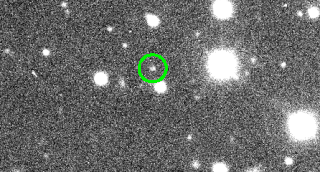
Hermippe, or Jupiter XXX, is a natural satellite of Jupiter. It was discovered concurrently with Eurydome by a team of astronomers from the Institute for Astronomy of the University of Hawaii led by David Jewitt and Scott S. Sheppard and Jan Kleyna in 2001, and given the temporary designation S/2001 J 3.

Praxidike, also known as Jupiter XXVII, is a retrograde irregular satellite of Jupiter. It was discovered by a team of astronomers from the University of Hawaii led by Scott S. Sheppard in 2000, and given the temporary designation S/2000 J 7.

S/2003 J 2 is a retrograde irregular satellite of Jupiter. The moon was discovered on 5 February 2003 by a team of astronomers from the University of Hawaii led by Scott S. Sheppard and David C. Jewitt, and was later announced on 4 March 2003. It was initially thought to be Jupiter's outermost known moon until recovery observations disproved this in 2020.

Eupheme, also Jupiter LX, originally known as S/2003 J 3, is an outer natural satellite of Jupiter, 2 km in diameter.

Jupiter LV, provisionally known as S/2003 J 18, is a natural satellite of Jupiter. It was discovered by a team of astronomers led by Brett J. Gladman in 2003.
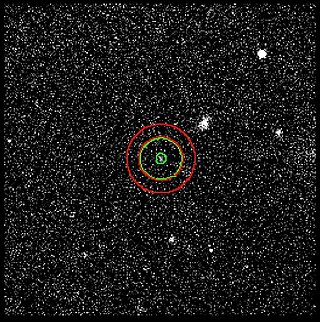
Mneme, also known as Jupiter XL, is a retrograde irregular satellite of Jupiter. It was discovered by teams of astronomers led by Brett J. Gladman and Scott S. Sheppard in 2003, and was provisionally designated S/2003 J 21.
Thelxinoe, also known as Jupiter XLII, is a natural satellite of Jupiter. It was discovered by a team of astronomers from the University of Hawaii led by Scott S. Sheppard in 2004 from pictures taken in 2003, and originally received the temporary designation S/2003 J 22.

The Ananke group is a group of retrograde irregular satellites of Jupiter that follow similar orbits to Ananke and are thought to have a common origin.
The Pasiphae group is a group of retrograde irregular satellites of Jupiter that follow similar orbits to Pasiphae and are thought to have a common origin.

Jupiter LII, originally known as S/2010 J 2, is a natural satellite of Jupiter. It was discovered by Christian Veillet in 2010. It received its permanent number in March 2015. It takes 1.69 years to orbit around Jupiter, and its average distance is 21.01 million km. Jupiter LII has a diameter of about 1 kilometer and in 2010 it was labeled the smallest known moon in the Solar System to have been discovered from Earth. It is a member of the Ananke group. With an estimated diameter of 1 km (0.62 mi), Jupiter LII is one of the smallest known moons of Jupiter.
The following outline is provided as an overview of and topical guide to Jupiter:

Jupiter LIV, originally known as S/2016 J 1, is an outer natural satellite of Jupiter. It was discovered by Scott S. Sheppard in 2016, but not announced until June 2, 2017 via a Minor Planet Electronic Circular from the Minor Planet Center. It is about 1 kilometer in diameter and orbits at a semi-major axis of about 20,650,845 km with an inclination of about 139.8°. It belongs to the Ananke group.
Jupiter LXVIII, provisionally known as S/2017 J 7, is an outer natural satellite of Jupiter. It was discovered by Scott S. Sheppard and his team in 2017, but not announced until July 17, 2018, via a Minor Planet Electronic Circular from the Minor Planet Center. It is about 2 kilometers in diameter and orbits at a semi-major axis of about 20,627,000 km with an inclination of about 143.4°. It belongs to the Ananke group.
Jupiter LXX, originally known as S/2017 J 9, is an outer natural satellite of Jupiter. It was discovered by Scott S. Sheppard and his team in 2017, but not announced until July 17, 2018, via a Minor Planet Electronic Circular from the Minor Planet Center. It is about 3 kilometers in diameter and orbits at a semi-major axis of about 21,487,000 km with an inclination of about 152.7°. It belongs to the Ananke group.
S/2021 J 1 is a small outer natural satellite of Jupiter discovered by Scott S. Sheppard on 12 August 2021, using the 6.5-meter Magellan-Baade Telescope at Las Campanas Observatory, Chile. It was announced by the Minor Planet Center on 5 January 2023, after observations were collected over a long enough time span to confirm the satellite's orbit.
