AD 68 (LXVIII) was a leap year starting on Friday of the Julian calendar. At the time, it was known as the Year of the Consulship of Silius Italicus and Trachalus, or the start of the Year of the Four Emperors. The denomination AD 68 for this year has been used since the early medieval period, when the Anno Domini calendar era became the prevalent method in Europe for naming years. These are now used throughout the world.

Annas was appointed by the Roman legate Quirinius as the first High Priest of the newly formed Roman province of Iudaea in AD 6 – just after the Romans had deposed Archelaus, Ethnarch of Judaea, thereby putting Judaea directly under Roman rule.

James the Just, or a variation of James, brother of the Lord, was a brother of Jesus, according to the New Testament. He was an early leader of the Jerusalem Church of the Apostolic Age. He died as a martyr in AD 62 or 69.
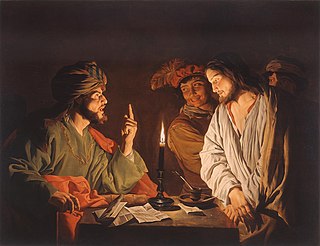
Joseph ben Caiaphas, known simply as Caiaphas in the New Testament, was the Jewish high priest who, according to the gospels, organized a plot to kill Jesus. He famously presided over the Sanhedrin trial of Jesus. The primary sources for Caiaphas' life are the New Testament, and the writings of Josephus. Josephus records that he was made high priest by the Roman procurator Valerius Gratus after Simon ben Camithus had been deposed

Theophilus was the High Priest in the Second Temple in Jerusalem from 37 to 41 CE according to Josephus's Antiquities of the Jews. He was a member of one of the wealthiest and most influential Jewish families in Iudaea Province during the 1st century. A growing but still uncommon belief points to this person as the person to whom the Gospel of Luke is addressed, but Theophilus is a common enough name that there are many other possibilities for the addressee of Luke's Gospel and the Acts of the Apostles.
Theophilus is the name or honorary title of the person to whom the Gospel of Luke and the Acts of the Apostles are addressed. It is thought that both the Gospel of Luke and Acts of the Apostles were written by the same author, and often argued that the two books were originally a single unified work. Both Luke and Acts were written in a refined Koine Greek, and the name "θεόφιλος" ("Theophilos"), as it appears therein, means friend of God or (be)loved by God or loving God in the Greek language. The true identity of Theophilus is unknown, with several conjectures and traditions around an identity. In English Theophilus is also written "Theophilos", both a common name and an honorary title among the learned (academic) Romans and Jews of the era. The life of Theophilus would coincide with the writing of Luke and the author of the Acts.
Simon bar Giora was the leader of one of the major Judean rebel factions during the First Jewish–Roman War in 1st-century Roman Judea, who vied for control of the Jewish polity while attempting to expel the Roman army, but incited a bitter internecine war in the process.
Eleazar ben Simon was a Zealot leader during the First Jewish-Roman War who fought against the armies of Cestius Gallus, Vespasian, and Titus Flavius. From the onset of the war in 66 CE until the destruction of the temple in 70 CE, he fought vehemently against the Roman garrisons in Judea and against his fellow Jewish political opponents in order to establish an independent Jewish state at Jerusalem. Although the Jewish defeat at Jerusalem cannot be entirely attributed to Eleazar ben Simon, his inability to establish unity with John of Gischala and Simon bar Giora resulted in a bitter civil war that weakened the Jewish resistance against Rome. Eleazar ben Simon and his Zealots' radical anti-Roman policies and eradication of the moderate temple aristocracy from Jerusalem in 67 CE also prevented any peaceful agreement with Rome to avoid the death and destruction which ensued in 70 CE.
The Teacher of Righteousness is a figure found in some of the Dead Sea Scrolls at Qumran, most prominently in the Damascus Document. This document speaks briefly of the origins of the sect, probably Essenes, 390 years after the reign of Nebuchadnezzar and after 20 years of "groping" blindly for the way. "God... raised for them a Teacher of Righteousness to guide them in the way of His heart".
Joshua ben Gamla or Joshua the son of Gamala, was a Jewish high priest in about 64-65 CE. He was killed during the First Jewish–Roman War. The Talmud refers to Joshua ben Gamala, while in the earlier Greek works of Josephus Flavius he is called Isous huios Gamala, son of Gamala.
Valerius Gratus was the Roman Prefect of Iudaea province under Tiberius from 15 to 26 CE. He succeeded Annius Rufus and was replaced by Pontius Pilate. The government of Gratus is chiefly remarkable for the frequent changes he made in the appointment of the high-priesthood. He deposed Ananus, and substituted Ishmael ben Fabus, then Eleazar, son of Arianus, then Simon, son of Camith, and lastly Joseph Caiaphas, the son-in-law of Ananus.
Lucceius Albinus was the Roman Procurator of Judea from 62 until 64 AD and the governor of Mauretania Tingitana from 64 until 69 AD.
Eleazar is a common Jewish given name for a male.
Ananus ben Ananus, d. 68 CE, was a Herodian-era High Priest of Israel in Jerusalem, Iudaea Province. He was the High Priest who ordered the execution by stoning of James the brother of Jesus, according to the surviving manuscripts of The Antiquities of the Jews. A delegation sent by citizens upset over the perceived breach of justice met Albinus before he reached Judea, and Albinus responded with a letter informing Ananus that it was illegal to convene the Sanhedrin without Albinus' permission and threatening to punish the priest. Ananus was therefore deposed by King Herod Agrippa II before Albinus's arrival and replaced with Jesus ben Damneus.

The Zealot Temple Siege was a short siege of the Temple in Jerusalem fought between Jewish factions during the First Jewish–Roman War. According to the historian Josephus, the forces of Ananus ben Ananus, one of the heads of the Judean provisional government and former High Priest of Israel, besieged the Zealots who held the Temple. When John of Giscala led the Zealots to believe that Ananus had contacted the Roman General Vespasian for assistance in retaking control of all Jerusalem, the Zealots, driven to desperation, asked the Edomites (Idumeans) for assistance in preventing the delivery of the city to the Romans. When the Edomites arrived, the Zealots opened the gates of Jerusalem to them, and the Edomites slaughtered ben Hanan's forces, killing him as well.

Jesus son of Damneus was a Herodian-era High Priest of Israel in Jerusalem, Iudaea Province.
Joseph Cabi ben Simon was a Herodian-era High Priest of Israel in Jerusalem, Iudaea Province, appointed by Herod Agrippa II.
. . . the king [Agrippa] . . . gave the high priesthood to Joseph, who was called Cabi, the son of Simon, formerly high priest. And now Caesar, upon hearing the death of Festus, sent Albinus into Judea, as procurator. But the king deprived Joseph of the high priesthood, and bestowed the succession to that dignity on the son of Ananus, who was also himself called Ananus.
The Judean provisional government was a short-lived de facto governing entity of Judea, which was established in the year 66 by Judean rebel forces of the Pharisee and Saduccee parties, and aimed to govern the Judean state. The government functioned until the Zealot Temple Siege in the year 68, when most of its leaders were massacred in the inter-rebel struggle.
Joseph ben Gurion was according to Josephus one of the chief leaders of the First Jewish–Roman War, which erupted in the year 66 in Roman Judea. Along with Ananus ben Ananus, ben Gurion was heading the Judean provisional government (66–68), formed in the aftermath of the Battle of Beth Horon (66). Ben Gurion was killed in the year 68 during the carnage of the Zealot Temple Siege.
