
László Kovács is a Hungarian politician and diplomat, former European Commissioner for Taxation and Customs Union. He was the foreign minister of Hungary twice, from 1994 to 1998 and from 2002 to 2004. He also served as chairman of the Hungarian Socialist Party (MSZP) from 1998 to 2004.

Hungary competed at the 1972 Summer Olympics in Munich, West Germany. 232 competitors, 187 men and 45 women, took part in 134 events in 20 sports.
Kovač, meaning "blacksmith" in South Slavic languages, is a common surname in Croatia, Bosnia-Herzegovina, Slovenia and Serbia.

Nimród E. Antal is a Hungarian-American film director, screenwriter and actor.
Kovács or Kovacs, meaning blacksmith, is one of the most common Hungarian family names.

Vultureni is a commune in Cluj County, Transylvania, Romania. It is composed of six villages: Băbuțiu (Báboc), Bădești (Bádok), Chidea (Kide), Făureni (Kolozskovácsi), Șoimeni (Sólyomkő), and Vultureni.
Hungary competed at the 1960 Summer Olympics in Rome, Italy. 184 competitors, 157 men and 27 women, took part in 107 events in 18 sports.
Hungary competed at the 1968 Summer Olympics in Mexico City, Mexico. 167 competitors, 135 men and 32 women, took part in 116 events in 15 sports.

The Confrontation is a 1969 Hungarian drama film directed by Miklós Jancsó. It was listed to compete at the 1968 Cannes Film Festival, but the festival was cancelled due to the events of May 1968 in France.
Hungarian Rhapsody is a 1979 Hungarian drama film directed by Miklós Jancsó. It was entered into the 1979 Cannes Film Festival. It won Golden Peacock at the 7th International Film Festival of India.
András is a Hungarian masculine given name, the Hungarian form of Andrew. Notable people with the name include:

András Kovács was a Hungarian film director and screenwriter. He directed 30 films between 1961 and 1996. His 1968 film The Lost Generation was entered into the 6th Moscow International Film Festival. His 1978 film A ménesgazda was entered into the 29th Berlin International Film Festival. His 1981 film Temporary Paradise won the Silver Prize at the 12th Moscow International Film Festival. His 1985 film The Red Countess was entered into the 14th Moscow International Film Festival.

The Hungarian Radio Symphony Orchestra is a Hungarian radio orchestra. It is part of the Hungarian Television and Broadcasting Organisation, Magyar Rádió.
Viktor Bánky was a Hungarian film editor and director.
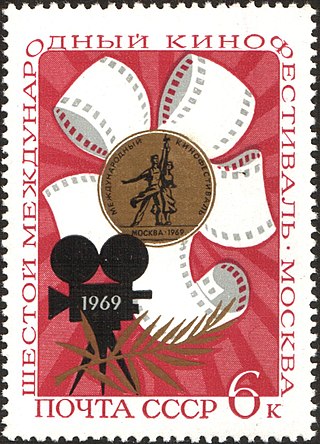
The 6th Moscow International Film Festival was held from 7 to 22 July 1969. The Golden Prizes were awarded to the Cuban film Lucía directed by Humberto Solás, the Italian film Serafino directed by Pietro Germi and the Soviet film We'll Live Till Monday directed by Stanislav Rostotsky.
Antisemitism in contemporary Hungary principally takes the form of negative stereotypes relating to Jews, although historically it manifested itself more violently. Studies show antisemitism has become more prevalent since the fall of Communism, particularly among the younger generations. Surveys performed from 2009 and beyond have consistently found high levels of antisemitic feelings amongst the general population.

The Notebook is a 2013 Hungarian drama film co-written and directed by János Szász. It is based on the first novel, of the same name, of the 1986 prize winning The Notebook Trilogy by Ágota Kristóf.
András Kovács is a Hungarian sociologist and historian. He is a professor at Central European University, Budapest, in the Nationalism Studies Program and Jewish Studies Program. Furthermore, Kovács is a Doctor of Sciences at the Hungarian Academy of Sciences.
The Budapest Twelve is a list of 12 Hungarian films considered the best from the period between 1948 and 1968. The films were chosen in secret ballot of the Hungarian film industry in 1968.
The following lists events in the year 2010 in Hungary.
This page is based on this
Wikipedia article Text is available under the
CC BY-SA 4.0 license; additional terms may apply.
Images, videos and audio are available under their respective licenses.
