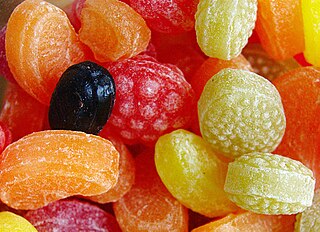
Anise candies were first made by the Benedictine monks of the abbey of Flavigny (founded in 719), as reported by the Roman traveller Flavius.
After the French Revolution, several confectioners began making this delicacy using the same recipe. Only one manufacturer remains today at the abbey, Maison Troubat, who claims to follow a recipe which has been in use since 1591.
Each candy is made in a dragee process starting with a single anise seed: Over a period of 15 days it is covered with successive coats of flavored sugar syrup. The finished candy is always called "Anis" by its makers, even when the flavor is one of violet, rose, mint, jasmine, liquorice, or orange instead of anise.
The candy maker "Anis de Flavigny" (2006)
External links
Official website of the Maison Troubat, the sole surviving manufacturer of Anis de Flavigny.
Five-spice powder is a spice mixture of five or more spices—commonly star anise, cloves, Chinese cinnamon, Sichuan pepper, and fennel seeds—used predominantly in almost all branches of Chinese cuisine. The five flavors of the spices refers to the five traditional Chinese elements. The addition of eight other spices creates thirteen-spice powder (十三香), which is used less commonly.
Anise, also called aniseed or rarely anix, is a flowering plant in the family Apiaceae native to the eastern Mediterranean region and Southwest Asia.
Pastis is an anise-flavoured spirit and apéritif traditionally from France, typically containing less than 100 g/L sugar and 40–45% ABV.
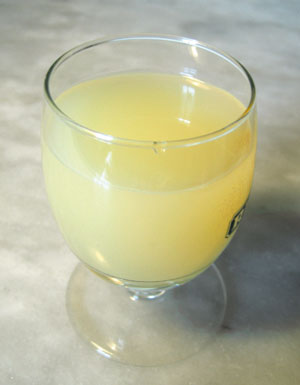
Anisette, or Anis, is an anise-flavored liqueur that is consumed in most Mediterranean countries. It is colorless and, because it contains sugar, is sweeter than dry anise flavoured spirits. The most traditional style of anisette is that produced by means of distilling aniseed, and is differentiated from those produced by simple maceration by the inclusion of the word distilled on the label.
Ouzo is a dry anise-flavored aperitif that is widely consumed in Greece. It is made from rectified spirits that have undergone a process of distillation and flavoring. Its taste is similar to other anise liquors like pastis, sambuca, mastika, rakı, and arak.
Gummy bears are small, fruit gum candies, similar to a jelly baby in some English-speaking countries. The candy is roughly 2 cm (0.8 in) long and shaped in the form of a bear. The gummy bear is one of many gummies, popular gelatin-based candies sold in a variety of shapes and colors by various brands such as Haribo.
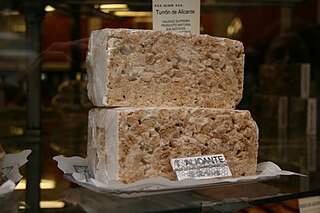
Turrón, torró or torrone is a Mediterranean nougat confection, typically made of honey, sugar, and egg white, with toasted almonds or other nuts, and usually shaped either into a rectangular tablet or a round cake. Turrón is usually eaten as a dessert food around Christmas in Spain and Italy.
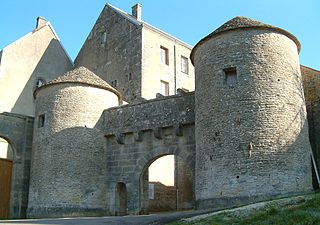
Flavigny-sur-Ozerain is a commune in the French department of Côte-d'Or, in Bourgogne-Franche-Comté.
Life Savers is an American brand of ring-shaped hard and soft candy. Its range of mints and fruit-flavored candies is known for its distinctive packaging, coming in paper-wrapped aluminum foil rolls.
Flavigny may refer to:
Sugar plums are a type of dragée or other hard candy made into small round or oval shapes. The "plum" in the name of these confections does not always mean plum in the sense of the fruit, but rather their small size and spherical or oval shape. Traditional sugar plums often contained no fruit, instead being made mostly of pure sugar. These candies were comfits, and often surrounded a seed, nut, or spice.
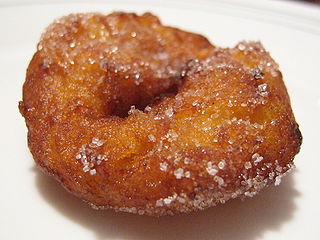
A buñuelo (Spanish:[buˈɲwelo], alternatively called boñuelo, bimuelo, birmuelo, bermuelo, bumuelo, burmuelo, or bonuelo, is a fried dough fritter found in Spain, Latin America, and other regions with a historical connection to Spaniards, including Southwest Europe, the Balkans, Anatolia, and other parts of Asia and North Africa. Buñuelos are traditionally prepared at Christmas. It will usually have a filling or a topping. In Mexican cuisine, it is often served with a syrup made with piloncillo.
Springerle is a type of South German biscuit or cookie with an embossed design made by pressing a mold onto rolled dough and allowing the impression to dry before baking. This preserves the detail of the surface pattern. While historical molds show that springerle were baked for religious holidays and secular occasions throughout the year, they are now most commonly associated with the Christmas season.
Barley sugar is a traditional variety of boiled sweet, often yellow or orange in colour, which is usually made with an extract of barley, giving it a characteristic taste and colour. In Britain it is usually sold in the shape of twisted sticks. Barley sugar is very similar to clear toy candy and to hard caramel candy in its texture and taste.
Flavigny Abbey is a former Benedictine monastery, now occupied by a little handcraft and family factory [today, the TROUBAT family for tree génération), in Flavigny-sur-Ozerain, Côte-d'Or département, France. The monks at this abbey were the original makers of the well-known aniseed confectionery Anise de Flavigny.
Vanilla is frequently used to flavor ice cream, especially in North America, Asia, and Europe. Vanilla ice cream, like other flavors of ice cream, was originally created by cooling a mixture made of cream, sugar, and vanilla above a container of ice and salt. The type of vanilla used to flavor ice cream varies by location. In North America and Europe consumers are interested in a more prominent, smoky flavor, while in Ireland, a more anise-like flavor is desired. To create the smooth consistency of ice cream, the mixture has to be stirred occasionally and then returned to the container of ice and salt to continue the solidification process. According to Iced: 180 Very Cool Concoctions, many people often consider vanilla to be the "default" or "plain" flavor of ice cream.
A hard candy, or boiled sweet, is a sugar candy prepared from one or more sugar-based syrups that is heated to a temperature of 160 °C (320 °F) to make candy. Among the many hard candy varieties are stick candy such as the candy cane, lollipops, rock, aniseed twists, and bêtises de Cambrai. "Boiled" is a misnomer, as sucrose melts fully at approximately 186 °C. Further heating breaks it into glucose and fructose molecules before it can vaporize.
Brazilian tea culture has its origins in the infused beverages, or chás, made by the indigenous cultures of the Amazon and the Río de la Plata basins. It has evolved since the Portuguese colonial period to include imported varieties and tea-drinking customs.
This page is based on this Wikipedia article Text is available under the CC BY-SA 4.0 license; additional terms may apply. Images, videos and audio are available under their respective licenses.


 The candy maker "Anis de Flavigny" (2006)