The cassette culture refers to the practices associated with amateur production and distribution of music and sound art on compact cassette that emerged in the mid-1970s. The cassette was used by fine artists and poets for the independent distribution of new work. This article focuses on the independent music scene associated with the cassette that burgeoned internationally in the second half of the 1970s.
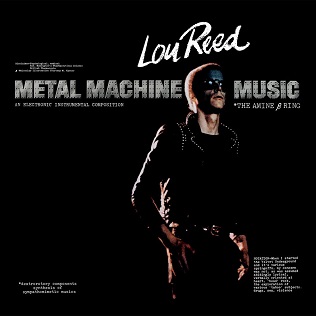
Metal Machine Music is the fifth studio album by American rock musician Lou Reed. It was recorded on a three-speed Uher machine and was mastered/engineered by Bob Ludwig. It was released as a double album in July 1975 by RCA Records, but taken off the market three weeks later. A radical departure from the rest of his catalog, the Metal Machine Music album features no songs or recognizably structured compositions, eschewing melody and rhythm for modulated feedback and noise music guitar effects, mixed at varying speeds by Reed. Also in 1975, RCA released a Quadrophonic version of the Metal Machine Music recording that was produced by playing it back both forward and backward, and by flipping the tape over.

In music, a single is a type of release of a song recording of fewer tracks than an album or LP record, typically one or two tracks. A single can be released for sale to the public in a variety of physical or digital formats. Singles may be standalone tracks or connected to an artist's album, and in the latter case would often have at least one single release before the album itself, called lead singles.

An extended play (EP) is a musical recording that contains more tracks than a single but fewer than an album or LP record. Contemporary EPs generally contain up to eight tracks and have a playing time of 15 to 30 minutes. An "EP" is usually less cohesive than an album and more "non-committal".
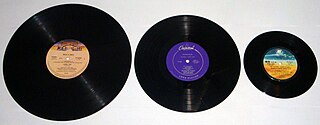
A phonograph record, a vinyl record, or simply a record or vinyl is an analog sound storage medium in the form of a flat disc with an inscribed, modulated spiral groove. The groove usually starts near the outside edge and ends near the center of the disc. The stored sound information is made audible by playing the record on a phonograph.

An album is a collection of audio recordings issued on a medium such as compact disc (CD), vinyl (record), audio tape, or digital. Albums of recorded sound were developed in the early 20th century as individual 78 rpm records collected in a bound book resembling a photo album; this format evolved after 1948 into single vinyl long-playing (LP) records played at 33+1⁄3 rpm.
Rare groove is music that is very hard to source or relatively obscure. Rare groove is primarily associated with funk, R&B and jazz funk, but is also connected to subgenres including jazz rock, reggae, Latin jazz, soul, rock music, northern soul, and disco. Vinyl records that fall into this category generally have high re-sale prices. Rare groove records have been sought by not only collectors and lovers of this type of music, but also by hip hop artists and producers.

"Head Like a Hole" is a song by the American industrial rock band Nine Inch Nails, released as the second single from the group's debut album, Pretty Hate Machine. It enjoyed heavy rotation on the radio at the time of its release, eventually reaching number 9 on Billboard's Bubbling Under Hot 100 chart.

The overwhelming majority of records manufactured have been of certain sizes, playback speeds, and appearance. However, since the commercial adoption of the gramophone record, a wide variety of records have also been produced that do not fall into these categories, and they have served a variety of purposes.
Robert Philip Orlando also known as Bobby Orlando or just Bobby O, is an American record producer, indie record label owner, songwriter, and musician. He is regarded as an innovator in the Hi-NRG genre for developing his signature sound, using a "powerful beat" and "new wave-style" vocals with the help of a "heavy [synthesizer] bass", synthesizers, piano, guitars, cowbells.
Emil Beaulieau, or more fully, “Emil Beaulieau: America’s Greatest Living Noise Artist” is the stage name of Ron Lessard, a prominent noise musician who primarily records for his own label: RRRecords. He has collaborated and performed with many well-known noise artists, including Merzbow, Pain Jerk, Richard Ramirez from Black Leather Jesus and Sonic Disorder. Beaulieau frequently performs with a custom-made four-armed turntable named the Minutoli after its creator, a friend of the artist. Dressed in his trademark pink dress shirt, tie, and grey cardigan, Emil Beaulieau acts out comical performances.

RRRecords is a record label and used- and new-record shop based in Lowell, Massachusetts. RRRecords was the first American record label to publish underground "noise music" in the early 1980s as well as publishing the first American vinyl by Merzbow, Masonna, Hanatarash, Violent Onsen Geisha, and various other artists. In its first twenty years, the label issued hundreds of releases. RRR's owner, Ron Lessard, is a supporter of new artists who has created several sub-labels and series to specifically highlight unknown and underground musicians.
Skullhead was a nationalist Oi! band from the Newcastle area. It was part of the Rock Against Communism (RAC) movement.

The Haters are a noise music and conceptual art troupe from the United States. Founded in 1979, they are one of the earliest acts in the modern noise scene. The group is primarily the work of the Hollywood, California-based musician, artist, writer, and filmmaker GX Jupitter-Larsen, accompanied by a constantly changing lineup of other "members", usually local experimental musicians and artists in whatever town a Haters performance happens to take place.

This is a comprehensive discography of the Japanese noise musician Masami Akita, best known for his project Merzbow. Since 1980 he has released hundreds of recordings, collaborated with dozens of musicians, contributed over two hundred exclusive tracks to compilations, and made numerous guest appearances on recordings by other artists.
Cook Records was a record label founded by Emory Cook (1913–2002), an audio engineer and inventor. From 1952 to 1966, Cook used his Sounds of our Times and Cook Laboratories record labels to demonstrate his philosophy about sound, recording equipment, and manufacturing techniques.
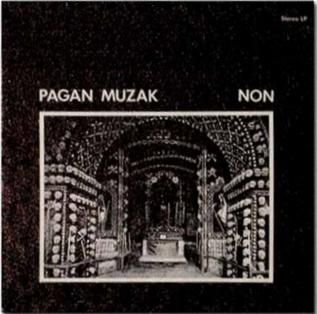
Pagan Muzak is a landmark industrial-noise 7" vinyl released by NON. The release was pressed with 17 tracks of locked grooves and includes an off center hole drilled for an alternate method of play.

The LP is an analog sound storage medium, specifically a phonograph record format characterized by: a speed of 33+1⁄3 rpm; a 12- or 10-inch diameter; use of the "microgroove" groove specification; and a vinyl composition disk. Introduced by Columbia Records in 1948, it was soon adopted as a new standard by the entire US record industry and, apart from a few relatively minor refinements and the important later addition of stereophonic sound in 1957, it remained the standard format for record albums during a period in popular music known as the album era. LP was originally a trademark of Columbia and competed against the smaller 7-inch sized "45" or "single" format by RCA Victor, eventually ending up on top. Today in the vinyl revival era, a large majority of records are based on the LP format and hence the LP name continues to be in use today to refer to new records.

From Here to Infinity is the first solo album by the Sonic Youth guitarist/songwriter Lee Ranaldo. The album consists of several compositions performed by Ranaldo with guitar, amplifier feedback, and guitar stompbox effects recorded onto extended tape loops.
P16.D4 was a German electronic noise music collective, active primarily from 1980 to 1988. P16.D4 embraced tape cut-ups, musique concrète, endless recycling and transformation of previously published material, and many long-distance collaborations with like-minded artists such as DDAA, Vortex Campaign, Nurse With Wound, and Merzbow. Their active participation in the international industrial tape scene yielded collaborative output such as their release Distruct, where bands such as Nurse with Wound, Nocturnal Emissions, Die Tödliche Doris, and The Haters provided the source material. The longest-term collaboration was with the installation and conceptual artist Achim Wollscheid, who used P16.D4 sounds as the basis for LPs he recorded under the name SBOTHI. Ralf Wehowsky, the only constant member of the group, later released solo material under the alias RLW.


