
Fra Angelico, OP was a Dominican friar and Italian Renaissance painter of the Early Renaissance, described by Giorgio Vasari in his Lives of the Artists as having "a rare and perfect talent". He earned his reputation primarily for the series of frescoes he made for his own friary, San Marco, in Florence, then worked in Rome and other cities. All his known work is of religious subjects.

Giorgio Vasari was an Italian Renaissance painter and architect, who is best known for his work Lives of the Most Excellent Painters, Sculptors, and Architects, considered the ideological foundation of all art-historical writing, and still much cited in modern biographies of the many Italian Renaissance artists he covers, including Leonardo da Vinci and Michelangelo, although he is now regarded as including many factual errors, especially when covering artists from before he was born.

Domenico di Tommaso Curradi di Doffo Bigordi, professionally known as Domenico Ghirlandaio, was an Italian Renaissance painter born in Florence. Ghirlandaio was part of the so-called "third generation" of the Florentine Renaissance, along with Verrocchio, the Pollaiolo brothers and Sandro Botticelli.

Andrea del Castagno or Andrea di Bartolo di Bargilla was an Italian Renaissance painter in Florence, influenced chiefly by Masaccio and Giotto di Bondone. His works include frescoes in Sant'Apollonia in Florence and the painted equestrian monument of Niccolò da Tolentino (1456) in Florence Cathedral. He in turn influenced the Ferrarese school of Cosmè Tura, Francesco del Cossa and Ercole de' Roberti.

Luca Signorelli was an Italian Renaissance painter from Cortona, in Tuscany, who was noted in particular for his ability as a draftsman and his use of foreshortening. His massive frescos of the Last Judgment (1499–1503) in Orvieto Cathedral are considered his masterpiece.

Antonio del Pollaiuolo, also known as Antonio di Jacopo Pollaiuolo or Antonio Pollaiuolo, was an Italian Renaissance painter, sculptor, engraver, and goldsmith, who made important works in all these media, as well as designing works in others, for example vestments, metal embroidery being a medium he worked in at the start of his career.

Il Sodoma was the name given to the Italian Renaissance painter Giovanni Antonio Bazzi. Il Sodoma painted in a manner that superimposed the High Renaissance style of early 16th-century Rome onto the traditions of the provincial Sienese school; he spent the bulk of his professional life in Siena, with two periods in Rome.

Pisanello, born Antonio di Puccio Pisano or Antonio di Puccio da Cereto, also erroneously called Vittore Pisano by Giorgio Vasari, was one of the most distinguished painters of the early Italian Renaissance and Quattrocento. He was acclaimed by poets such as Guarino da Verona and praised by humanists of his time, who compared him to such illustrious names as Cimabue, Phidias and Praxiteles.

Lorenzo di Credi was an Italian Renaissance painter and sculptor best known for his paintings of religious subjects, and portraits. With some excursions to nearby cities, his whole life was spent in Florence. He is most famous for having worked in the studio of Andrea del Verrocchio at the same time as the young Leonardo da Vinci, who seems to have influenced his style considerably.
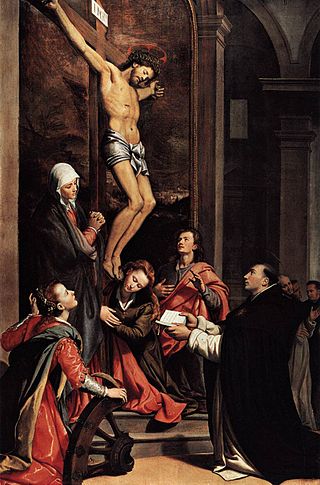
Santi di Tito was one of the most influential and leading Italian painters of the proto-Baroque style – what is sometimes referred to as "Counter-Maniera" or Counter-Mannerism.

Ridolfo di Domenico Bigordi, better known as Ridolfo Ghirlandaio was an Italian Renaissance painter active mainly in Florence. He was the son of Domenico Ghirlandaio.

Giovanni Battista Naldini (1535–1591) was an Italian painter in a late-Mannerist style, active in Florence and Rome.
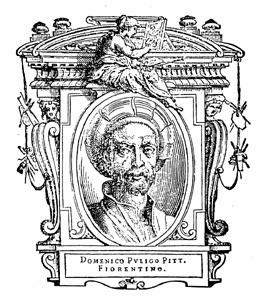
Domenico Puligo (1492–1527) was an Italian painter of the Renaissance, active in Florence. His real name was Domenico di Bartolomeo Ubaldini.

Giovanni Antonio Sogliani was an Italian painter of the Renaissance, active mainly in Florence.
Raffaello da Montelupo, born Raffaele Sinibaldi, was a sculptor and architect of the Italian Renaissance, and an apprentice of Michelangelo. He was the son of another Italian sculptor, Baccio da Montelupo. Both father and son are profiled in Vasari's Le Vite delle più eccellenti pittori, scultori, ed architettori.

The Lives of the Most Excellent Painters, Sculptors, and Architects, often simply known as The Lives, is a series of artist biographies written by 16th-century Italian painter and architect Giorgio Vasari, which is considered "perhaps the most famous, and even today the most-read work of the older literature of art", "some of the Italian Renaissance's most influential writing on art", and "the first important book on art history".

Andrea del Sarto was an Italian painter from Florence, whose career flourished during the High Renaissance and early Mannerism. He was known as an outstanding fresco decorator, painter of altar-pieces, portraitist, draughtsman, and colorist. Although highly regarded during his lifetime as an artist senza errori, his renown was eclipsed after his death by that of his contemporaries Leonardo da Vinci, Michelangelo, and Raphael.

Zanobi di Benedetto di Caroccio degli Strozzi, normally referred to more simply as Zanobi Strozzi, was an Italian Renaissance painter and manuscript illuminator active in Florence and nearby Fiesole. He was closely associated with Fra Angelico, probably as his pupil, as told by Vasari. He is the same painter as the Master of the Buckingham Palace Madonna. Most of his surviving works are manuscript illuminations but a number of panel paintings have also been attributed to him, including seven altarpieces and six panels with the Virgin and Child, along with some designs for metalwork.
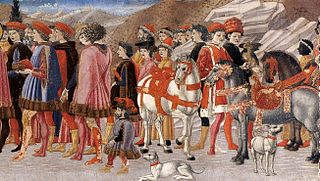
Giovanni di Francesco del Cervelliera or Giovanni di Francesco was an Italian Renaissance painter, active in Florence in the mid-fifteenth century.
Antonia di Paolo di Dono (1456–1491) was the daughter of Paolo di Dono, nicknamed Uccello, a well-known early Renaissance Florentine painter. Giorgio Vasari's biography of Uccello states that he had "a daughter who knew how to draw." Antonia was recorded in the Libro dei Morti of the painter's guild, Arte dei Medici e Speziali, as a "pittoressa." This was the first time the feminine form of the word "painter" appears in Florentine public records and the first formal recognition of a fifteenth-century woman artist.


