In music theory, a diatonic scale is any heptatonic scale that includes five whole steps and two half steps (semitones) in each octave, in which the two half steps are separated from each other by either two or three whole steps, depending on their position in the scale. This pattern ensures that, in a diatonic scale spanning more than one octave, all the half steps are maximally separated from each other.

An equal temperament is a musical temperament or tuning system, which approximates just intervals by dividing an octave into equal steps. This means the ratio of the frequencies of any adjacent pair of notes is the same, which gives an equal perceived step size as pitch is perceived roughly as the logarithm of frequency.

In music, there are two common meanings for tuning:
In music theory, the tritone is defined as a musical interval composed of three adjacent whole tones. For instance, the interval from F up to the B above it is a tritone as it can be decomposed into the three adjacent whole tones F–G, G–A, and A–B. According to this definition, within a diatonic scale there is only one tritone for each octave. For instance, the above-mentioned interval F–B is the only tritone formed from the notes of the C major scale. A tritone is also commonly defined as an interval spanning six semitones. According to this definition, a diatonic scale contains two tritones for each octave. For instance, the above-mentioned C major scale contains the tritones F–B and B–F. In twelve-equal temperament, the tritone divides the octave exactly in half as 6 of 12 semitones or 600 of 1,200 cents.
This is an alphabetical index of articles related to music.
In jazz and blues, a blue note is a note that—for expressive purposes—is sung or played at a slightly different pitch from standard. Typically the alteration is between a quartertone and a semitone, but this varies depending on the musical context.

In Western music theory, a major second is a second spanning two semitones. A second is a musical interval encompassing two adjacent staff positions. For example, the interval from C to D is a major second, as the note D lies two semitones above C, and the two notes are notated on adjacent staff positions. Diminished, minor and augmented seconds are notated on adjacent staff positions as well, but consist of a different number of semitones.
The intervals from the tonic (keynote) in an upward direction to the second, to the third, to the sixth, and to the seventh scale degrees (of a major scale are called major.

A semitone, also called a half step or a half tone, is the smallest musical interval commonly used in Western tonal music, and it is considered the most dissonant when sounded harmonically. It is defined as the interval between two adjacent notes in a 12-tone scale. For example, C is adjacent to C♯; the interval between them is a semitone.

A quarter tone is a pitch halfway between the usual notes of a chromatic scale or an interval about half as wide as a semitone, which itself is half a whole tone. Quarter tones divide the octave by 50 cents each, and have 24 different pitches.
George Secor was an American composer from Chicago. He was the discoverer of miracle temperament and eponym of the secor.
In music, 72 equal temperament, called twelfth-tone, 72-TET, 72-EDO, or 72-ET, is the tempered scale derived by dividing the octave into twelfth-tones, or in other words 72 equal steps. Play (help·info) Each step represents a frequency ratio of 72√2, or 16+2⁄3 cents, which divides the 100 cent "halftone" into 6 equal parts and is thus a "twelfth-tone". Since 72 is divisible by 1, 2, 3, 4, 6, 8, 9, 12, 18, 24, 36, and 72, 72-EDO includes all those equal temperaments. Since it contains so many temperaments, 72-EDO contains at the same time tempered semitones, third-tones, quartertones and sixth-tones, which makes it a very versatile temperament.
Twelve-tone equal temperament is the musical system that divides the octave into 12 parts, all of which are equally tempered on a logarithmic scale, with a ratio equal to the 12th root of 2. That resulting smallest interval, 1⁄12 the width of an octave, is called a semitone or half step.

In music, 53 equal temperament, called 53 TET, 53 EDO, or 53 ET, is the tempered scale derived by dividing the octave into 53 equal steps. Play (help·info) Each step represents a frequency ratio of 21⁄53, or 22.6415 cents, an interval sometimes called the Holdrian comma.
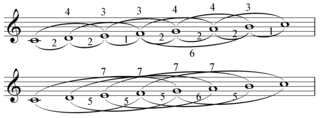
In diatonic set theory, Rothenberg propriety is an important concept, lack of contradiction and ambiguity, in the general theory of musical scales which was introduced by David Rothenberg in a seminal series of papers in 1978. The concept was independently discovered in a more restricted context by Gerald Balzano, who termed it coherence.
In music, the major Locrian scale, also called the Locrian major scale, is the scale obtained by sharpening the second and third notes of the diatonic Locrian mode. With a tonic of C, it consists of the notes C D E F G♭ A♭ B♭. It can be described as a whole tone scale extending from G♭ to E, with F introduced within the diminished third interval from E to G♭. The scale therefore shares with the Locrian mode the property of having a diminished fifth above the tonic.

Music theory analyzes the pitch, timing, and structure of music. It uses mathematics to study elements of music such as tempo, chord progression, form, and meter. The attempt to structure and communicate new ways of composing and hearing music has led to musical applications of set theory, abstract algebra and number theory.

In musical tuning, a temperament is a tuning system that slightly compromises the pure intervals of just intonation to meet other requirements. Most modern Western musical instruments are tuned in the equal temperament system. Tempering is the process of altering the size of an interval by making it narrower or wider than pure. "Any plan that describes the adjustments to the sizes of some or all of the twelve fifth intervals in the circle of fifths so that they accommodate pure octaves and produce certain sizes of major thirds is called a temperament." Temperament is especially important for keyboard instruments, which typically allow a player to play only the pitches assigned to the various keys, and lack any way to alter pitch of a note in performance. Historically, the use of just intonation, Pythagorean tuning and meantone temperament meant that such instruments could sound "in tune" in one key, or some keys, but would then have more dissonance in other keys.
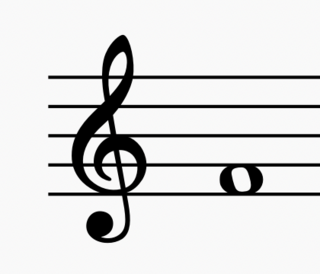
F is a musical note, the fourth above C. It is also known as fa in fixed-do solfège. It has enharmonic equivalents of E♯ and G, amongst others.

The harmonic seventh chord is a major triad plus the harmonic seventh interval. This interval is somewhat narrower and is "sweeter in quality" than an "ordinary" minor seventh, which has a just intonation ratio of 9:5, or an equal-temperament ratio of 1000 cents.
In music, 17 tone equal temperament is the tempered scale derived by dividing the octave into 17 equal steps. Each step represents a frequency ratio of 17√2, or 70.6 cents.

