The technological singularity – also, simply, the singularity – is a hypothetical future point in time at which technological growth becomes uncontrollable and irreversible, resulting in unforeseeable changes to human civilization.

Whole brain emulation (WBE), mind upload or brain upload is the hypothetical futuristic process of scanning the mental state of a particular brain substrate and copying it to a computer. The computer could then run a simulation model of the brain's information processing, such that it would respond in essentially the same way as the original brain and experience having a conscious mind.
A friendly artificial intelligence is a hypothetical artificial general intelligence (AGI) that would have a positive effect on humanity. It is a part of the ethics of artificial intelligence and is closely related to machine ethics. While machine ethics is concerned with how an artificially intelligent agent should behave, friendly artificial intelligence research is focused on how to practically bring about this behaviour and ensuring it is adequately constrained. As such, the development of safe, socially beneficial artificial intelligence or artificial general intelligence is a function of the social psychology of AI research communities, and so can be constrained by extrinsic measures and motivated by intrinsic measures.
Orion's Arm is a multi-authored online science fiction world-building project, first established in 2000 by M. Alan Kazlev, Donna Malcolm Hirsekorn, Bernd Helfert and Anders Sandberg and further co-authored by many people since. Anyone can contribute articles, stories, artwork, or music to the website. A large mailing list exists, in which members debate aspects of the world they are creating, discussing additions, modifications, issues arising, and work to be done.

Singularitarianism is a movement defined by the belief that a technological singularity—the creation of superintelligence—will likely happen in the medium future, and that deliberate action ought to be taken to ensure that the singularity benefits humans.
Artificial general intelligence (AGI) is the hypothetical intelligence of a machine that has the capacity to understand or learn any intellectual task that a human being can. It is a primary goal of some artificial intelligence research and a common topic in science fiction and futures studies. AGI can also be referred to as strong AI, full AI, or general intelligent action.
A matrioshka brain is a hypothetical megastructure proposed by Robert J. Bradbury (1956–2011), based on the Dyson sphere, of immense computational capacity. It is an example of a Class B stellar engine, employing the entire energy output of a star to drive computer systems. This concept derives its name from the nesting Russian Matryoshka dolls. The concept was deployed by its inventor, Robert Bradbury, in the anthology Year Million: Science at the Far Edge of Knowledge.
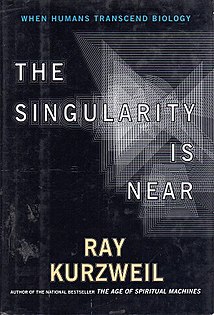
The Singularity Is Near: When Humans Transcend Biology is a 2005 non-fiction book about artificial intelligence and the future of humanity by inventor and futurist Ray Kurzweil.

An AI takeover is a hypothetical scenario in which artificial intelligence (AI) becomes the dominant form of intelligence on Earth, with computers or robots effectively taking the control of the planet away from the human species. Possible scenarios include replacement of the entire human workforce, takeover by a superintelligent AI, and the popular notion of a robot uprising. Some public figures, such as Stephen Hawking and Elon Musk, have advocated research into precautionary measures to ensure future superintelligent machines remain under human control. Robot rebellions have been a major theme throughout science fiction for many decades though the scenarios dealt with by science fiction are generally very different from those of concern to scientists.
In the Orion's Arm fictional universe, a barrier B exists to intelligence amplification and recursive self-improvement such that given any entity T, T is so intelligent that they have totally advanced beyond the human or equivalent sapient condition if and only if T has exceeded B. Given any entity E, E is transapient if and only if it has exceeded B. They represent an intermediate ranking between ordinary sophont and archailect.

Anders Sandberg is a researcher, science debater, futurist, transhumanist and author. He holds a Ph.D. in computational neuroscience from Stockholm University, and is currently a James Martin Research Fellow at the Future of Humanity Institute at Oxford University.

A Dyson tree is a hypothetical genetically engineered plant capable of growing inside a comet, suggested by the physicist Freeman Dyson. Plants could produce a breathable atmosphere within hollow spaces in the comet, utilising solar energy for photosynthesis and cometary materials for nutrients, thus providing self-sustaining habitats for humanity in the outer solar system analogous to a greenhouse in space or a shell grown by a mollusc.
The following outline provides an overview of and a topical guide to transhumanism, an international intellectual and cultural movement that affirms the possibility and desirability of fundamentally transforming the human condition by developing and making widely available technologies to eliminate aging and to greatly enhance human intellectual, physical and psychological capacities. Transhumanist thinkers study the potential benefits and dangers of emerging and hypothetical technologies that could overcome fundamental human limitations as well as study the ethical matters involved in developing and using such technologies. They predict that human beings may eventually be able to transform themselves into beings with such greatly expanded abilities as to merit the label posthuman.
The following outline is provided as an overview of and topical guide to artificial intelligence:

Technology in science fiction examines the possibilities and implications of new technological concepts. Authors have taken, or created, new innovations and technologies, and elaborated on what they might be and how they might be used. This exchange goes in both directions – sometimes the technology appears first in science fiction, then becomes reality and other times the real technology comes first, and science fiction authors speculate about how it might be used, and how it might affect the human condition. Likewise, the accuracy of the technology portrayed spans a wide range – sometimes it is existing technology, sometimes it is a physically realistic portrayal of a far-out technology, and sometimes it is simply a plot device that looks scientific, but has no basis in science. Examples drawn from space travel in science fiction include:

Transcendent Man is a 2009 documentary film by American filmmaker Barry Ptolemy about inventor, futurist and author Ray Kurzweil and his predictions about the future of technology in his 2005 book, The Singularity is Near. In the film, Ptolemy follows Kurzweil around his world as he discusses his thoughts on the technological singularity, a proposed advancement that will occur sometime in the 21st century when progress in artificial intelligence, genetics, nanotechnology, and robotics will result in the creation of a human-machine civilization.
Posthuman or post-human is a concept originating in the fields of science fiction, futurology, contemporary art, and philosophy that literally means a person or entity that exists in a state beyond being human. The concept addresses questions of ethics and justice, language and trans-species communication, social systems, and the intellectual aspirations of interdisciplinarity.
Hypothetical technology is technology that does not exist yet, but that could exist in the future. This article presents examples of technologies that have been hypothesized or proposed, but that have not been developed yet.

The Singularity is the sixth full-length studio album by Swedish metal band Scar Symmetry, released by Nuclear Blast on 3 October 2014 (EU). This is the first album of the Singularity trilogy, and the first Scar Symmetry album to be composed, produced, mixed and mastered entirely by guitarist Per Nilsson, and is the last album with Kenneth Seil on bass.

