Biography
He was born to Mary and Frederick Sparks, a federal government clerk. He was apprenticed to an architect but also took private painting lessons from Howard Helmick. His progress there encouraged him to enroll at the Corcoran Art School. After some time at Corcoran the Director, E. F. Andrews, appointed him to the sensitive position of monitor in the "painting from life" (nude) art classes.
In 1898 he won a design competition, along with his collaborator J. Elfreth Watkins, chief of buildings for the United States National Museum, for a proposed "Hall of American Inventions" to be built at the Exposition Universelle (1900). As a result, he was given a place on the installation committee and went to Paris. While there, he took employment that provided him the means to study at the Académie Julian with Jean-Paul Laurens. After two years there, he transferred to the École des Beaux-Arts, where he studied with Fernand Cormon and William Bouguereau. He remained in Paris for ten years altogether; taking numerous trips to the Mediterranean coast and North Africa.
He returned to the United States in 1908, when Arthur Hamerschlag, head of Andrew Carnegie's new Carnegie Technical Schools, in Pittsburgh, Pennsylvania, hired him to be the founding head of the Department of Painting and Illustration. Very early on, he encountered resistance to his plans for the "painting from life" class, being told that using "a cow, a dog, or a calf" would be more decent, despite the fact that Carnegie himself had no objection to nudes. He eventually prevailed, and used human models throughout his tenure there. While teaching, he continued to paint and participated in numerous exhibitions in Philadelphia, Chicago and New York.
He resigned his post in 1919, intending to live at the art colony in New Hope, Pennsylvania; where he would join his old friend, Edward Redfield. Before he got there, however, he contracted the "Spanish flu" and died in Philadelphia. His works remained little known until the 1960s, when interest in them was revived.

Henry Clay Frick was an American industrialist, financier, and art patron. He founded the H. C. Frick & Company coke manufacturing company, was chairman of the Carnegie Steel Company, and played a major role in the formation of the giant U.S. Steel manufacturing concern. He also financed the construction of the Pennsylvania Railroad and the Reading Company, and had extensive real estate holdings in Pittsburgh and throughout the state of Pennsylvania. He later built the historic neoclassical Frick Mansion, and upon his death donated his extensive collection of old master paintings and fine furniture to create the celebrated Frick Collection and art museum. However, as a founding member of the South Fork Fishing and Hunting Club, he was also in large part responsible for the alterations to the South Fork Dam that caused its failure, leading to the catastrophic Johnstown Flood. His vehement opposition to unions also caused violent conflict, most notably in the Homestead Strike.

Greater Pittsburgh is a populous region centered around Pittsburgh, Pennsylvania, the region's largest city and economic hub. The region encompasses Pittsburgh's urban core county, Allegheny, and six adjacent Pennsylvania counties: Armstrong, Beaver, Butler, Fayette, Washington, and Westmoreland in Western Pennsylvania, which constitutes the Pittsburgh, PA Metropolitan Statistical Area MSA as defined by the U.S. Census Bureau.

Everett Longley Warner was an American Impressionist painter and printmaker, as well as a leading contributor to US Navy camouflage during both World Wars.

Colin Campbell Cooper, Jr. was an American impressionist painter of architectural paintings, especially of skyscrapers in New York City, Philadelphia, and Chicago. An avid traveler, he was also known for his paintings of European and Asian landmarks, as well as natural landscapes, portraits, florals, and interiors. In addition to being a painter, he was also a teacher and writer. His first wife, Emma Lampert Cooper, was also a highly regarded painter.
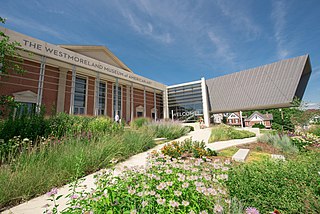
The Westmoreland Museum of American Art is an art museum in Greensburg, Pennsylvania devoted to American art, with a particular concentration on the art of southwestern Pennsylvania.

Robert Gwathmey was an American social realist painter. His wife was photographer Rosalie Gwathmey(September 15, 1908 – February 12, 2001) and his son was architect Charles Gwathmey.

Leopold Gould Seyffert was an American artist. Born in California, Missouri and raised as a child in Colorado and then Pittsburgh, his career brought him eventually to New York City, via Philadelphia and Chicago. In New York the dealer Macbeth established him as one of the leading portraitists of the 20th century and his over 500 portraits continue to decorate the galleries, rooms and halls of many of America's museums and institutions.
Lawrence Calcagno was a San Francisco Bay area abstract expressionist painter. He described his artistic motivation in the following words
Nathan Dunn (1896–1983) was an American painter born July 4, 1896 in Pittsburgh, Pennsylvania. Dunn's work is associated with the Pennsylvania Impressionists. He was an impressionist, abstract, and modernist artist and was named a Fellow of the Royal Society of Arts. His paintings are held in private and museum collections.

Aaron Harry Gorson was an American artist.
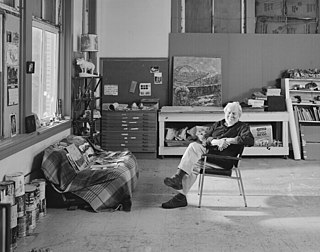
Robert L. Qualters, Jr. is an American painter, installation artist and printmaker based in Pittsburgh, Pennsylvania. His work encompasses traditional painting, as well as murals, and collaborations with other Pittsburgh-based artists across several disciplines. He is associated with the Bay Area Figurative Movement of Representational Painting.

Joseph Michael Plavcan was an American painter and teacher from Erie, Pennsylvania.
Edmund Marion Ashe (1867-1941) was an American artist. He was most known for his varying styles of art, which included faithful representations of factories, posters of World War I bond drives, and watercolors of the Gibson Girl.
Joseph E. Temple Fund Gold Medal (defunct) was a prestigious art prize awarded by the Pennsylvania Academy of the Fine Arts most years from 1883 to 1968. A Temple Medal recognized the best oil painting by an American artist shown in PAFA's annual exhibition. Recipients included James Whistler, John Singer Sargent, Winslow Homer, Thomas Eakins, Robert Henri and Edward Hopper.

Walter Elmer Schofield was an American Impressionist landscape and marine painter. Although he never lived in New Hope or Bucks County, Schofield is regarded as one of the Pennsylvania Impressionists.
Samuel Rosenberg (1896–1972) was an American artist and Professor at Carnegie Mellon University in Pittsburgh, PA. He showed his work at the Museum of Modern Art, the Whitney Museum in New York, the National Academy of Art in Washington, the Corcoran Gallery, and in the Pennsylvania Academy of Fine Arts. He was a beloved art teacher, and some of his students were Mel Bochner, Philip Pearlstein and Andy Warhol.
Rochelle Blumenfeld is an American artist from Pittsburgh, Pennsylvania. Her paintings have been exhibited in many public and private collections, including the Carnegie Museum of Art. Her work has been included in the Bicentennial Exhibit of “American Painters in Paris” in Paris, France, Copley Society of Art, Boston, Dunfermline Fife, Scotland, and the Westmoreland Museum of American Art, Greensburg, Pennsylvania.

Bernard Karfiol was an American painter and watercolorist. His work was indebted to French modernism and wished to synthesize Hellenic classical painting and modernist abstract concerns.

William David Hanna, known as David Hanna, was an American artist who produced drawings, paintings, and sculpture in graphite, watercolor, egg tempera, drybrush, bronze, and marble. Hanna lived and worked in Pittsburgh, Pennsylvania, and Bristol, Maine. His art predominantly focused on the structures, furnishings, and people of those regions.

The Prodigal Son is a sculpture group by George Grey Barnard that depicts the loving reunion of the father and son from the New Testament "Parable of the Prodigal Son."


