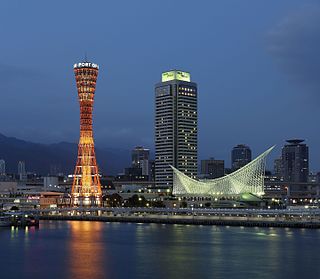
Kobe is the capital city of Hyōgo Prefecture Japan. With a population around 1.5 million, Kobe is Japan's seventh-largest city and the third-largest port city after Tokyo and Yokohama. It is located in Kansai region, which makes up the southern side of the main island of Honshū, on the north shore of Osaka Bay. It is part of the Keihanshin metropolitan area along with Osaka and Kyoto. The Kobe city centre is located about 35 km (22 mi) west of Osaka and 70 km (43 mi) southwest of Kyoto.

Hyōgo Prefecture is a prefecture of Japan located in the Kansai region of Honshu. Hyōgo Prefecture has a population of 5,469,762 and has a geographic area of 8,400 square kilometres (3,200 sq mi). Hyōgo Prefecture borders Kyoto Prefecture to the east, Osaka Prefecture to the southeast, and Okayama Prefecture and Tottori Prefecture to the west.

Nishinomiya is a city located in Hyōgo Prefecture, Japan. As of 1 November 2022, the city had an estimated population of 484,368 in 218,948 households and a population density of 4800 persons per km². The total area of the city is 99.98 square kilometres (38.60 sq mi). Nishinomiya is an important commercial and shipping city in the Kansai region with the third largest population in Hyōgo Prefecture. Nishinomiya is best known as the home of Kōshien Stadium, where the Hanshin Tigers baseball team plays home games and where Japan's annual high school baseball championship is held.
Hanshin, derived from the second kanji from Osaka (大阪) and the first kanji from Kobe (神戸), refers generally to Osaka, Kobe, and the surrounding area in the Kansai region of Japan.

Ashiya is a city in Hyōgo Prefecture, Japan. As of 1 November 2022, the city had an estimated population of 95,485 in 45562 households and a population density of 5200 persons per km². The total area of the city is 53.44 square kilometres (20.63 sq mi).

Ashiya Station is a passenger railway station located in the city of Ashiya, Hyōgo Prefecture, Japan. It is operated by the West Japan Railway Company.
Ashiya Station (芦屋駅) is the name of two train stations in Ashiya, Hyōgo, Japan:

Ashiya University is a private university in Ashiya, Hyōgo, Japan, founded in 1964.
Hyōgo bugyō (兵庫奉行) were officials of the Tokugawa shogunate in Amagasaki Domain, during the Edo period of Japan. Appointments to this prominent office were usually fudai daimyō, but this was amongst the senior administrative posts open to those who were not daimyō. Conventional interpretations have construed these Japanese titles as "commissioner", "overseer" or "governor".
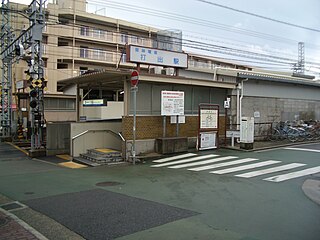
Uchide Station is a passenger railway station located in the city of Ashiya Hyōgo Prefecture, Japan. It is operated by the private transportation company Hanshin Electric Railway.

Ashiya Station is a passenger railway station located in the city of Ashiya Hyōgo Prefecture, Japan. It is operated by the private transportation company Hanshin Electric Railway.
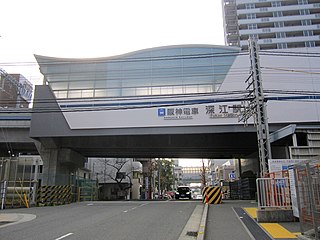
Fukae Station is a railway station in Higashinada-ku, Kobe, Hyōgo Prefecture, Japan. It is owned and operated by private operator Hanshin Electric Railway.
Ashiya College is a private junior college in Ashiya, Hyōgo, Japan.

Shukugawa Station is a passenger railway station located in the Aioichō neighborhood of the city of Nishinomiya, Hyōgo Prefecture, Japan. It is operated by the private transportation company Hankyu Railway.
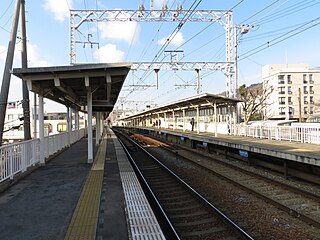
Ashiyagawa Station is a passenger railway station located in the city of Ashiya, Hyōgo Prefecture, Japan. It is operated by the private transportation company Hankyu Railway.

Tatiana Viktorovna Stepanova, also Tetiana Stepanova, is a Ballet master, choreographer, ballet dancer, critic, essayist and historian of the dance.
Harue Kitamura was a Japanese politician, lawyer, and feminist. She is the first woman to be elected mayor of a Japanese city, serving three terms as the mayor of Ashiya, Hyogo.
Fujiko Shiraga was a Japanese avant-garde artist and one of the earliest female members of the Gutai Art Association. Active as an artist between the early 1950s and 1961, Shiraga was known for creating highly tactile artworks by pasting and creasing sheets of torn Japanese paper. Since last decade, Shiraga's works have received growing art-historical attention. Her paper works, paintings, and installations were featured in major Western exhibitions on Gutai art and two posthumous retrospectives.

Gendai Bijutsu Kondankai was a study and discussion group founded in 1952 to facilitate interdisciplinary and cross-genre exchanges among Japanese artists based in the Kansai region. Among the participants were key figures of Japanese avant-garde art after World War II, such as calligraphers Shiryū Morita, Yuichi Inoue and Sōgen Eguchi, potter Yasuo Hayashi, and painters Waichi Tsutaka, Kokuta Suda, Jirō Yoshihara and future members of the Gutai Art Association. Genbi's activities, which included monthly meetings and group exhibitions, ceased in 1957.

