
Giovanni di Pietro di Bernardone, known as Francis of Assisi, was an Italian mystic, poet, and Catholic friar who founded the religious order of the Franciscans. Inspired to lead a Christian life of poverty, he became a beggar and itinerant preacher.

The Franciscans are a group of related mendicant religious orders of the Catholic Church. Founded in 1209 by the Italian saint Francis of Assisi, these orders include three independent orders for men, orders for nuns such as the Order of Saint Clare, and the Third Order of Saint Francis open to male and female members. They adhere to the teachings and spiritual disciplines of the founder and of his main associates and followers, such as Clare of Assisi, Anthony of Padua, and Elizabeth of Hungary. Several smaller Protestant Franciscan orders or other groups have been established since late 1800s as well, particularly in the Anglican and Lutheran traditions.

Assisi is a town and commune of Italy in the Province of Perugia in the Umbria region, on the western flank of Monte Subasio.

Thomas of Celano was an Italian friar of the Franciscans as well as a poet and the author of three hagiographies about Francis of Assisi.

The Poor Clares, officially the Order of Saint Clare, originally referred to as the Order of Poor Ladies, and also known as the Clarisses or Clarissines, the Minoresses, the Franciscan Clarist Order, and the Second Order of Saint Francis, are members of an enclosed order of nuns in the Roman Catholic Church. The Poor Clares were the second Franciscan branch of the order to be established. The first order of the Franciscans, which was known as the Order of Friars Minor, was founded by Saint Francis of Assisi in 1209. Three years after founding the Order of Friars Minor, Francis of Assisi and Clare of Assisi founded the Order of Saint Clare, or Order of Poor Ladies, on Palm Sunday in the year 1212. They were organized after the manner of the Order of Friars Minor and before the Third Order of Saint Francis was founded. As of 2011, there were over 20,000 Poor Clare nuns in over 75 countries throughout the world. They follow several different observances and are organized into federations.
Saint Clare may refer to:
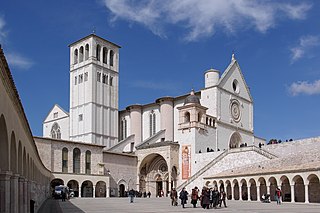
The Basilica of Saint Francis of Assisi is the mother church of the Roman Catholic Order of Friars Minor Conventual in Assisi, a town in the Umbria region in central Italy, where Saint Francis was born and died. It is a papal minor basilica and one of the most important places of Christian pilgrimage in Italy. With its accompanying friary, Sacro Convento, the basilica is a distinctive landmark to those approaching Assisi. It has been a UNESCO World Heritage Site since 2000.
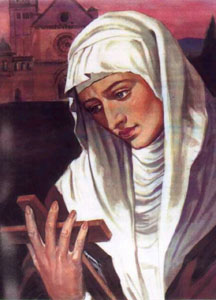
Agnes of Assisi was one of the first abbesses of the Order of Poor Ladies. She also planted additional communities of the order. She was a younger sister of Clare of Assisi, who is credited with founding the order. Pope Benedict XIV canonized Agnes as a saint in 1753.

Brother Leo was the favorite disciple, secretary and confessor of Francis of Assisi. The dates of his birth and of his becoming a Franciscan are not known; a native of Assisi, he was one of the small group of most trusted companions of the saint during his last years.

Assisi Cathedral, dedicated to San Rufino, is a major church in Assisi, Italy. This stately church in Umbrian Romanesque style was the third church built on the same site to contain the remains of bishop Rufinus of Assisi, martyred in the 3rd century. The construction was started in 1140 to the designs by Giovanni da Gubbio, as attested by the wall inscription visible inside the apse. He may be the same Giovanni who designed the rose-window on the façade of Santa Maria Maggiore in 1163.

The Little Flowers of St. Francis is a florilegium, divided into 53 short chapters, on the life of Saint Francis of Assisi that was composed at the end of the 14th century. The anonymous Italian text, almost certainly by a Tuscan author, is a version of the Latin Actus beati Francisci et sociorum eius, of which the earliest extant manuscript is one of 1390 AD. Luke Wadding ascribes the text to Ugolino da Santa Maria, whose name occurs three times in the Actus. Most scholars are now agreed that the author was Ugolino Brunforte.

The Capuchin Poor Clares is a Catholic religious order of Pontifical Right for women founded in Naples, Italy, in 1538, by Blessed Maria Lorenza Longo. The order still exists and it now has communities in the United States. Members are referred to as Capuchinesses.

Elias of Cortona was a close associate of Saint Francis of Assisi and one of the earliest followers to join the newly founded Order of Friars Minor. A lay brother, he rose to positions of significant leadership within the order, serving as both vicar general and minister general. Saint Francis himself appointed Elias vicar general in 1221.

San Damiano is a church with a monastery near Assisi, Italy. Built in the 12th century, it was the first monastery of the Order of Saint Clare, where Saint Clare built her community.
While there are no saints named St. Claire in English, there are several saints named St. Clare. They are spelled "Ste. Claire" in French.

Emerging since the 19th century, there are several Protestant adherent and groups, sometimes organised as religious orders, which strive to adhere to the teachings and spiritual disciplines of Saint Francis of Assisi.
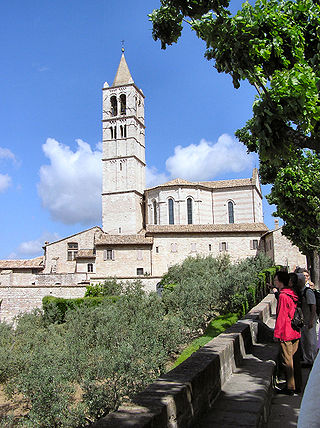
The Basilica of Saint Clare is a church in Assisi, central Italy. It is dedicated to and contains the remains of Clare of Assisi, a follower of Francis of Assisi and founder of the Order of Poor Ladies, known today as the Order of Saint Clare.

Chiara Offreduccio, known as Clare of Assisi, is an Italian saint who was one of the first followers of Francis of Assisi.
Amata of Assisi was a saint, a Poor Clare nun, and one of Saint Clare of Assisi's original followers. Amata was born into a noble family in Assisi, Italy; her father was Don Martin di Cora and her mother Donna Penenda, Clare's oldest sister. Her name means "beloved" in Latin and is a common religious name among the Poor Clares. Amata grew up "vivacious and pleasure-seeking". Her parents wanted Amata to marry and as her hagiographer Agnes Dunbar states, she was "pleased with dress and worldly vanity". Dunbar also reports that her aunt "grieved for the peril in which she saw her, and prayed that she might strive to please God rather than men". Amata was close to Clare while growing up, but Clare's piety left little impression on her, until she visited Clare at her monastery to get her advice about her engagement and chose to remain with Clare instead of marriage, despite the "desperate and violent pleas" of her friends and fiancé.
San Damiano is the Italian for Saint Damian. It may also refer to:

