Related Research Articles
Professional certification, trade certification, or professional designation, often called simply certification or qualification, is a designation earned by a person to assure qualification to perform a job or task. Not all certifications that use post-nominal letters are an acknowledgement of educational achievement, or an agency appointed to safeguard the public interest.

A general practitioner (GP) or family physician is a doctor who is a consultant in general practice.
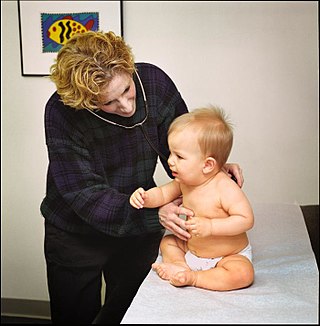
General practice is personal, family, and community-orientated comprehensive primary care that includes diagnosis, continues over time and is anticipatory as well as responsive.

Family medicine is a medical specialty within primary care that provides continuing and comprehensive health care for the individual and family across all ages, genders, diseases, and parts of the body. The specialist, who is usually a primary care physician, is named a family physician. It is often referred to as general practice and a practitioner as a general practitioner. Historically, their role was once performed by any doctor with qualifications from a medical school and who works in the community. However, since the 1950s, family medicine / general practice has become a specialty in its own right, with specific training requirements tailored to each country. The names of the specialty emphasize its holistic nature and/or its roots in the family. It is based on knowledge of the patient in the context of the family and the community, focusing on disease prevention and health promotion. According to the World Organization of Family Doctors (WONCA), the aim of family medicine is "promoting personal, comprehensive and continuing care for the individual in the context of the family and the community". The issues of values underlying this practice are usually known as primary care ethics.

The Chartered Governance Institute is a qualifying and membership body for company secretaries and governance professionals operating in several common law jurisdictions.

The Royal is a British period medical drama, produced by Yorkshire Television, and broadcast on ITV from 2003 until its cancellation in 2011. The series is set in the 1960s and focuses on the lives of the staff at the fictional "St Aidan's Royal Free Hospital", a National Health Service hospital serving the fictional rural seaside town of Elsinby and its surrounding area. The programme began originally as a spin-off of ITV's period drama series Heartbeat and the first three series featured crossovers with Heartbeat and appearances by its cast members. From the start of the fourth series, the crossover elements were removed, and The Royal focussed on stories involving its own cast.

The Royal Australian College of General Practitioners (RACGP) is the professional body for general practitioners (GPs) in Australia. The RACGP is responsible for maintaining standards for quality clinical practice, education and training, and research in Australian general practice. The RACGP represents over 40,000 members across metropolitan, urban, rural and remote Australia.
Office administration is a set of day-to-day activities that are related to the maintenance of an office building, financial planning, record keeping and billing, personal development, physical distribution and logistics, within an organization. An employee that undertakes these activities is commonly called an office administrator or office manager, and plays a key role in any organization's infrastructure, regardless of the scale. Many administrative positions require the candidate to have an advanced skill set in the software applications Microsoft Word, Excel and Access.
General medical services (GMS) is the range of healthcare that is provided by general practitioners as part of the National Health Service in the United Kingdom. The NHS specifies what GPs, as independent contractors, are expected to do and provides funding for this work through arrangements known as the General Medical Services Contract. Today, the GMS contract is a UK-wide arrangement with minor differences negotiated by each of the four UK health departments. In 2013 60% of practices had a GMS contract as their principal contract. The contract has sub-sections and not all are compulsory. The other forms of contract are the Personal Medical Services or Alternative Provider Medical Services contracts. They are designed to encourage practices to offer services over and above the standard contract. Alternative Provider Medical Services contracts, unlike the other contracts, can be awarded to anyone, not just GPs, don't specify standard essential services, and are time limited. A new contract is issued each year.

NHS Scotland, sometimes styled NHSScotland, is the publicly–funded healthcare system in Scotland and one of the four systems that make up the National Health Service in the United Kingdom. It operates 14 territorial NHS boards across Scotland, supported by seven special non-geographic health boards, and Public Health Scotland.
A Company secretary is a senior position in the corporate governance of organizations, playing a crucial role in ensuring adherence to statutory and regulatory requirements. This position is integral to the efficient functioning of corporations, particularly in common law jurisdictions. The Company Secretary serves as a guardian of compliance, a facilitator of communication between the board of directors and other stakeholders, and a custodian of corporate records.
The Postgraduate Medical Education and Training Board was the non-departmental public body responsible for postgraduate medical education and training in the United Kingdom (UK). The General Medical Council (GMC) took over the functions of PMETB on 1 April 2010 when the two organisations merged.
International Association of Medical Colleges (IAOMC) is a professional association, basically meant for peer evaluation of the medical education and maintaining uniform standards and recognition of physicians qualifications provided by individual medical schools anywhere in the world.
An audio typist is someone who specialises in typing text from a vocal source which they listen to. The original voice document is usually recorded onto microcassettes by someone dictating into a Dictaphone. The audio typist will have learnt to touch type at a high speed which means they can look at the monitor or keep an eye on a waiting area as they are typing because they do not need to look at the keyboard. A specialist player called a micro cassette transcriber (below) is used for playback of the cassettes to maximise the typing speed.

Governance Institute of Australia, formerly Chartered Secretaries Australia, is an independent professional association for company secretaries, governance advisers and risk managers in Australia, committed to promoting sound practice in governance and risk management.

Clinical commissioning groups (CCGs) were National Health Service (NHS) organisations set up by the Health and Social Care Act 2012 to organise the delivery of NHS services in each of their local areas in England. On 1 July 2022 they were abolished, and replaced by Integrated care systems as a result of the Health and Care Act 2022.
EMIS Health, formerly known as Egton Medical Information Systems, supplies electronic patient record systems and software used in primary care, acute care and community pharmacy in the United Kingdom. The company is based in Leeds. It claims that more than half of GP practices across the UK use EMIS Health software and holds number one or two market positions in its main markets. In June 2022 the company was acquired by Bordeaux UK Holdings II Limited, an affiliate of UnitedHealth's Optum business for a 49% premium on EMIS's closing share price.
GP Federations became popular among English general practitioners after 2010 as a means to exploit the opportunities—or mitigate the threats—posed by the Five Year Forward View proposals in the English NHS which envisaged delivering primary care at a larger scale than the traditional GP list. It is widely believed that ‘Practices cannot survive on their own – they have to look at ways of making themselves stronger.’ 15 sites were selected in December 2015 to test new enhanced primary care models serving populations of 30,000 to 50,000 patients. Some, but by no means all, clinical commissioning groups have given financial support to encourage the formation of federations.
In Practice Systems Limited (INPS) is a health informatics company, part of the Cegedim group and based in the United Kingdom.
References
- ↑ "AMSPAR". Cherith Simmons. Retrieved 22 June 2017.
- ↑ "Qualifications". AMSPAR. Archived from the original on 19 October 2016. Retrieved 22 June 2017.
- ↑ "New GP commissioning group board member who is married to Tory in 'Plebgate' affair". Islington Tribune. 5 April 2013. Retrieved 22 June 2017.[ permanent dead link ]
- ↑ "Exclusive: Practice manager stress leaves 67% on brink of quitting". GP Online. 7 April 2014. Retrieved 22 June 2017.
- ↑ "THE ASSOCIATION OF MEDICAL SECRETARIES, PRACTICE MANAGERS, ADMINISTRATORS AND RECEPTIONISTS LIMITED". Companies House. Retrieved 22 June 2017.
- ↑ "The Association Of Medical Secretaries, Practice Managers, Administrators And Receptionists Limited". Total Giving. Retrieved 22 June 2017.