
The Battle of Atlanta took place during the Atlanta Campaign of the American Civil War on July 22, 1864, just southeast of Atlanta, Georgia. Continuing their summer campaign to seize the important rail and supply hub of Atlanta, Union forces commanded by William Tecumseh Sherman overwhelmed and defeated Confederate forces defending the city under John Bell Hood. Union Major General James B. McPherson was killed during the battle, the second-highest-ranking Union officer killed in action during the war. Despite the implication of finality in its name, the battle occurred midway through the Atlanta campaign, and the city did not fall until September 2, 1864, after a Union siege and various attempts to seize railroads and supply lines leading to Atlanta. After taking the city, Sherman's troops headed south-southeastward toward Milledgeville, the state capital, and on to Savannah with the March to the Sea.

Sherman's March to the Sea was a military campaign of the American Civil War conducted through Georgia from November 15 until December 21, 1864, by William Tecumseh Sherman, major general of the Union Army. The campaign began on November 15 with Sherman's troops leaving Atlanta, recently taken by Union forces, and ended with the capture of the port of Savannah on December 21. His forces followed a "scorched earth" policy, destroying military targets as well as industry, infrastructure, and civilian property, disrupting the Confederacy's economy and transportation networks.

The Army of the Tennessee was a Union army in the Western Theater of the American Civil War, named for the Tennessee River. A 2005 study of the army states that it "was present at most of the great battles that became turning points of the war—Fort Donelson, Vicksburg, and Atlanta" and "won the decisive battles in the decisive theater of the war."

The Battle of Nashville was a two-day battle in the Franklin-Nashville Campaign that represented the end of large-scale fighting west of the coastal states in the American Civil War. It was fought at Nashville, Tennessee, on December 15–16, 1864, between the Confederate Army of Tennessee under Lieutenant General John Bell Hood and the Union Army of the Cumberland (AoC) under Major General George H. Thomas. In one of the largest victories achieved by the Union Army during the war, Thomas attacked and routed Hood's army, largely destroying it as an effective fighting force.
The Army of the Shenandoah was a field army of the Union Army active during the American Civil War. First organized as the Department of the Shenandoah in 1861 and then disbanded in early 1862, the army became most effective after its recreation on August 1, 1864 under the command of Philip Sheridan. The army's actions during the Valley campaigns of 1864 rendered the Shenandoah Valley of Virginia unable to produce foodstuffs for the Confederate States Army, a condition which would hasten the conclusion of the American Civil War.

The Atlanta campaign was a series of battles fought in the Western Theater of the American Civil War throughout northwest Georgia and the area around Atlanta during the summer of 1864. Union Maj. Gen. William Tecumseh Sherman invaded Georgia from the vicinity of Chattanooga, Tennessee, beginning in May 1864, opposed by the Confederate general Joseph E. Johnston.

The Battle of Peachtree Creek was fought in Georgia on July 20, 1864, as part of the Atlanta Campaign in the American Civil War. It was the first major attack by Lt. Gen. John Bell Hood since taking command of the Confederate Army of Tennessee. The attack was against Maj. Gen. William T. Sherman's Union army, which was perched on the doorstep of Atlanta. The main armies in the conflict were the Union Army of the Cumberland, commanded by Maj. Gen. George Henry Thomas and two corps of the Confederate Army of Tennessee.

The Battle of Kennesaw Mountain was fought on June 27, 1864, during the Atlanta Campaign of the American Civil War. The most significant frontal assault launched by Union Major General William T. Sherman against the Confederate Army of Tennessee under General Joseph E. Johnston, it produced a tactical defeat for the Union forces but failed to deliver the result that the Confederacy desperately needed: a halt to Sherman's advance on Atlanta, Georgia.
The Army of the Ohio was the name of two Union armies in the American Civil War. The first army became the Army of the Cumberland and the second army was created in 1863.

Georgia was one of the original seven slave states that formed the Confederate States of America in February 1861, triggering the U.S. Civil War. The state governor, Democrat Joseph E. Brown, wanted locally raised troops to be used only for the defense of Georgia, in defiance of Confederate president Jefferson Davis, who wanted to deploy them on other battlefronts. When the Union blockade prevented Georgia from exporting its plentiful cotton in exchange for key imports, Brown ordered farmers to grow food instead, but the breakdown of transport systems led to desperate shortages.

The city of Atlanta, Georgia, in Fulton County, was an important rail and commercial center during the American Civil War. Although relatively small in population, the city became a critical point of contention during the Atlanta Campaign in 1864 when a powerful Union Army approached from Union-held Tennessee. The fall of Atlanta was a critical point in the Civil War, giving the North more confidence, and leading to the re-election of President Abraham Lincoln and the eventual dissolution of the Confederacy. The capture of the "Gate City of the South" was especially important for Lincoln as he was in a contentious election campaign against the Democratic opponent George B. McClellan.

The 104th Ohio Infantry Regiment, sometimes 104th Ohio Volunteer Infantry, was an infantry regiment in the Union army during the American Civil War. It played a conspicuous role at the Battle of Franklin during the 1864 Franklin–Nashville campaign, where six members later received the Medal of Honor, most for capturing enemy flags.

The 1st Arkansas Infantry (1861–1865) was a Confederate Army infantry regiment during the American Civil War. The regiment was raised in April 1861 by Colonel Thompson B. Flournoy. It moved first to Virginia, but transferred back to Tennessee and served the rest of the war in the western theater, seeing action in the Kentucky, Tennessee and Georgia campaigns. Following its depletion in numbers, the regiment was consolidated several times with other Arkansas regiments, finally merging in 1865 into the 1st Arkansas Consolidated Infantry Regiment. There were three regiments known as "1st Arkansas" during the war. The second unit with the designation of "1st Arkansas" was the 1st Infantry, Arkansas State Troops, which was mustered into Confederate service at Pitman's Ferry, Arkansas, on 23 July 1861, under the command of Colonel Patrick Cleburne; this unit was eventually redesignated as the 15th Arkansas Volunteer Infantry. The third unit bearing the title "1st Arkansas" was the 1st Arkansas Volunteer Infantry, which served with the Union Army.

Events from the year 1864 in the United States.
The 83rd Indiana Infantry Regiment, sometimes called 83rd Indiana Volunteer Infantry Regiment, was an infantry regiment that served in the Union Army during the American Civil War.
The following units and commanders fought in the Confederate Army of Tennessee during the Battle of Atlanta on July 22, 1864. The Union order of battle is listed separately. The orders of battle for the first and second phases of the campaign are listed separately as well.
The following Confederate Army units and commanders fought in the Atlanta campaign of the American Civil War. The Union order of battle is listed separately. Order of battle compiled from the army organization during the campaign.
The following Confederate Army units and commanders fought in the Battle of Jonesborough of the American Civil War on August 31-September 1, 1864. The Union order of battle is listed separately.
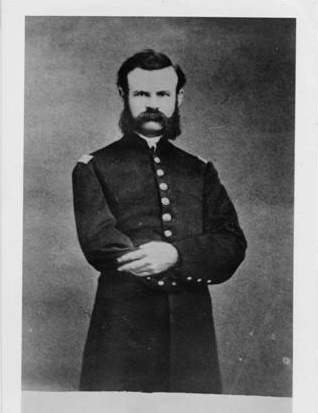
Battery F, 2nd Illinois Light Artillery Regiment was an artillery battery from Illinois that served in the Union Army during the American Civil War. The battery was organized in December 1861 at Cape Girardeau, Missouri. The unit fought at Shiloh, First Corinth, and Second Corinth in 1862 and at Vicksburg and Jackson in 1863. The battery served in the Atlanta campaign and at Nashville in 1864. It was mustered out of federal service in July 1865. The battery's first commander was John Wesley Powell who later led an exploration of the Grand Canyon.
The order of battle for the Battle of Dallas includes:
