Perception is the organization, identification, and interpretation of sensory information in order to represent and understand the presented information, or the environment.

An illusion is a distortion of the senses, which can reveal how the human brain normally organizes and interprets sensory stimulation. Though illusions distort our perception of reality, they are generally shared by most people.
This is a glossary of medical terms related to communications disorders which are conditions that could have the potential to negatively impact the level at which an individual can hear, understand, and respond to others.

The vestibulocochlear nerve, known as the eighth cranial nerve, transmits sound and equilibrium (balance) information from the inner ear to the brain.
Stimulus modality, also called sensory modality, is one aspect of a stimulus or what is perceived after a stimulus. For example, the temperature modality is registered after heat or cold stimulate a receptor. Some sensory modalities include: light, sound, temperature, taste, pressure, and smell. The type and location of the sensory receptor activated by the stimulus plays the primary role in coding the sensation. All sensory modalities work together to heighten stimuli sensation when necessary.
Sound localization is a listener's ability to identify the location or origin of a detected sound in direction and distance. It may also refer to the methods in acoustical engineering to simulate the placement of an auditory cue in a virtual 3D space.
Sensory substitution is a change of the characteristics of one sensory modality into stimuli of another sensory modality.
Subjective constancy or perceptual constancy is the perception of an object or quality as constant even though our sensation of the object changes. While the physical characteristics of an object may not change, in an attempt to deal with our external world, our perceptual system has mechanisms that adjust to the stimulus.
In medicine and anatomy, the special senses are the senses that have specialized organs devoted to them:
A sensory cue is a statistic or signal that can be extracted from the sensory input by a perceiver, that indicates the state of some property of the world that the perceiver is interested in perceiving.
In perception and psychophysics, auditory scene analysis (ASA) is a proposed model for the basis of auditory perception. This is understood as the process by which the human auditory system organizes sound into perceptually meaningful elements. The term was coined by psychologist Albert Bregman. The related concept in machine perception is computational auditory scene analysis (CASA), which is closely related to source separation and blind signal separation.
Computational auditory scene analysis (CASA) is the study of auditory scene analysis by computational means. In essence, CASA systems are "machine listening" systems that aim to separate mixtures of sound sources in the same way that human listeners do. CASA differs from the field of blind signal separation in that it is based on the mechanisms of the human auditory system, and thus uses no more than two microphone recordings of an acoustic environment. It is related to the cocktail party problem.

Cortical deafness is a rare form of sensorineural hearing loss caused by damage to the primary auditory cortex. Cortical deafness is an auditory disorder where the patient is unable to hear sounds but has no apparent damage to the anatomy of the ear, which can be thought of as the combination of auditory verbal agnosia and auditory agnosia. Patients with cortical deafness cannot hear any sounds, that is, they are not aware of sounds including non-speech, voices, and speech sounds. Although patients appear and feel completely deaf, they can still exhibit some reflex responses such as turning their head towards a loud sound.

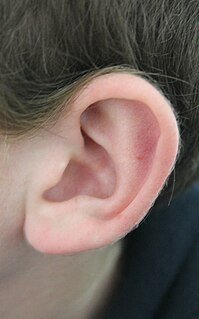
Hearing, or auditory perception, is the ability to perceive sounds by detecting vibrations, changes in the pressure of the surrounding medium through time, through an organ such as the ear. The academic field concerned with hearing is auditory science.
The neuronal encoding of sound is the representation of auditory sensation and perception in the nervous system.
Psychoacoustics is the scientific study of sound perception and audiology – how humans perceive various sounds. More specifically, it is the branch of science studying the psychological and physiological responses associated with sound. It can be further categorized as a branch of psychophysics. Psychoacoustics received its name from a field within psychology—i.e., recognition science—which deals with all kinds of human perceptions. It is an interdisciplinary field of many areas, including psychology, acoustics, electronic engineering, physics, biology, physiology, and computer science.
Many types of sense loss occur due to a dysfunctional sensation process, whether it be ineffective receptors, nerve damage, or cerebral impairment. Unlike agnosia, these impairments are due to damages prior to the perception process.
Selective auditory attention or selective hearing is a type of selective attention and involves the auditory system of the nervous system. Selective hearing is characterized as the action in which people focus their attention on a specific source of a sound or spoken words. The sounds and noise in the surrounding environment is heard by the auditory system but only certain parts of the auditory information are processed in the brain. Most often, auditory attention is directed at things people are most interested in hearing. In an article by Krans, Isbell, Giuliano, and Neville (2013), selective auditory attention is defined as the ability to acknowledge some stimuli while ignoring other stimuli that is occurring at the same time. An example of this is a student focusing on a teacher giving a lesson and ignoring the sounds of classmates in a rowdy classroom (p. 53). This is an example of bottlenecking which means that information cannot be processed simultaneously so only some sensory information gets through the "bottleneck" and is processed. A brain simply cannot process all sensory information that is occurring in an environment so only that which is most important is thoroughly processed. Selective hearing is not a physiological disorder but rather it is the capability of humans to block out sounds and noise. It is the notion of ignoring certain things in the surrounding environment. Over the years, there has been increased research in the selectivity of auditory attention, namely selective hearing.

Illusory discontinuity is an auditory illusion in which a continuous ongoing sound becomes inaudible during a brief, non-masking noise. The illusion is perceived only by some listeners, but not by others, reflecting individual variation in hearing abilities. It has been estimated that among young adults 24% are susceptible to illusory discontinuity. The most susceptible listeners describe their sensations in terms of the sound actually containing a physical gap.
The illusory discontinuity is strongest when the interrupting sound is short (50ms). Longer sounds elicit weaker illusory discontinuity; this effect may be related to better auditory segregation.