Related Research Articles

The British Isles are a group of islands in the North Atlantic off the north-western coast of continental Europe, consisting of the islands of Great Britain, Ireland, the Isle of Man, the Hebrides and over six thousand smaller islands. They have a total area of about 315,159 km2 (121,684 sq mi) and a combined population of almost 72 million, and include two sovereign states, the Republic of Ireland, and the United Kingdom of Great Britain and Northern Ireland. The Channel Islands, off the north coast of France, are sometimes taken to be part of the British Isles, even though they do not form part of the archipelago.

Dublin is the capital and largest city of Ireland. Situated on a bay on the east coast, at the mouth of the River Liffey, it lies within the province of Leinster. It is bordered on the south by the Dublin Mountains, a part of the Wicklow Mountains range. It has an urban area population of 1,173,179, while the population of the Dublin Region as of 2016 was 1,347,359. The population of the Greater Dublin Area was 1,904,806 per the 2016 census.

Ireland, also known as the Republic of Ireland, is a country in north-western Europe occupying 26 of 32 counties of the island of Ireland. The capital and largest city is Dublin, which is located on the eastern side of the island. Around 40% of the country's population of 4.9 million people resides in the Greater Dublin Area. The sovereign state shares its only land border with Northern Ireland which is part of the United Kingdom. It is otherwise surrounded by the Atlantic Ocean, with the Celtic Sea to the south, St George's Channel to the south-east, and the Irish Sea to the east. It is a unitary, parliamentary republic. The legislature, the Oireachtas, consists of a lower house, Dáil Éireann, an upper house, Seanad Éireann, and an elected President who serves as the largely ceremonial head of state, but with some important powers and duties. The head of government is the Taoiseach, who is elected by the Dáil and appointed by the President; the Taoiseach in turn appoints other government ministers.

The Great Famine, also known as the Great Hunger, the Great Starvation, the Famine, or the Irish Potato Famine, was a period of mass starvation and disease in Ireland from 1845 to 1849. With the most severely affected areas in the west and south of Ireland, where the Irish language was dominant, the period was contemporaneously known in Irish as An Drochshaol, loosely translated as "the hard times". The worst year of the period was 1847, known as "Black '47". During the famine, about 1 million people died and 1 million more left the country, causing the country's population to fall by 20%–25%.

Northern Ireland is variously described as a country, province, or region, which is part of the United Kingdom. Located in the northeast of the island of Ireland, Northern Ireland shares a border to the south and west with the Republic of Ireland. In 2011, its population was 1,810,863, constituting about 30% of the island's total population and about 3% of the UK's population. Established by the Northern Ireland Act 1998 as part of the Good Friday Agreement, the Northern Ireland Assembly holds responsibility for a range of devolved policy matters, while other areas are reserved for the British government. Northern Ireland co-operates with the Republic of Ireland in several areas, and the Agreement granted the Republic the ability to "put forward views and proposals" with "determined efforts to resolve disagreements between the two governments".
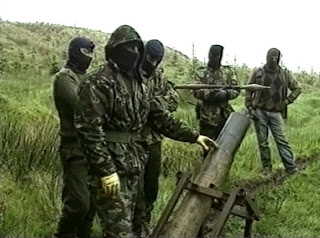
The Irish Republican Army, also known as the Provisional Irish Republican Army, and informally as the Provos, was an Irish republican paramilitary organisation that sought to end British rule in Northern Ireland, facilitate Irish reunification and bring about an independent republic encompassing all of Ireland. It was the most active republican paramilitary group during the Troubles. It saw itself as the army of the all-island Irish Republic and as the sole legitimate successor to the original IRA from the Irish War of Independence. It was designated a terrorist organisation in the United Kingdom and an illegal organisation in the Republic of Ireland, both of whose authority it rejected.
Sinn Féin is an Irish republican and democratic socialist political party active in both the Republic of Ireland and Northern Ireland.

The Troubles was an ethno-nationalist conflict in Northern Ireland during the late 20th century. Also known internationally as the Northern Ireland conflict, it is sometimes described as an "irregular war" or "low-level war". The conflict began in the late 1960s and is usually deemed to have ended with the Good Friday Agreement of 1998. Although the Troubles mostly took place in Northern Ireland, at times the violence spilled over into parts of the Republic of Ireland, England, and mainland Europe.
The United Kingdom of Great Britain and Northern Ireland, commonly known as the United Kingdom or Britain, is a sovereign country located off the northwestern coast of the European mainland. The United Kingdom includes the island of Great Britain, the northeastern part of the island of Ireland, and many smaller islands. Northern Ireland shares a land border with the Republic of Ireland. Otherwise, the United Kingdom is surrounded by the Atlantic Ocean, with the North Sea to the east, the English Channel to the south and the Celtic Sea to the southwest, giving it the 12th-longest coastline in the world. The Irish Sea separates Great Britain and Ireland. The total area of the United Kingdom is 94,000 square miles (240,000 km2).

Ireland is an island in the North Atlantic. It is separated from Great Britain to its east by the North Channel, the Irish Sea, and St George's Channel. Ireland is the second-largest island of the British Isles, the third-largest in Europe, and the twentieth-largest on Earth.

The Irish War of Independence or Anglo-Irish War was a guerrilla war fought in Ireland from 1919 to 1921 between the Irish Republican Army and British forces: the British Army, along with the quasi-military Royal Irish Constabulary (RIC) and its paramilitary forces the Auxiliaries and Ulster Special Constabulary (USC). It was part of the Irish revolutionary period.

The Irish are an ethnic group and nation native to the island of Ireland, who share a common Irish ancestry, identity and culture. Ireland has been inhabited for about 12,500 years according to archaeological studies. For most of Ireland's recorded history, the Irish have been primarily a Gaelic people. From the 9th century, small numbers of Vikings settled in Ireland, becoming the Norse-Gaels. Anglo-Normans conquered parts of Ireland in the 12th century, while England's 16th/17th-century conquest and colonisation of Ireland brought many English and Lowland Scots people to parts of the island, especially the north. Today, Ireland is made up of the Republic of Ireland and the smaller Northern Ireland. The people of Northern Ireland hold various national identities including British, Irish, Northern Irish or some combination thereof.

The GAA Hurling All-Ireland Senior Championship, known simply as the All-Ireland Championship, is an annual inter-county hurling competition organised by the Gaelic Athletic Association (GAA). It is the highest inter-county hurling competition in Ireland, and has been contested every year except one since 1887.
The Notre Dame Fighting Irish football team is the intercollegiate football team representing the University of Notre Dame in South Bend, Indiana. The team is coached by Brian Kelly and plays its home games at the campus's Notre Dame Stadium, which has a capacity of 77,622. Notre Dame is one of six schools that competes as an Independent at the National Collegiate Athletic Association (NCAA) Football Bowl Subdivision (FBS) level; however, they play five games a year against opponents from the Atlantic Coast Conference (ACC), of which Notre Dame is a member in all other sports except ice hockey. Notre Dame football is competing as an ACC member for the 2020 FBS season.
The Irish Republican Army (IRA) is a name used by various paramilitary organisations in Ireland throughout the 20th and the 21st centuries. Organisations going by this name have been dedicated to irredentism through Irish republicanism, the belief that all of Ireland should be an independent republic free from British rule. The original Irish Republican Army was raised in 1917 from members of the Irish Volunteers and the Irish Citizen Army, later reinforced by Irishmen who returned to Ireland to fight against Britain in the Irish War of Independence. In Irish law, this IRA was the army of the revolutionary Irish Republic as declared by its parliament, Dáil Éireann, in 1919. In the century that followed, the original IRA was reorganised, changed and split on multiple occasions, to such a degree that many subsequent paramilitary organisations have been known by that title – most notably the Provisional Irish Republican Army which was a key participant during the Troubles. The contemporary IRA organisations each claim the sole right to use that name, as they each insist they are the only legitimate descendants of the original IRA.
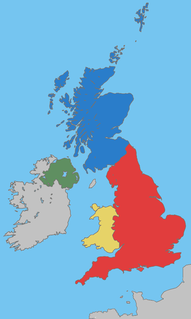
The United Kingdom of Great Britain and Northern Ireland (UK), since 1922, comprises four constituent countries: England, Scotland, and Wales, as well as Northern Ireland, which is variously described as a country, province or region.

Irish, also known in English as Gaelic, is a Goidelic language of the Insular Celtic branch of the Celtic language family, itself a part of the Indo-European language family. Irish originated on the island of Ireland and was the language of most of the population until the late 18th century. Although English has been the first language of most residents of the island since the early 19th century, Irish is spoken as a first language in broad areas of counties Galway, Kerry, Cork and Donegal, as well as smaller areas of Waterford, Mayo and Meath. It is also spoken by a larger group of habitual but non-traditional speakers, mostly in urban areas where the majority are second language speakers. Daily users outside the education system number around 73,000, and over 1.85 million people across the island claim some ability with the language.

The Good Friday Agreement (GFA), or Belfast Agreement, is a pair of agreements signed on 10 April 1998 that ended most of the violence of the Troubles, a political conflict in Northern Ireland that had ensued since the late 1960s. It was a major development in the Northern Ireland peace process of the 1990s. Northern Ireland's present devolved system of government is based on the agreement. The agreement also created a number of institutions between Northern Ireland and the Republic of Ireland, and between the Republic of Ireland and the United Kingdom.
References
 | This geographical article about County Cork is a stub. You can help Wikipedia by expanding it. |