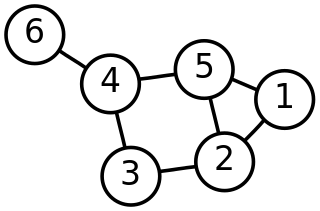
Discrete mathematics is the study of mathematical structures that are fundamentally discrete rather than continuous. In contrast to real numbers that have the property of varying "smoothly", the objects studied in discrete mathematics – such as integers, graphs, and statements in logic – do not vary smoothly in this way, but have distinct, separated values. Discrete mathematics therefore excludes topics in "continuous mathematics" such as calculus or Euclidean geometry. Discrete objects can often be enumerated by integers. More formally, discrete mathematics has been characterized as the branch of mathematics dealing with countable sets. However, there is no exact definition of the term "discrete mathematics." Indeed, discrete mathematics is described less by what is included than by what is excluded: continuously varying quantities and related notions.
Distributed computing is a field of computer science that studies distributed systems. A distributed system is a system whose components are located on different networked computers, which communicate and coordinate their actions by passing messages to one another from any system. The components interact with one another in order to achieve a common goal. Three significant characteristics of distributed systems are: concurrency of components, lack of a global clock, and independent failure of components. Examples of distributed systems vary from SOA-based systems to massively multiplayer online games to peer-to-peer applications.
In mathematics, graph theory is the study of graphs, which are mathematical structures used to model pairwise relations between objects. A graph in this context is made up of vertices which are connected by edges. A distinction is made between undirected graphs, where edges link two vertices symmetrically, and directed graphs, where edges link two vertices asymmetrically. Graphs are one of the principal objects of study in discrete mathematics.

A semantic network, or frame network is a knowledge base that represents semantic relations between concepts in a network. This is often used as a form of knowledge representation. It is a directed or undirected graph consisting of vertices, which represent concepts, and edges, which represent semantic relations between concepts, mapping or connecting semantic fields. A semantic network may be instantiated as, for example, a graph database or a concept map.
The Semantic Web is an extension of the World Wide Web through standards set by the World Wide Web Consortium (W3C). The goal of the Semantic Web is to make Internet data machine-readable.
The Resource Description Framework (RDF) is a family of World Wide Web Consortium (W3C) specifications originally designed as a metadata data model. It has come to be used as a general method for conceptual description or modeling of information that is implemented in web resources, using a variety of syntax notations and data serialization formats. It is also used in knowledge management applications.

A Petri net, also known as a place/transition (PT) net, is one of several mathematical modeling languages for the description of distributed systems. It is a class of discrete event dynamic system. A Petri net is a directed bipartite graph that has two types of elements, places and transitions, depicted as white circles and rectangles, respectively. A place can contain any number of tokens, depicted as black circles. A transition is enabled if all places connected to it as inputs contain at least one token. Some sources state that Petri nets were invented in August 1939 by Carl Adam Petri—at the age of 13—for the purpose of describing chemical processes.

A graphical model or probabilistic graphical model (PGM) or structured probabilistic model is a probabilistic model for which a graph expresses the conditional dependence structure between random variables. They are commonly used in probability theory, statistics—particularly Bayesian statistics—and machine learning.
Query languages or data query languages (DQLs) are computer languages used to make queries in databases and information systems.
RDF Schema is a set of classes with certain properties using the RDF extensible knowledge representation data model, providing basic elements for the description of ontologies. It uses various forms of RDF vocabularies, intended to structure RDF resources. RDF and RDFS can be saved in a triplestore, then one can entail some knowledge from them using a query language, like SPARQL.
A bigraph can be modelled as the superposition of a graph and a set of trees.
Commitment ordering (CO) is a class of interoperable serializability techniques in concurrency control of databases, transaction processing, and related applications. It allows optimistic (non-blocking) implementations. With the proliferation of multi-core processors, CO has also been increasingly utilized in concurrent programming, transactional memory, and software transactional memory (STM) to achieve serializability optimistically. CO is also the name of the resulting transaction schedule (history) property, defined in 1988 with the name dynamic atomicity. In a CO compliant schedule, the chronological order of commitment events of transactions is compatible with the precedence order of the respective transactions. CO is a broad special case of conflict serializability and effective means to achieve global serializability across any collection of database systems that possibly use different concurrency control mechanisms.
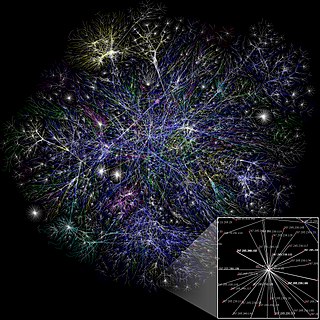
In the mathematical field of graph theory, the Erdős–Rényi model is either of two closely related models for generating random graphs or the evolution of a random network. They are named after Hungarian mathematicians Paul Erdős and Alfréd Rényi, who first introduced one of the models in 1959, while Edgar Gilbert introduced the other model contemporaneously and independently of Erdős and Rényi. In the model of Erdős and Rényi, all graphs on a fixed vertex set with a fixed number of edges are equally likely; in the model introduced by Gilbert, each edge has a fixed probability of being present or absent, independently of the other edges. These models can be used in the probabilistic method to prove the existence of graphs satisfying various properties, or to provide a rigorous definition of what it means for a property to hold for almost all graphs.
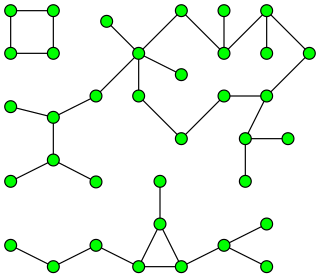
In graph theory, a pseudoforest is an undirected graph in which every connected component has at most one cycle. That is, it is a system of vertices and edges connecting pairs of vertices, such that no two cycles of consecutive edges share any vertex with each other, nor can any two cycles be connected to each other by a path of consecutive edges. A pseudotree is a connected pseudoforest.

A wait-for graph in computer science is a directed graph used for deadlock detection in operating systems and relational database systems.
A triplestore or RDF store is a purpose-built database for the storage and retrieval of triples through semantic queries. A triple is a data entity composed of subject-predicate-object, like "Bob is 35" or "Bob knows Fred".
The Architecture Design and Assessment System (ADAS) was a set of software programs offered by the Research Triangle Institute from the mid-1980s until the early 1990s.
In computing, a graph database (GDB) is a database that uses graph structures for semantic queries with nodes, edges, and properties to represent and store data. A key concept of the system is the graph. The graph relates the data items in the store to a collection of nodes and edges, the edges representing the relationships between the nodes. The relationships allow data in the store to be linked together directly and, in many cases, retrieved with one operation. Graph databases hold the relationships between data as a priority. Querying relationships is fast because they are perpetually stored in the database. Relationships can be intuitively visualized using graph databases, making them useful for heavily inter-connected data.
GSS is an RDF vocabulary for representation of data in a model of labeled directed graph. Using it will make a relatively complex data resource modeled in RDF, much easier to understand by declaring simple styling and visibility instructions to be applied on selected resources, literals and properties.
Cypher is a declarative graph query language that allows for expressive and efficient data querying in a property graph.

