
Free software is computer software distributed under terms that allow users to run the software for any purpose as well as to study, change, and distribute it and any adapted versions. Free software is a matter of liberty, not price; all users are legally free to do what they want with their copies of a free software regardless of how much is paid to obtain the program. Computer programs are deemed "free" if they give end-users ultimate control over the software and, subsequently, over their devices.
Freeware is software, most often proprietary, that is distributed at no monetary cost to the end user. There is no agreed-upon set of rights, license, or EULA that defines freeware unambiguously; every publisher defines its own rules for the freeware it offers. For instance, modification, redistribution by third parties, and reverse engineering are permitted by some publishers but prohibited by others. Unlike with free and open-source software, which are also often distributed free of charge, the source code for freeware is typically not made available. Freeware may be intended to benefit its producer by, for example, encouraging sales of a more capable version, as in the freemium and shareware business models.
An open-source license is a type of license for computer software and other products that allows the source code, blueprint or design to be used, modified and/or shared under defined terms and conditions. This allows end users and commercial companies to review and modify the source code, blueprint or design for their own customization, curiosity or troubleshooting needs. Open-source licensed software is mostly available free of charge, though this does not necessarily have to be the case.
Shareware is a type of proprietary software which is initially shared by the owner for trial use at little or no cost with usually limited functionality or incomplete documentation but which can be upgraded upon payment. Shareware is often offered as a download from a website or on a compact disc included with a magazine. Shareware differs from freeware, which is fully-featured software distributed at no cost to the user but without source code being made available; and free and open-source software, in which the source code is freely available for anyone to inspect and alter.
In computing, source code is any collection of code, with or without comments, written using a human-readable programming language, usually as plain text. The source code of a program is specially designed to facilitate the work of computer programmers, who specify the actions to be performed by a computer mostly by writing source code. The source code is often transformed by an assembler or compiler into binary machine code that can be executed by the computer. The machine code might then be stored for execution at a later time. Alternatively, source code may be interpreted and thus immediately executed.

Spyware is software with malicious behavior that aims to gather information about a person or organization and send it to another entity in a way that harms the user. For example, by violating their privacy or endangering their device's security. This behavior may be present in malware as well as in legitimate software. Websites may engage in spyware behaviors like web tracking. Hardware devices may also be affected. Spyware is frequently associated with advertising and involves many of the same issues. Because these behaviors are so common, and can have non-harmful uses, providing a precise definition of spyware is a difficult task.

A wiki is a hypertext publication collaboratively edited and managed by its own audience directly using a web browser. A typical wiki contains multiple pages for the subjects or scope of the project and could be either open to the public or limited to use within an organization for maintaining its internal knowledge base.
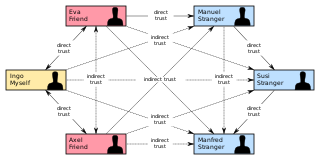
In cryptography, a web of trust is a concept used in PGP, GnuPG, and other OpenPGP-compatible systems to establish the authenticity of the binding between a public key and its owner. Its decentralized trust model is an alternative to the centralized trust model of a public key infrastructure (PKI), which relies exclusively on a certificate authority. As with computer networks, there are many independent webs of trust, and any user can be a part of, and a link between, multiple webs.
Beerware is a tongue-in-cheek term for software released under a very relaxed license. It provides the end user with the right to use a particular program.
nofollow is a setting on a web page hyperlink that directs search engines not to use the link for page ranking calculations. It is specified in the page as a type of link relation; that is: <a rel="nofollow" ...>. Because search engines often calculate a site's importance according to the number of hyperlinks from other sites, the nofollow setting allows web site authors to indicate that the presence of a link is not an endorsement of the target site's importance.
This is a comparison of free and open-source software licences. The comparison only covers software licences with a linked article for details, approved by at least one expert group at the FSF, the OSI, the Debian project or the Fedora project. For a list of licences not specifically intended for software, see List of free content licences.

WTFPL is a permissive free software license, compatible with the GNU GPL. As a public domain like license, the WTFPL is essentially the same as dedication to the public domain. It allows redistribution and modification of the work under any terms. The title is an abbreviation of "Do What The Fuck You Want To Public License".
In software development, effort estimation is the process of predicting the most realistic amount of effort required to develop or maintain software based on incomplete, uncertain and noisy input. Effort estimates may be used as input to project plans, iteration plans, budgets, investment analyses, pricing processes and bidding rounds.

Copyleft is the practice of granting the right to freely distribute and modify intellectual property with the requirement that the same rights be preserved in derivative works created from that property. Copyleft in the form of licenses can be used to maintain copyright conditions for works ranging from computer software, to documents, art, scientific discoveries and even certain patents.
Proprietary software, also known as non-free software or closed-source software, is computer software for which the software's publisher or another person reserves some rights from licenses to use, modify, share modifications, or share the software. It is the opposite of open-source or free software. Non-free software sometimes includes patent rights.

The GNU General Public License is a series of widely used free software licenses that guarantee end users the freedom to run, study, share, and modify the software. The licenses were originally written by Richard Stallman, founder of the Free Software Foundation (FSF), for the GNU Project, and grant the recipients of a computer program the rights of the Free Software Definition. The GPL series are all copyleft licenses, which means that any derivative work must be distributed under the same or equivalent license terms. This is in distinction to permissive software licenses, of which the BSD licenses and the MIT License are widely used, less restrictive examples. GPL was the first copyleft license for general use.

The GNU Free Documentation License is a copyleft license for free documentation, designed by the Free Software Foundation (FSF) for the GNU Project. It is similar to the GNU General Public License, giving readers the rights to copy, redistribute, and modify a work and requires all copies and derivatives to be available under the same license. Copies may also be sold commercially, but, if produced in larger quantities, the original document or source code must be made available to the work's recipient.
The zlib license is a permissive free software license which defines the terms under which the zlib software library can be distributed. It is also used by many other free software packages. The libpng library uses a similar license sometimes referred interchangeably as the zlib/libpng license.
Software categories are groups of software. They allow software to be understood in terms of those categories, instead of the particularities of each package. Different classification schemes consider different aspects of software.

Viv is an intelligent personal assistant software created by the developers of Siri. It debuted on May 9, 2016, at TechCrunch Disrupt New York. Compared to Siri, the software's platform is open and can accommodate external plug-ins written to work with the assistant. It can also handle more complex queries. The development team has been working on the software since 2012 and had raised over $22 million in funding by early 2015 and $30 million by early 2016.
