This page is based on this
Wikipedia article Text is available under the
CC BY-SA 4.0 license; additional terms may apply.
Images, videos and audio are available under their respective licenses.

Georg Wittig was a German chemist who reported a method for synthesis of alkenes from aldehydes and ketones using compounds called phosphonium ylides in the Wittig reaction. He shared the Nobel Prize in Chemistry with Herbert C. Brown in 1979.

Karl Waldemar Ziegler was a German chemist who won the Nobel Prize in Chemistry in 1963, with Giulio Natta, for work on polymers. The Nobel Committee recognized his "excellent work on organometallic compounds [which]...led to new polymerization reactions and ... paved the way for new and highly useful industrial processes". He is also known for his work involving free-radicals, many-membered rings, and organometallic compounds, as well as the development of Ziegler–Natta catalyst. One of many awards Ziegler received was the Werner von Siemens Ring in 1960 jointly with Otto Bayer and Walter Reppe, for expanding the scientific knowledge of and the technical development of new synthetic materials.

Johann Friedrich Wilhelm Adolf von Baeyer was a German chemist who synthesised indigo, developed a nomenclature for cyclic compounds. He was ennobled in the Kingdom of Bavaria in 1885 and was the 1905 recipient of the Nobel Prize in Chemistry.
Struve is a surname. Notable people with the surname include:
Schröter or Schroeter may refer to:

Heinrich Limpricht was a German chemist. Limpricht was a pupil of Friedrich Wöhler; he worked on the chemistry of furans and pyrroles, discovering furan in 1870.
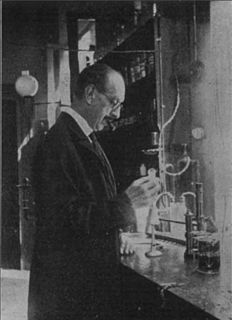
Ludwig Gattermann was a German chemist who contributed significantly to both organic and inorganic chemistry.

Karl Sebastian von Pfeufer was a German physician who was a native of Bamberg.

Johann Karl Wilhelm Ferdinand Tiemann was a German chemist and together with Karl Reimer discoverer of the Reimer-Tiemann reaction.
Gaertner or Gärtner is a German surname meaning "gardener". Notable people with the surname include:

Kunowsky is a crater in the Mare Acidalium quadrangle of Mars, located at 57.1° north latitude and 9.7° west longitude. It is 67.4 km in diameter and was named after Georg Karl Friedrich Kunowsky, a German astronomer (1786–1846). Because it lies on a large flat plain, Kunowsky is easy to spot on maps and pictures. It lies in the northern hemisphere just south of the very large crater Lomonosov.
T Scorpii, or Nova Scorpii 1860, was a nova in the globular cluster Messier 80. It was discovered on 21 May 1860 by Arthur von Auwers at Koenigsberg Observatory and was independently discovered by Norman Pogson on May 28th at Hartwell observatory. It was at magnitude 7.5 at discovery, reaching a maximum of magnitude 6.8, outshining the whole cluster.
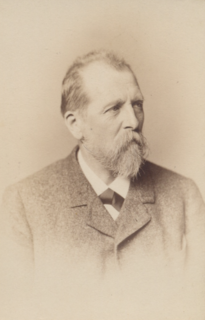
Ernst Wilhelm Hildebrand was a German painter. Many art websites mistakenly identify him as "Swiss".

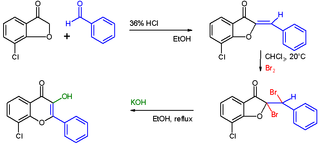
In chemistry, 3,3,4,4-tetramethyltetrahydrofuran-2,5-dione is a heterocyclic compound with the formula C
8H
12O
3, or (CH3)2(COC2COO)(CH3)2. It is a white crystalline solid with a pungent camphoraceous odor.