
Hagia Sophia, officially the Hagia Sophia Grand Mosque, is a mosque and major cultural and historical site in Istanbul, Turkey. The cathedral was a Greek Orthodox church from 360 AD until the conquest of Constantinople by the Ottoman Empire in 1453. It served as a mosque until 1935, when it became a museum. In 2020, the site once again became a mosque.
Byzantine architecture is the architecture of the Byzantine Empire, or Eastern Roman Empire.
Hagia Sophia is a UNESCO World Heritage Site in Istanbul, Turkey. It was built in 537 as the Greek Orthodox patriarchal cathedral, later becoming a Roman Catholic cathedral, then a Sunni mosque, then a museum. It currently functions as a mosque.

Fatih is a district of and a municipality (belediye) in Istanbul, Turkey, and home to almost all of the provincial authorities but not the courthouse. It encompasses the peninsula coinciding with old Constantinople. In 2009, the district of Eminönü, which had been a separate municipality located at the tip of the peninsula, was once again remerged into Fatih because of its small population. Fatih is bordered by the Golden Horn to the north and the Sea of Marmara to the south, while the Western border is demarked by the Theodosian wall and the east by the Bosphorus Strait.

Hagia Sophia is a formerly Greek Orthodox church which was converted into a mosque in 1584, and located in Trabzon, in the north-eastern part of Turkey. It was converted into a museum in 1964 and back into a mosque in 2013. It dates back to the thirteenth century when Trabzon was the capital of the Empire of Trebizond. It is located near the seashore and two miles west of the medieval town's limits. It is one of a few dozen Byzantine sites extant in the area. It has been described as being "regarded as one of the finest examples of Byzantine architecture."

Hagia Irene or Hagia Eirene, sometimes known also as Saint Irene, is an Eastern Orthodox church located in the outer courtyard of Topkapı Palace in Istanbul. It is the oldest known church in Istanbul and the only Byzantine church in Istanbul that has not been converted into a mosque, as it was used as an arsenal for storing weapons until the 19th century. The Hagia Irene today operates as a museum and concert hall.
The conversion of non-Islamic places of worship into mosques occurred during the life of Muhammad and continued during subsequent Islamic conquests and under historical Muslim rule. Hindu temples, Jain Temples, Christian churches, synagogues, and Zoroastrian fire temples have been converted into mosques.

Hagia Sophia in İznik (Nicaea) in Bursa Province, Turkey, was built as a Byzantine-era basilican church. Converted into the Orhan Mosque after the Ottoman conquest, it was turned into a museum in 1935. The church is now once again in service as a mosque. It is in the centre of town, within the old walled area.

Iznik is a town and an administrative district in the province of Bursa, Turkey. It used to be known as Nicaea, from which its modern name derives. The town lies in a fertile basin at the eastern end of Lake İznik, with ranges of hills to the north and south. As the crow flies, the town is only 90 kilometres southeast of Istanbul but by road it is 200 km around the Gulf of İzmit. It is 80 km by road from Bursa.
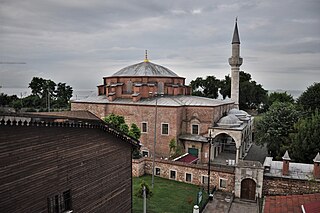
Little Hagia Sophia Mosque (church), formerly the Church of Saints Sergius and Bacchus, is a former Greek Eastern Orthodox church dedicated to Saints Sergius and Bacchus in Constantinople, built between 532 and 536, and converted into a mosque during the Ottoman Empire.
Islam is the largest religion in Turkey according to the state, with 99.8% of the population being initially registered by the state as Muslim, for anyone whose parents are not of any other officially recognised religion and the remaining 0.2% are Christians or adherents of other officially recognised religions like Judaism. Due to the nature of this method, the official number of Muslims include people with no religion; converted people and anyone who is of a different religion from their Muslim parents, but has not applied for a change of their individual records. These records can be changed or even blanked out on the request of the citizen, by filing an e-Government application since May 2020, using a valid electronic signature to sign the electronic application. Any change in religion records additionally results in a new ID card being issued. Any change in religion record also leaves a permanent trail in the census record, however, record of change of religion is not accessible except for the citizen in question, next-of-kin of the citizen in question, the citizenship administration and courts.

The Pammakaristos Church, also known as the Church of Theotokos Pammakaristos, is one of the most famous Byzantine churches in Istanbul, Turkey, and was the last pre-Ottoman building to house the Ecumenical Patriarchate. Converted in 1591 into the Fethiye Mosque, it is today partly a museum housed in a side chapel or parekklesion. One of the most important examples of Constantinople's Palaiologan architecture, the church contains the largest quantity of Byzantine mosaics in Istanbul after the Hagia Sophia and Chora Church.

The Hagia Sophia in Thessaloniki, Greece. With its current structure dating from the 7th century, the church is one of the oldest churches in the city still standing today. Because of its outstanding Byzantine art and architecture, in addition to its importance in early Christianity, it is one of several monuments in Thessaloniki listed as a UNESCO World Heritage Site in 1988.

Kalenderhane Mosque is a former Eastern Orthodox church in Istanbul, converted into a mosque by the Ottomans. With high probability the church was originally dedicated to the Theotokos Kyriotissa. The building is sometimes referred to as Kalender Haneh Jamissi and St. Mary Diaconissa. This building represents one among the few extant examples of a Byzantine church with domed Greek cross plan.

Soğukçeşme Sokağı is a small street with historic houses in the Sultanahmet neighborhood of Istanbul, Turkey, sandwiched in-between the Hagia Sophia and Topkapı Palace. The car-free zone street is named after the fountain situated at its end towards Gülhane Park.

Archbishop Elpidophoros of America is a bishop of the Ecumenical Patriarchate of Constantinople. On 22 June 2019 he became the Archbishop of the Greek Orthodox Archdiocese of America. The official title of Archbishop Elpidophoros: His Eminence Archbishop Elpidophoros (Lambriniadis) of America, Most Honorable Exarch of the Greek Orthodox Archdiocese of America. He is the eighth Archbishop of America elected since the establishment of the Greek Orthodox Archdiocese in 1922.

Gli was a Turkish European Shorthair cat from Istanbul best known for living in the Hagia Sophia, for which she became an Internet celebrity, grabbing the attention of visiting tourists. Gli was born in 2004 and was raised at Hagia Sophia. She gained significant media attention when the Hagia Sophia was re-opened to worship in 2020.

The Church of Hagia Sophia or Holy Wisdom is a Byzantine church in the medieval town of Monemvasia, Peloponnese, Greece. It forms part of the wider archaeological site of Monemvasia. It was built on the upper town of Monemvasia, and was originally dedicated to Panagia Hodegetria. It is the most important monument of Monemvasia. The Venetians, who held Monemvasia for some time, used it as a Catholic church dedicated to Madonna, while during the Ottoman period it was converted into a mosque before being restored to Christian worship upon Greece's independence in 1930.
