
Shams ud-Din Iltutmish was the third of the Mamluk kings who ruled the former Ghurid territories in northern India. He was the first Muslim sovereign to rule from Delhi, and is thus considered the effective founder of the Delhi Sultanate.
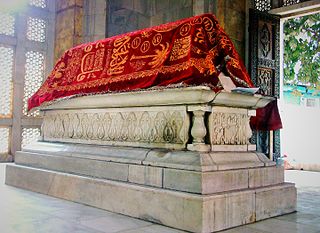
Qutb ud-Din Aibak, was a Turkic general of the Ghurid emperor Muhammad Ghori. He was in charge of the Ghurid territories in northern India, and after Muhammad Ghori's assassination in 1206, he established the Delhi Sultanate (1206–1526), and started the Mamluk dynasty, which would rule the Sultanate until 1290.

The Mamluk dynasty was a dynasty which ruled Delhi Sultanate from 1206 to 1290. It was the first of five unrelated dynasties to rule the Delhi Sultanate until 1526. Before the establishment of the Mamluk dynasty, Qutb al-Din Aibak's tenure as a Ghurid dynasty administrator lasted from 1192 to 1206, a period during which he led forays into the Gangetic plain and established control over some of the new areas.

Izz al-Din Aybak was the first of the Mamluk sultans of Egypt in the Turkic Bahri line. He ruled from 1250 until his death in 1257.
The Ghurid dynasty was a Persianate dynasty of presumably eastern Iranian Tajik origin, which ruled from the 8th-century to 1215. The Ghurids were centered in the hills of Ghor region in the present-day central Afghanistan, where they initially started out as local chiefs. They gradually converted to Sunni Islam after the conquest of Ghor by the Ghaznavid ruler Mahmud of Ghazni in 1011. The Ghurids eventually overran the Ghaznavids when Muhammad of Ghor seized Lahore and expelled the Ghaznavids from their last stronghold.

Aybak is a provincial town, medieval caravan stop, and the headquarters of the Samangan Province in the district of the same name in the northern part of Afghanistan. As an ancient town and major Buddhist centre during the 4th and 5th centuries under the then Kushan rulers, it has the ruins of that period at a place known now as Takht-i-rustam, which is located on a hill above the town.
Nāṣir ad-Dīn Maḥmūd was the eldest son of the Delhi Sultan Shamsuddin Iltutmish and his chief consort Turkan Khatun,, the daughter of Qutb ud-Din Aibak. He was, in all probabilities, the full brother of Razia Sultana. He was the governor of Awadh and later served as the governor of Bengal until his death in 1229. Then in 1230 the son of Iwaz Khalji, Balka Khalji declared himself as independent king of Bengal. Thus in 1231 Iltutmish marched against him and defeated him and made Alauddin Jani as the next governor of Bengal.
Aram Shah was the second Sultan of the Delhi Sultanate. He briefly held the throne from Lahore after the unexpected death of Qutb ud-Din Aibak before being defeated and dethroned by Iltutmish who began ruling from Delhi.
Nasir-ud-Din Qabacha or Kaba-cha was the Muslim governor of Multan, appointed by the Ghurid ruler Muhammad Ghori in 1203.

Ikhtiyār al-Dīn Muḥammad Bakhtiyār Khaljī, also known as Bakhtiyar Khalji, was a Turko-Afghan military general of the Ghurid ruler Muhammad of Ghor, who led the Muslim conquests of the eastern Indian regions of Bengal and Bihar and established himself as their ruler. He was the founder of the Khalji dynasty of Bengal, which ruled Bengal for a short period, from 1203 to 1227 CE.
Tughral Tughan Khan, later known as Mughith ad-Din Tughral, was an officer of the Delhi Sultanate. He governed Bengal during 1236-1246 CE and again during 1272-1281 CE.
Awar Khan Aibak was an usurper to the governorship of Bengal (Lakhnauti) under the Mamluk Sultan Iltutmish. His rule lasted in 1236 before effectively being overthrown and replaced by Tughral Tughan Khan.

Malik Saif ad-Dīn Aibak Yughantat was a governor of Bengal (Lakhnauti) under the Mamluk dynasty of Delhi from 1232 to 1236. He was the first of the slave-officers to govern Bengal.

Ḥusām ad-Dīn ʿIwaz bin Ḥusayn Khaljī, later known by his regnal title as Ghiyāth ad-Dīn ʿIwaz Shāh, was a two-time governor of Bengal under the Delhi Sultanate, and a member of the Khalji dynasty of Bengal. During his second term, lasting from 1212 to 1227, Khalji declared himself as an independent ruler of Bengal.
Muḥammad Shīrān Khaljī, or simply Shiran Khalji, was the second governor of the Khalji dynasty of Bengal, based in Lakhnauti, Bengal, from 1206 until 1208.
Feroz or Firuz is a Persian name meaning 'victorious', derived from the middle Persian name Peroz or Piruz. Related names are Phiroze, Feroze, and Parviz.
Sayf al-Din, also Saif al-Din, Sayf/Saif ad-Din, or Sayf/Saif ud-Din etc., may refer to:
The Khalji dynasty was the first Muslim dynasty to rule Bengal. The dynasty, which hailed from the Garmsir region of present-day Afghanistan, was founded in 1204 by Muhammad Bakhtiyar Khalji, a Muslim Turko-Afghan general of the Ghurid Empire. The Khaljis initially pledged allegiance to Sultan Muhammad of Ghor until his death in 1206, though their rule in Bengal was mostly independent. Under the rule of Iwaz Khalji, Bengal experienced major developments such as its first naval force, flood defence systems and linkage with the Grand Trunk Road. The dynasty was based in the city of Lakhnauti in northern Bengal, later expanding eastwards and southwards. Nasiruddin Mahmud, the son of Mamluk sultan Iltutmish of Delhi managed to conquer Bengal in 1227; although the Khaljis briefly reasserted their independence, they surrendered to the Mamluks in 1231, who replaced them with a series of regional governors.
Turkic peoples have historically been associated as one of the non-indigenous peoples to have ruled areas of the Indian subcontinent. Modern day Turkish people in India, on the other hand, are very small in number, and are recent immigrants from Turkey. In the 1961 census, 58 people stated that their mother tongue was Turkish. According to the 2001 census, 126 residents of India stated their place of birth as Turkey. In a state visit during early 2010, Prime Minister Abdullah Gül of Turkey met Turkish expatriates living in India and handed out Hindi-Turkish dictionaries to Turkish students in New Delhi.
