
Guadalupe Island is a volcanic island located 241 kilometres off the western coast of Mexico's Baja California Peninsula and about 400 km (200 nmi) southwest of the city of Ensenada in the state of Baja California, in the Pacific Ocean. The various volcanoes are extinct or dormant. In 2005 Guadalupe Island and its surrounding waters and islets were declared a biosphere reserve to restore its vegetation and to protect its population of marine mammals and birds. The island is a popular destination for great white shark cage diving. Guadalupe Island is inhabited only by scientists, military personnel operating a weather station, and a small group of seasonal fishermen. The island is mostly arid and has very little surface water.
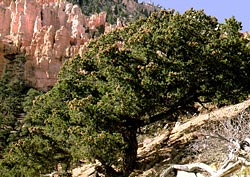
Pinus edulis, the Colorado pinyon, two-needle piñon, pinyon pine, or simply piñon, is a pine in the pinyon pine group whose ancestor was a member of the Madro-Tertiary Geoflora and is native to the United States.

Heart of palm is a vegetable harvested from the inner core and growing bud of certain palm trees, most notably the coconut, juçara, açaí palm, palmetto, and peach palm. Harvesting of many uncultivated or wild single-stemmed palms results in palm tree death. However, other palm species are clonal or multi-stemmed plants, and moderate harvesting will not kill the entire clonal palm. Heart of palm may be eaten on its own, and often it is eaten in a salad.

Sapote is a term for a soft, edible fruit. The word is incorporated into the common names of several unrelated fruit-bearing plants native to southern Mexico, Central America and northern parts of South America. It is also known in Caribbean English as soapapple.
Bullfrog is a common English language term to refer to large, aggressive frogs, regardless of species.

Brahea edulis, the Guadalupe palm or palma de Guadalupe, is a palm endemic to Guadalupe Island, Mexico, although a few stands have been planted elsewhere. It is a fan palm which grows 4.50 to 13 metres tall. It grows on the island between 400 and 1,000 metres above mean sea level (ASL), with this altitudinal zonation producing one of the few fog oases present in North America.

Archontophoenix cunninghamiana – commonly known as Bangalow palm, king palm, Illawara palm or piccabeen palm – is a tree in the palm family Arecaceae which is endemic to the east coast of New South Wales and Queensland, Australia.
Ice plant or iceplant may refer to:
Edulis, edible in Latin, is a species name present in a number of Latin species names:
Edule, edible in Latin, may refer to:

Euterpe edulis, commonly known as juçara, jussara, açaí-do-sul or palmiteiro, is a palm species in the genus Euterpe. It is now predominantly used for hearts of palm. It is closely related to the açaí palm, a species cultivated for its fruit and superior hearts of palm. The larvae of Caligo brasiliensis are reported to feed on E. edulis.

The Guadalupe Island Biosphere Reserve,, is located in the Pacific Ocean and is part of Baja California state of Mexico. The Reserve consists of Guadalupe Island and several small islands nearby plus a large expanse of surrounding ocean. The Reserve was created by the government of Mexico on 25 April 2005 and is located 250 kilometres (160 mi) from the mainland. The Reserve is 4,770 square kilometres (1,840 sq mi) in size of which 263 square kilometres (102 sq mi) is land and the remainder is water.
This page is based on this
Wikipedia article Text is available under the
CC BY-SA 4.0 license; additional terms may apply.
Images, videos and audio are available under their respective licenses.
