
Ultra high frequency (UHF) is the ITU designation for radio frequencies in the range between 300 megahertz (MHz) and 3 gigahertz (GHz), also known as the decimetre band as the wavelengths range from one meter to one tenth of a meter. Radio waves with frequencies above the UHF band fall into the super-high frequency (SHF) or microwave frequency range. Lower frequency signals fall into the VHF or lower bands. UHF radio waves propagate mainly by line of sight; they are blocked by hills and large buildings although the transmission through building walls is strong enough for indoor reception. They are used for television broadcasting, cell phones, satellite communication including GPS, personal radio services including Wi-Fi and Bluetooth, walkie-talkies, cordless phones, and numerous other applications.
Code of Federal Regulations, Title 47, Part 15 is an oft-quoted part of Federal Communications Commission (FCC) rules and regulations regarding unlicensed transmissions. It is a part of Title 47 of the Code of Federal Regulations (CFR), and regulates everything from spurious emissions to unlicensed low-power broadcasting. Nearly every electronics device sold inside the United States radiates unintentional emissions, and must be reviewed to comply with Part 15 before it can be advertised or sold in the US market.
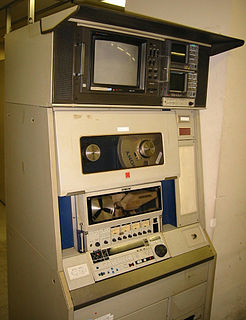
1–inch Type C is a professional reel-to-reel analog recording helical scan videotape format co-developed and introduced by Ampex and Sony in 1976. It became the replacement in the professional video and broadcast television industries for the then-incumbent 2–inch quadruplex videotape open-reel format. Additionally, it replaced the unsuccessful type A format, also invented by Ampex, and, primarily in mainland Europe, it supplemented the type B format, invented by the Fernseh division of Bosch, but it was replaced by type C format also there.
The FM broadcasting in India began in 1977, but boomed after 2001 when the privatisation of FM broadcasting began. AIR's FM LRS was inaugurated on 1 July 2001 at 14:28 hours in Kodaikanal in the frequency 100.5 MHz. The Two Radio Persons Dr.Musiri.T.A.Veerasamy and B.Rajaram made 100.5 popular and the LRS was upgraded to a " METRO FM " Channel in just two months. The channel covered a radius of about 200 km due to its location at 2200 meters above MSL at Kodaikanal. Later, the stalwarts like Supra in 2002 and Maha Somaskandamoorthy in 2003 have joined KODAI FM, as it is popularly known. It is the biggest individual FM channel in India in both area coverage and listenership.
International standard ISO/IEC 11801Information technology — Generic cabling for customer premises specifies general-purpose telecommunication cabling systems that are suitable for a wide range of applications. It covers both balanced copper cabling and optical fibre cabling.

KHTB is a commercial FM radio station licensed to Provo, Utah, and serving the Salt Lake City metropolitan area. It is owned by Cumulus Media and broadcasts a Top 40 - CHR radio format, simulcast with 94.9 KENZ Provo. The radio studios are in South Salt Lake, near the I-15/I-80 interchange.

KJHM is a commercial FM radio station licensed to Watkins, Colorado, and serving the Denver metropolitan area. It is owned by Max Media and airs a Rhythmic oldies format branded as "Jammin' 101.5". Its studios are located on Parker Road in Aurora.
IEEE 802.11g-2003 or 802.11g is an amendment to the IEEE 802.11 specification that operates in the 2.4 GHz microwave band. The standard has extended throughput to up to 54 Mbit/s using the same 20MHz bandwidth as 802.11b uses to achieve 11 Mbit/s. This specification under the marketing name of Wi-Fi has been implemented all over the world. The 802.11g protocol is now Clause 19 of the published IEEE 802.11-2007 standard, and Clause 19 of the published IEEE 802.11-2012 standard.
WKES is a non-commercial, listener-supported FM radio station broadcasting a Christian talk and teaching radio format. Licensed to Lakeland, Florida, it serves the Tampa Bay area from its studios at Keswick Christian School in Seminole. The station is owned by the Moody Bible Institute of Chicago and features programming from Moody Radio.

WLXX is a commercial FM radio station licensed to Richmond, Kentucky, and serving the Lexington metropolitan area. The station simulcasts an adult hits radio format with WCYN-FM Cynthiana, Kentucky. The two stations are owned by Cumulus Media. They subscribe to the nationally syndicated JACK FM radio service, using the slogan "Playing What We Want!" The playlist is mostly rock hits from the 1980s, 90s and early 2000s, but includes pop and novelty hits from the last 50 years. Unlike most music stations, WLXX and WCYN-FM do not have DJs, but use the prerecorded voice of Howard Cogan to make humorous and sometimes sarcastic quips. The station Program Director is Patrick Scott.
MVS Radio are a group of four international Spanish radio networks owned by the mass media conglomerate MVS Comunicaciones. The group of radio networks consists of Exa FM, La Mejor, FM Globo and MVS Noticias and are broadcast in a various Latin American countries including Argentina, Costa Rica, Ecuador, El Salvador, Honduras, Mexico, Panama and the United States.

WXKB is a commercial radio station licensed to Cape Coral, Florida, broadcasting to Fort Myers and Southwest Florida. WXKB is owned by the Beasley Broadcast Group and airs a Top 40 music format branded as "B-103.9 All the Hits", sometimes called "The Killer B."
This is a list of smartphones manufactured by Acer. They either run Android or Windows Mobile.

988 FM is a Malaysian Chinese-language radio station. Its broadcast area covers West Malaysia and Singapore. It is managed by Star Rfm Sdn Bhd, a wholly owned subsidiary of Star Publications (M) Bhd. 988 began broadcasting in 1996 as a trilingual radio station, with 50% Chinese content and became a fully-fledged radio station in December 1997. In a listenership surveys conducted by GfK between August and September 2015, 988 FM commanded a weekly listenership of 1.7 million, an expansion by 30%. It is the number one Chinese-language station in the northern region of West Malaysia.
Long Term Evolution (LTE) telecommunications networks use several frequency bands with associated bandwidths.

MOR Entertainment, formerly known as MOR Philippines, is a national brand of new media radio stations operated by media conglomerate ABS-CBN Corporation. As an on-air entity, MOR stations primarily played contemporary middle-of-the-road and original Pinoy music, as well as radio drama and talk content. MOR started in 2001 as the FM brand of ABS-CBN Regional and terrestrially operated 15 radio stations in the Philippines.
Frequency bands for 5G New Radio, which is the air interface or radio access technology of the 5G mobile networks, are separated into two different frequency ranges. First there is Frequency Range 1 (FR1), which includes sub-6 GHz frequency bands, some of which are traditionally used by previous standards, but has been extended to cover potential new spectrum offerings from 410 MHz to 7125 MHz. The other is Frequency Range 2 (FR2), which includes frequency bands from 24.25 GHz to 52.6 GHz.

