
Nihon-buyō refers to the classical Japanese performing art of dance.
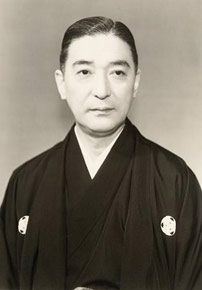
Bandō Mitsugorō VIII was one of Japan's most revered kabuki actors from the 1930s until his death. He was a renowned tachiyaku and katakiyaku, specializing in particular in the aragoto style. He was officially designated as a "Living National Treasure" by the Japanese government in 1973.

Bandō Tamasaburō V is a Kabuki actor and the most popular and celebrated onnagata currently on stage. He has also acted in several films.

Bandō Tamasaburō is a stage name taken on by a series of kabuki actors of the Bandō family. Of the five who have held this name, most were adopted into the lineage. Many members of the Bandō family were also adopted or blood members of the Morita family, who established and ran the Morita-za theatre in Edo.

Bandō Shūka I, also known as Bandō Tamasaburō I, was a Japanese Kabuki actor, and the first in the lineage to hold each of the stage-names Shūka and Tamasaburō.

Aragoto (荒事), or 'rough style', is a style of kabuki acting that uses exaggerated, dynamic kata and speech. Aragoto roles are characterised by the bold red or blue makeup worn by actors, as well as their enlarged and padded costumes. The term "aragoto" is an abbreviation of the term "aramushagoto", which literally means "wild-warrior style".

Bandō Mitsugorō III (1773–1831) was a prominent male kabuki actor. He was considered one of the best tachiyaku of the early 19th century. He is famous for a great many roles, and for his rivalry with the Kamigata (Kyoto-Osaka) actor Nakamura Utaemon III.

Nakamura Kankurō VI is a Japanese kabuki and film and television actor. Born Masayuki Namino, he is the eldest son of actor Nakamura Kanzaburō XVIII and the older brother of Nakamura Shichinosuke II. He is a well-known tachiyaku actor just like his father Kanzaburō XVIII and his younger brother Shichinosuke II.
Shunsen Natori was a Japanese woodblock printer, considered by many to be the last master in the art of kabuki yakusha-e "actor pictures".
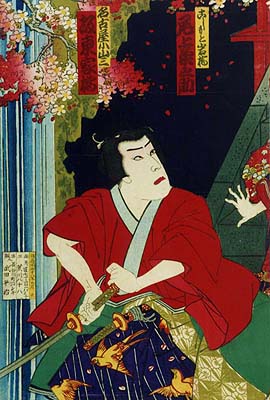
Bandō Kakitsu I was a Japanese kabuki actor of the Uzaemon acting lineage, also commonly known as Ichimura Uzaemon XIV. He was an influential actor during the Kaei through Meiji eras of the Japanese imperial calendar. He is best known for his wagotoshi roles.

Morita Kan'ya XIV was a Japanese kabuki actor. He was a tachiyaku actor, specializing in playing the roles of young, handsome lovers in the wagoto style, a type of role known as nimaime. Kan'ya is also known for his early postwar film career, and as the adoptive father of Bandō Tamasaburō V, the most famous and popular onnagata of today.

Onnagata, also oyama (女形), are male actors who play female roles in kabuki theatre.
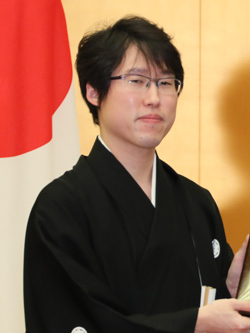
Yūta, Yuta or Yuuta is a common masculine Japanese given name.
Bandō Mitsugorō X was a Japanese television presenter and kabuki actor. He was the grandson of Bandō Mitsugorō VIII and son of Bandō Mitsugorō IX.

Bandō Mitsugorō IX was a Kabuki actor. He was the son-in-law of Bandō Mitsugorō VIII and the father of Bandō Mitsugorō X. He was married to Bando Mitsugoro VIII's oldest daughter, Yoshiko, in 1955. He took his stage name after the death of his father-in-law in 1975.

Bandō Mitsugorō VII was a Japanese kabuki actor. He was the adopted father of Bandō Mitsugorō VIII. He was officially designated a living national treasure by the Japanese government. He was a recipient of the Person of Cultural Merit and a member of the Japan Art Academy.
Bandō Minosuke II is a Japanese actor, kabuki actor, and the leading bassist of buyō Bandō-ryū. His real name is Mitsuhisa Morita. He is the current and second holder of the Kabuki name "Bandō Minosuke". Yamatoya is his yagō and Mitsudai is his family crest. He is represented by the Horipro Booking Agency.

Hiroshi Hasebe is the professional pseudonym of Makoto Matsuno, a Japanese theatre critic and professor at Tokyo University of the Arts.
Yuta Bando is a Japanese long-distance runner.
Yuta Bandoh, also known as Taku Matsushiba (松司馬拓), is a Japanese composer. He is best known for his work on Belle (2021), Yuri on Ice (2016), Kaiju No. 8 (2024), and Poupelle of Chimney Town (2020), as well as his collaborations with Kenshi Yonezu. Bandoh won the 45th Japan Academy Film Prize for Outstanding Achievement in Music for his work on Belle.
This page is based on this
Wikipedia article Text is available under the
CC BY-SA 4.0 license; additional terms may apply.
Images, videos and audio are available under their respective licenses.
