Bangkok gubernatorial election, 2008

Last updated
Bangkok gubernatorial election, 2008
Flag of Bangkok.svg
  2004 October 5, 2008 (2008-10-05) 2009  
Turnout 54.18%

  APIRAK AKI2.png
Candidate Apirak Kosayothin Prapas Chongsa-nguan
Party Democrat People's Power
Popular vote991,018543,488
Percentage45.93%25.19%

Bangkok gubernatorial election 2008 by district.svg
Gubernatorial election results map. Blue denotes districts won by Kosayothin

Governor before election

Apirak Kosayothin
Democrat

Elected Governor

Apirak Kosayothin
Democrat

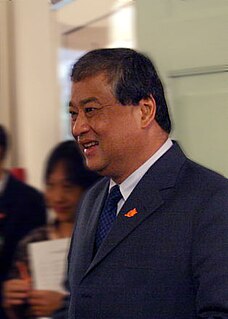
The eighth gubernatorial election for the city of Bangkok, Thailand, was held on 5 October 2008. The election was won by the incumbent Governor Apirak Kosayothin, placing him in his second consecutive four-year term in office, winning 45.93 percent of the vote. Of a total of 4,087,329 eligible voters, 2,214,320 voted, giving a turnout rate of 54.18 percent, lower than the 70 percent target expected by the Election Committee.

A governor is, in most cases, a public official with the power to govern the executive branch of a non-sovereign or sub-national level of government, ranking under the head of state. In federations, governor may be the title of a politician who governs a constituent state and may be either appointed or elected. The power of the individual governor can vary dramatically between political systems, with some governors having only nominal or largely ceremonial power, while others having a complete control over the entire government.

Election process by which a population chooses an individual to hold public office

An election is a formal group decision-making process by which a population chooses an individual to hold public office. Elections have been the usual mechanism by which modern representative democracy has operated since the 17th century. Elections may fill offices in the legislature, sometimes in the executive and judiciary, and for regional and local government. This process is also used in many other private and business organizations, from clubs to voluntary associations and corporations.
Bangkok Special administrative area in Thailand

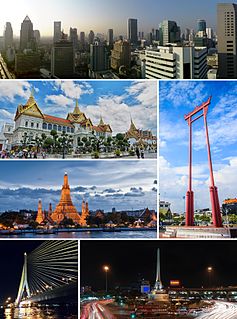
Bangkok is the capital and most populous city of Thailand. It is known in Thai as Krung Thep Maha Nakhon or simply Krung Thep. The city occupies 1,568.7 square kilometres (605.7 sq mi) in the Chao Phraya River delta in central Thailand, and has a population of over eight million, or 12.6 percent of the country's population. Over fourteen million people lived within the surrounding Bangkok Metropolitan Region at the 2010 census, making Bangkok the nation's primate city, significantly dwarfing Thailand's other urban centres in terms of importance.

Contents

Sixteen candidates contested the election. Mr Apirak, candidate for the opposition Democrat Party, was seen as the favourite. Other candidates included Chuwit Kamolvisit, a former massage parlour businessman who also ran in the 2004 election, Prapas Chongsa-nguan, former governor of the Mass Rapid Transit Authority of Thailand and candidate for the People's Power Party, Kriengsak Chareonwongsak, an academic and professor in business administration, and Leena Jangjanja, a businesswoman and lawyer who ran in the previous election and the 2006 senate election.

The Democrat Party is a Thai political party. The oldest party in Thailand, it was founded as a conservative and royalist party, and now upholds a conservative-liberal and classically liberal pro-market position.

Chuwit Kamolvisit Thai politician

Chuwit Kamolvisit is a controversial Thai politician who was once the country's biggest massage parlour owner, known as the "tub tycoon". After an arrest in 2003, he publicly claimed that he paid large bribes to many Thai police officers. He then sold some of his massage parlors, formed his own political party and unsuccessfully ran for Bangkok governor in August 2004. In 2005 he was elected for a four-year term to the Thai House of Representatives, but in 2006 the Constitutional Court removed him from parliament. In October 2008 he again ran for governor of Bangkok as an independent but was not elected. In the July 2011 general election his party won four seats in the House of Representatives. He used the pseudonym Davis Kamol on occasion.

Mass Rapid Transit Authority of Thailand

The Mass Rapid Transit Authority of Thailand is a government agency under the Ministry of Transport of Thailand. It is responsible the operation of rapid transit systems in the Bangkok Metropolitan Region and including other provinces as defined by the royal decree. The MRTA was founded in 1992 and underwent restructuring in 2000. The MRTA oversees the operation of the BTS outside Bangkok areas and MRT, which consists of the operational Blue Line and Purple Line. Other systems, including the Airport Rail Link, are owned and operated by other agencies.

The sixth elected governor of Bangkok, Mr Apirak is the second to be elected to a second term, after Chamlong Srimuang, governor from 1985–1992, who was incidentally arrested at a polling station early on the election day, on charges of insurrection due to his role as leader of the People's Alliance for Democracy, a group which has staged protests and occupied Government House since August. [1]

Chamlong Srimuang Thai politician

Chamlong Srimuang is a Thai activist and former politician. A former general, he was a leader of the "Young Turks" military clique, founded and led the Palang Dharma Party, served for six years as governor of Bangkok, led the anti-military uprising of May 1992, and is a prominent member of the People's Alliance for Democracy, a group strongly opposed to former prime minister Thaksin Shinawatra. Chamlong had supported the military junta that overthrew Thaksin in a coup. A devout Buddhist and follower of the Santi Asoke sect, he is now celibate, a vegetarian, and claims to have no worldly possessions. Chamlong Srimuang received the Ramon Magsaysay Award in the category of Government Service in 1992.

Peoples Alliance for Democracy advocacy group

The People's Alliance for Democracy (PAD) also called the National Liberation Alliance - กลุ่มพันธมิตรกู้ชาติ, Klum Phanthamit Ku Chat, Thai Patriots Network or more commonly the Yellow Shirts - เสื้อเหลือง, Suea Lueang - is a Thai political movement and pressure group. It was originally a coalition of protesters against Thaksin Shinawatra, the former Prime Minister of Thailand. Its leaders included media-mogul Sondhi Limthongkul and Major General Chamlong Srimuang. The PAD was a chief player in the Thailand political crisis of 2005 to 2006, the 2008 crisis, and the Cambodian–Thai border stand-off. Its membership consisted mainly of ultra-royalist middle-class and working-class Bangkok residents and anti-Thaksin Southerners, supported by some factions of the Thai Army, some leaders of Democrat Party, and the members of the state-enterprise labor unions.

2008 Thai political crisis

Beginning in 2008, there was worsening conflict between the People's Alliance for Democracy (PAD) and the People's Power Party (PPP) governments of Prime Ministers Samak Sundaravej and Somchai Wongsawat. It was a continuation of the 2005–2006 political crisis, when PAD protested against the Thai Rak Thai (TRT) party government of Prime Minister Thaksin Shinawatra. PAD followers usually dressed in yellow, yellow being the royal color of King Bhumibol Adulyadej, and were called "yellow shirts". UDD followers, known as supporters of the deposed prime minister Thaksin Shinawatra, dressed in red and were widely called "red shirts".

Campaign

Mr Apirak's four-year term as governor ended on 28 August 2008. Applications for the post were accepted from 1 to 5 September, and the official list of candidates was announced on 11 September. Campaigning included public speeches by candidates, television interviews, campaign trucks announcing messages through loudspeakers, and most noticeably, a multitude of campaign posters erected on the pavements, some of which fell over and injured pedestrians and motorcyclists. [2]

The more unusual campaigning stunts included Mrs Leena's bathing in a canal to reflect the local population's experiences, which ended tragically when her campaign manager drowned. [3] Nearer to the election day, Mr Chuwit caused headline news by punching and kicking a television journalist after an interview. [4]

Mr Chuwit also filed complaints against Mr Apirak, claiming that the appearance of Mr Apirak's name on the Bangkok Metropolitan Administration's election publicity posters violated electoral law. [5] The case was accepted by the Bangkok Election Committee, but a final ruling by the Election Commission would not be heard until after the election.

Polling and results

Polling was organised by the Bangkok Metropolitan Administration under the supervision of the Bangkok Election Commission, with a total budget of over 154 million baht. Voting took place from 08:00 to 15:00 on 5 October at 6,337 polling stations across the fifty districts of the city. [6]

Exit polls by Assumption and Suan Dusit Rajabhat Universities indicated that Mr Apirak had won 44 to 52 percent of the vote by the time the polling stations closed. [7] The unofficial results, to be submitted to the Election Commission for approval, were announced by the Bangkok City Clerk on midnight.

Summary of Bangkok gubernatorial election results, 2008 [8]

e    d  
CandidateAffiliationVotes%Rank
1Kittisak ThirawisitIndependent2,1020.109
2 Kriengsak Chareonwongsak Independent260,05112.054
3Metta TemchamnarnMetta Tham Group2,1050.108
4Warawut ThanangkornIndependent2,7710.137
5 Apirak Kosayodhin Democrat Party 991,01845.931
6Sumet TanthanasirikulKrung Thep Phatthana Team1,0780.0511
7Leena JungjanjaIndependent6,2670.295
8 Chuwit Kamolvisit Independent340,61615.793
9Wittaya JangkobpattanaIndependent3,7590.176
10Prapas Chongsa-nguan People's Power Party 543,48825.192
11Popsak PanseethongIndependent8110.0413
12Toranee Rithee-thamdamrongIndependent8520.0412
13Udom ViboonteppachatIndependent6170.0314
14Vachiraporn AayooyuenPublic Party (Satharanachon)1,1400.0510
15Somchai PaiboonIndependent5030.0215
16Nipon SimprayoonIndependent4210.0216
Total2,157,599100
"No vote" ballots37,345
Voided ballots19,376
Total turnout2,214,320

Notes

  1. AFP 2008.
  2. Head 2008.
  3. Sinlapalavan & Kongdejsakda 2008.
  4. Wong-Anan 2008.
  5. Wancharoen & Glahan 2008.
  6. BMA 2008a
  7. TNA 2008.
  8. BMA 2008b.

Related Research Articles

1936 United States presidential election

The United States presidential election of 1936 was the thirty-eighth quadrennial presidential election, held on Tuesday, November 3, 1936. In the midst of the Great Depression, incumbent Democratic President Franklin D. Roosevelt defeated Republican Governor Alf Landon of Kansas. Roosevelt won the highest share of the popular and electoral vote since the largely uncontested 1820 election. The sweeping victory consolidated the New Deal Coalition in control of the Fifth Party System.

Elections in Thailand refers to the democratic process in which some parts of the Government of Thailand is selected. These include the House of Representatives of Thailand, the Senate of Thailand, local Administrations, Governorship of Bangkok and national referendums. Thailand has so far had 25 general elections since 1933; the last election was in 2014. Voting in elections in Thailand is compulsory. All elections in Thailand are regulated by the Election Commission of Thailand.

Apirak Kosayodhin Thai politician

Apirak Kosayodhin is a former Thai business executive and former governor of Bangkok. In the gubernatorial elections on August 29, 2004 he won with 40% of the votes. He was re-elected on October 6, 2008, in the gubernatorial elections with 45% of the vote, but he resigned a month later after being indicted on charges of corruption.

Elections for local councils in Bangkok were held in 2006.

After Thailand's April 2006 elections were declared invalid by the Constitutional Court, it was decided that new elections would be held on 15 October 2006. Due to delays in the nomination of a new election committee the election were likely to be moved to November, but then cancelled indefinitely after the military's overthrow of the Thai government.

2008 Angolan legislative election

Legislative elections were held in Angola on 5 and 6 September 2008, as announced by President José Eduardo dos Santos on 27 December 2007. They were the first since the 1992 general elections, which had led to the outbreak of the second phase of the Angolan Civil War, which continued until 2002.

Bradley effect theory about discrepancies between opinion polls and election results in the United States

The Bradley effect is a theory concerning observed discrepancies between voter opinion polls and election outcomes in some United States government elections where a white candidate and a non-white candidate run against each other. The theory proposes that some voters who intend to vote for the white candidate would nonetheless tell pollsters that they are undecided or likely to vote for the non-white candidate. It was named after Los Angeles Mayor Tom Bradley, an African-American who lost the 1982 California governor's race despite being ahead in voter polls going into the elections.

2009 Equatorial Guinean presidential election

A presidential election was held in Equatorial Guinea on November 29, 2009. Teodoro Obiang Nguema, who has been President of Equatorial Guinea since 1979, ran for another term and won re-election with 95.4% of the vote, according to official results. Opposition leader Plácido Micó Abogo placed second with 3.6%. However, international observers and the main opposition candidate questioned the legitimacy of this election, noting the poor management which created an unfriendly field for other candidates to take part, media manipulation and the unbalanced results.

Bangkok Art and Culture Centre Contemporary Art, museum in Pathum Wan, Bangkok

Bangkok Art and Culture Centre is a contemporary arts centre in Bangkok, Thailand. Art, music, theatre, film, design and cultural/educational events take place in its exhibition and performance spaces. The centre includes cafes, commercial art galleries, bookshops, craft shops, and an art library. It is intended as a venue for cultural exchange, giving Bangkok an operational base on the international art scene. The number of visitors has risen from 300,000 in BACC's first year in 2007 to 1.7 million visitors in 2017.

Bangkok Metropolitan Administration

The Bangkok Metropolitan Administration is the local government of Bangkok, which includes the capital of the Kingdom of Thailand. The government is composed of two branches: the executive and the legislative. The administration's roles are to formulate and implement policies to manage Bangkok. Its purview includes transport services, urban planning, waste management, housing, roads and highways, security services, and the environment.

2009 Bangkok gubernatorial election

The ninth gubernatorial election for the city of Bangkok, Thailand was held on the 11 January 2009. The election came about after the resignation of Apirak Kosayothin on the 13 November 2008, the incumbent who was only just re-elected a little more than a month. the resignation stemmed from an indictment by the National Counter Corruption Commission or NCCC, in which Apirak was indicted for the controversial 6.6 billion Baht fire-engine procurement contract. The former Prime Minister and former Bangkok Governor Samak Sundaravej was also found guilty in the same verdict. On the 13 November Apirak in front of television cameras announced his resignation saying: "Like the Democrat Party, I support a move that will perpetuate politics-for-people" at the same time maintaining his innocence and stating that his resignation should become an example of a change in Thai politics, his resignation triggered an automatic by-election. By the end of the 11 January 2009, Sukhumband was declared the winner of the race, becoming the 15th Governor of Bangkok.

2011 Thai general election election

A general election for the 24th House of Representatives took place throughout Thailand on Sunday, 3 July 2011, by virtue of the Royal Decree Dissolving the House of Representatives, 2554 BE (2011), which caused the House of Representatives to be dissolved on 10 May 2011.

Early general elections were held in Thailand on Sunday, 2 February 2014, after Prime Minister Yingluck Shinawatra asked King Bhumibol Adulyadej to dissolve parliament more than a year early owing to Thailand's political crisis. Voters elected a new House of Representatives, the lower house of the National Assembly. Voting was disrupted in 69 of 375 constituencies by the opposition that had called for a boycott. This made a re-run in several stages necessary, depending on the security situation in the affected districts. The first re-run date was on 2 March. Results were expected to be announced after voting had taken place in all parts of the country.

Rak Thailand Party

The Rak Thailand Party is a political party in Thailand. It was founded in 2011, by Chuwit Kamolvisit, a major massage parlor owner. In campaign for the 2011 general election, the party was noted for its anti-corruption and protest canvass, presenting leader Chuwit as the "Angry Man". Eventually and to Chuwit's own surprise, the party won 3.07% of the party-list votes and can occupy four of the 500 seats in the House of Representatives. The party's MPs will sit on the opposition benches, together with their colleagues of the Democrats.

2013 Bangkok gubernatorial election

The tenth election for the governorship of Bangkok took place on 3 March 2013. The election was won by incumbent governor MR Sukhumbhand Paribatra of the Democrat Party. Twenty-five candidates contested the election. Pol Gen Pongsapat Pongcharoen, representing the Pheu Thai Party, was regarded as the other major contender.

2013–2014 Thai political crisis

The 2013–2014 Thai political crisis was a period of political instability in Thailand. Anti-government protests took place between November 2013 and May 2014, organised by the People's Democratic Reform Committee (PDRC), a political pressure group led by former Democrat Party parliamentary representative (MP) Suthep Thaugsuban. The protests eventually resulted in the removal of incumbent Prime Minister Yingluck Shinawatra, a coup d'état, and the establishment of the military junta.

The year 2008 was the 227th year of the Rattanakosin Kingdom of Thailand. It was the 63rd year in the reign of King Bhumibol Adulyadej, and is reckoned as year 2551 in the Buddhist Era. Much of the year was spent under the 2008 Thai political crisis, which saw political protests leading to the dissolution of the ruling People's Power Party by the Constitutional Court.

References