
His Majesty's Paymaster General or HM Paymaster General is a ministerial position in the Cabinet Office of the United Kingdom. The position is currently held by Nick Thomas-Symonds of the Labour Party.
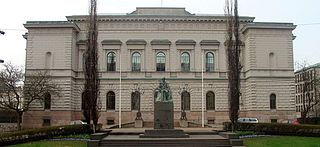
The Bank of Finland is the Finnish member of the Eurosystem and has been the monetary authority for Finland from 1865 to 1998, issuing the Finnish markka. It views itself as the fourth oldest surviving central bank in the world, after Sweden's Riksbank, the Bank of England, and the Bank of France, having been originally created in 1811-1812 as the Office of Exchange, Lending, and Deposits of the Grand Duchy of Finland before taking its current name in 1840. Unlike many other longstanding central banks, it has always been government-owned.
Westminster is an area within the City of Westminster, London, UK.
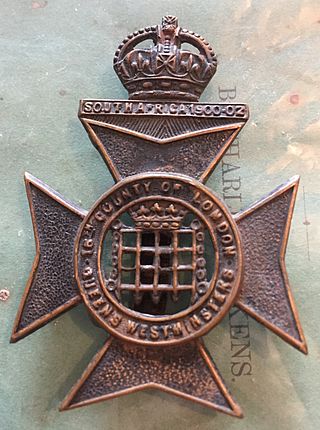
The Queen's Westminsters were an infantry regiment of the Territorial Army, part of the British Army. Originally formed from Rifle Volunteer Corps, which were established after a French invasion scare of 1859. The unit became part of the newly established London Regiment on the formation of the Territorial Force in 1908. It was subsequently amalgamated in 1921 with the Civil Service Rifles, and became a territorial Battalion of the King's Royal Rifle Corps in 1937. It ceased to exist as separate entity after it was amalgamated in 1961.

National Provincial Bank was a retail bank which operated in England and Wales. It was created in 1833 as National Provincial Bank of England, and expanded largely by taking over a number of other banks. Following the transformative acquisition of the Union Bank of London in 1918, it changed its name to National Provincial and Union Bank of England, then in 1924 shortened its name again to National Provincial Bank. It further acquired Coutts Bank in 1920, Grindlays Bank in 1924, Isle of Man Bank in 1961, District Bank in 1962, thus becoming one of the "Big Five" that dominated the UK banking sector for much of the 20th century, together with Barclays Bank, Lloyds Bank, Midland Bank and Westminster Bank. On 1 January 1970, it completed its merger with Westminster Bank to form National Westminster Bank.

Westminster Bank was a British retail bank which operated in England and Wales. It was created in 1834 as the London and Westminster Bank. It merged with the London and County Bank in 1909, after which it renamed itself the London County and Westminster Bank, then acquired the former business of Birkbeck Bank in 1911, Ulster Bank in 1917, and Parr's Bank in 1918, following which it changed its name again to London County Westminster and Parrs. It shortened its name to Westminster Bank in 1923.
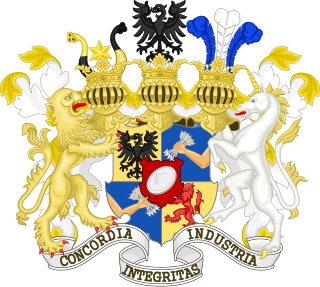
The Rothschild banking family of England is the English branch of the Rothschild family. It was founded in 1798 by Nathan Mayer Rothschild (1777–1836), who first settled in Manchester before moving to London, England, which was then part of the Kingdom of Great Britain. He was sent there from his home in Frankfurt by his father, Mayer Amschel Rothschild (1744–1812). Wanting his sons to succeed on their own and to expand the family business across Europe, Mayer Amschel Rothschild had his eldest son remain in Frankfurt, while his four other sons were sent to different European cities to establish a financial institution to invest in business and provide banking services. Nathan Mayer Rothschild, the third son, first established a textile jobbing business in Manchester and from there went on to establish N M Rothschild & Sons bank in London.
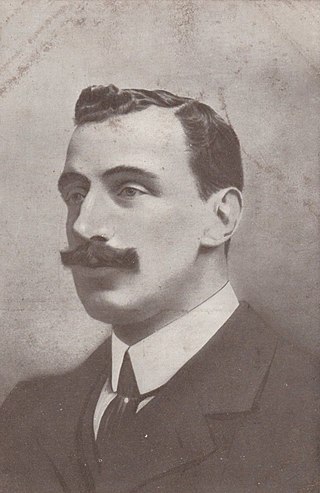
Sir William Gervase Beckett, 1st Baronet was a British banker and Conservative politician.
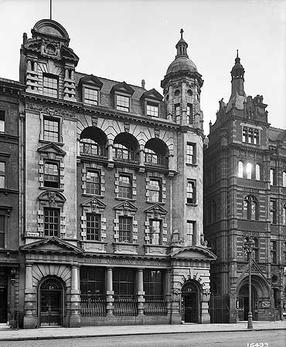
The historic overseas bank was established in London in 1828 as Leslie & Grindlay, agents and bankers to the British Army and business community in India. Banking operations expanded to include the Indian subcontinent, the Middle East and elements of Africa and Southeast Asia. It was styled Grindlay, Christian & Matthews in 1839, Grindlay & Co from 1843, Grindlay & Co Ltd from 1924 and Grindlays Bank Ltd in 1947 until its merger with the National Bank of India.
Maurice Elvey was one of the most prolific film directors in British history. He directed nearly 200 films between 1913 and 1957. During the silent film era he directed as many as twenty films per year. He also produced more than fifty films – his own as well as films directed by others.

Parr's Bank Limited was a bank that existed from 1782 to 1918. It was founded as Parr & Co. in Warrington, then in the county of Lancashire in the United Kingdom. In 1918 it was acquired by London County and Westminster Bank, and it was thus one of the predecessors of NatWest Group.

The Royal Air Force Memorial is a military memorial on the Victoria Embankment in central London, dedicated to the memory of the casualties of the Royal Air Force in World War I. Unveiled in 1923, it became a Grade II listed structure in 1958, and was upgraded to Grade II* in 2018. It is considered to be the official memorial of the RAF and related services.
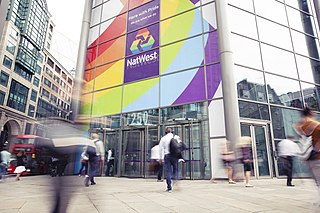
National Westminster Bank Public Limited Company, trading as NatWest, is a major retail and commercial bank in the United Kingdom based in London, England. It was established in 1968 by the merger of National Provincial Bank and Westminster Bank. In 2000, it became part of The Royal Bank of Scotland Group, which was re-named NatWest Group in 2020. Following ringfencing of the group's core domestic business, the bank became a direct subsidiary of NatWest Holdings; NatWest Markets comprises the non-ringfenced investment banking arm. As of November 2024, the British government currently owns 11.4% of NatWest Group after spending £45 billion ($61.87 billion) bailing out the lender in 2008; the proportion at one point was 54.7%. NatWest International is a trading name of RBS International, which also sits outside the ringfence.
William, Billy or Bill Lindsay may refer to:
The Bank of London and South America Limited was a British bank, which operated in South America between 1923 and 1971.
The Alliance Bank of Simla was a British-run though India-registered bank that commenced operations in Simla in 1874 under the management of James Lewis Walker. The bank was established to take over the business of the United Bank of India, established in 1866, which had operations in Simla and Umballa. Its board put the United Bank of India in voluntary liquidation on 21 March 1874, and Alliance Bank commenced operations two days later. After 49 years, Alliance Bank failed on 27 April 1923 due to speculation by its management. At the time that it failed it had 36 branches, including ones in Lahore, Lucknow, Peshawar, Rawalpindi, and Rangoon.

International Westminster Bank was a wholly-owned subsidiary of National Westminster Bank and its predecessors from 1913 to 1989, with branches in London, France, Spain and West Germany.

Moscow Narodny Bank Limited (MNB), London was created as an independent bank in October 1919 on the basis of the London branch or Mosnarbank (London) of the Moscow Narodny Bank, which had operated in London since 1915.
The Ideal Film Company was a British film production and distribution company that operated between 1911 and 1934.
National Westminster Bank of Canada, commonly known as NatWest Canada, was a wholly owned subsidiary of National Westminster Bank, a global integrated financial service group based in the United Kingdom, which operated from 1982 to 1998.
