The Nepalese rupee is the official currency of the Federal Democratic Republic of Nepal. The Nepalese rupee is subdivided into 100 paisa. The issuance of the currency is controlled by the Nepal Rastra Bank, the central bank of Nepal. The Nepalese rupee was introduced in 1932 when it replaced the Nepalese mohar at the rate 2:1.

The Bangladeshi taka is the currency of the People's Republic of Bangladesh. In Unicode, it is encoded at U+09F3৳.
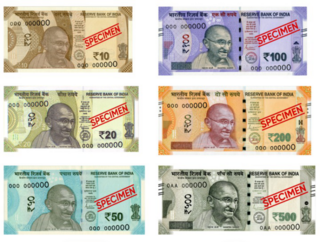
The Indian rupee is the official currency in the Republic of India. The rupee is subdivided into 100 paise. The issuance of the currency is controlled by the Reserve Bank of India. The Reserve Bank manages currency in India and derives its role in currency management on the basis of the Reserve Bank of India Act, 1934.
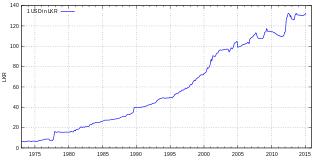
The Sri Lankan Rupee is the currency of Sri Lanka. It is subdivided into 100 cents, but cents are rarely seen in circulation due to its low value. It is issued by the Central Bank of Sri Lanka. The abbreviation Re (singular) and Rs (plural) is generally used, the World Bank suggests SL Rs as a fully disambiguating abbreviation for distinction from other currencies named "rupee".

The 10 Rupees Postage stamp depicting Mahatma Gandhi, issued by India in 1948, is one of India's most famous stamps. On 15 August 1948, on the occasion of the first anniversary of India's Independence Day, Gandhi was honored as the first Indian to be depicted on stamps of India. A set of 100 of these stamps was overprinted with the word "Service" and provided only to the Governor General of India for his official use. The 10 Rupees "Service" overprinted stamp is one of India's rarest and most highly valued stamps.
Between 1945 and 2007, Nepalese banknotes of Nepalese rupee were issued with the portraits of four different kings. Starting in October 2007 the king’s portrait was replaced by Mount Everest on all notes which have been issued since.
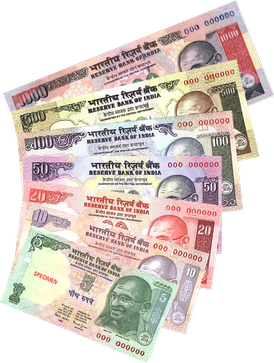
The Gandhi Series of banknotes are issued by the Reserve Bank of India (RBI) as the legal tender of Indian rupee. The series is so called because the obverse of the banknotes prominently display the portrait of Mahatma Gandhi. Since its introduction in 1996, this series replaced all Lion Capital Series banknotes issued before 1996. The Reserve Bank of India (RBI) introduced the series in 1996 with ₹10 and ₹500 banknotes.

The Indian 1000-rupee banknote is an obsolete denomination of the Indian rupee. It was first introduced by the Reserve Bank of India in 1938 under British rule and subsequently demonetized in 1946. Post-independence, the denomination was re-introduced in 1954. In January 1978, all high-denomination banknotes of ₹1000, ₹5000, and ₹10000 were demonetized in order to curb unaccounted cash money.
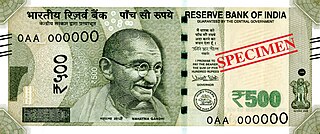
The Indian 500-rupee banknote is a denomination of the Indian rupee. In 1987, the ₹500 note was introduced, followed by the ₹1,000 note in the year 2000 while ₹1 and ₹2 notes were discontinued in 1995. The current ₹500 banknote, in circulation since 10 November 2016, is a part of the Mahatma Gandhi New Series. The previous banknotes of the Mahatma Gandhi Series, in circulation between October 1997 and November 2016, were demonetised on November 8, 2016.

The Indian 100-rupee banknote is a denomination of the Indian rupee. It has been in continuous production since Reserve Bank of India took over the functions of the controller of currency in India in 1935. The present ₹100 banknote in circulation is a part of the Mahatma Gandhi New Series.

The is a denomination of the Indian rupee. The present ₹50 banknote in circulation is a part of the Mahatma Gandhi New Series of banknotes. However, ₹50 banknotes of the previous series will continue to be legal tender.

The Indian 20-rupee banknote is a common denomination of the Indian rupee. The current ₹20 banknote in circulation is a part of the Mahatma Gandhi New Series. The Reserve Bank introduced the ₹20 note in the Mahatma Gandhi New Series in 2019, making it the last denomination to be introduced in the series.

The Indian 10-rupee banknote is a common denomination of the Indian rupee. The ₹10 note was one of the first notes introduced by the Reserve Bank of India as a part of the Mahatma Gandhi Series in 1996. These notes are presently in circulation along with the Mahatma Gandhi New Series which were introduced in January 2018, this is used alongside the 10 rupee coin.

The Reserve Bank of India (RBI), introduced the 2000 rupee note on November 8, 2016. The introduction of this high-value note was part of the government's demonetization exercise aimed at curbing corruption, black money, and counterfeit currency. On the same day, the Indian government announced the demonetization of the existing 500 rupee and 1000 rupee notes. The intention behind demonetization was to invalidate the old notes to disrupt illegal activities and promote a shift towards digital transactions.
The Mahatma Gandhi New Series of banknotes are issued by the Reserve Bank of India (RBI) as the legal tender of the Indian rupee, intended to replace the Mahatma Gandhi Series of banknotes. Announced on 8 November 2016, it followed the demonetisation of ₹500 and ₹1000 banknotes of the original Mahatma Gandhi Series. Similar to the preceding series of banknotes, the obverse of the Mahatma Gandhi New Series banknotes also prominently displays the portrait of Mahatma Gandhi. The logo of Swachh Bharat Abhiyan is also printed on the back of the banknotes of this series.

The Indian 200-rupee note (₹200) is a denomination of the Indian rupee. After the 2016 Indian banknote demonetisation, the new currency notes were announced by the Reserve Bank of India: ₹2,000, ₹500, ₹200, ₹100, ₹50, ₹20 and ₹10.

The Indian 5-rupee note is the second smallest Indian note in circulation. The Reserve Bank of India introduced the 5 rupee banknote as part of the Mahatma Gandhi Series in 1996. The printing of notes in the denominations of ₹5, however, has been discontinued as these denominations have been coinised.

The Lion Capital Series were a series of currency notes issued after India declared its independence from Great Britain and used until the Reserve Bank of India (RBI) introduced the Mahatma Gandhi Series in 1996 with banknotes in denominations of 10 and 500 rupees, and were designed with the image of the Lion Capital of Ashoka, the National Emblem which replaced the George VI banknote series. The first banknotes printed after India achieved its independence was a 1-rupee note.
