
The Western Front was the main theatre of war during the First World War. Following the outbreak of war in August 1914, the German Army opened the Western Front by invading Luxembourg and Belgium, then gaining military control of important industrial regions in France. The tide of the advance was dramatically turned with the Battle of the Marne. Following the Race to the Sea, both sides dug in along a meandering line of fortified trenches, stretching from the North Sea to the Swiss frontier with France, which changed little except during early 1917 and in 1918.

The Battle of the Somme, also known as the Somme Offensive, was a battle of the First World War fought by the armies of the British Empire and French Third Republic against the German Empire. It took place between 1 July and 18 November 1916 on both sides of the upper reaches of the River Somme in France. The battle was intended to hasten a victory for the Allies and was the largest battle of the war's Western Front. More than three million men fought in the battle and one million men were wounded or killed, making it one of the bloodiest battles in human history.
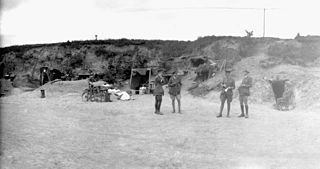
The Canadian Corps was a World War I corps formed from the Canadian Expeditionary Force in September 1915 after the arrival of the 2nd Canadian Division in France. The corps was expanded by the addition of the 3rd Canadian Division in December 1915 and the 4th Canadian Division in August 1916. The organization of a 5th Canadian Division began in February 1917 but it was still not fully formed when it was broken up in February 1918 and its men used to reinforce the other four divisions.

The Australian Corps was a World War I army corps that contained all five Australian infantry divisions serving on the Western Front. It was the largest corps fielded by the British Empire in France. At its peak the Australian Corps numbered 109,881 men. By 1918 the headquarters consisted of more than 300 personnel of all ranks, including senior staff officers, as well as supporting personnel such as clerks, drivers and batmen. Formed on 1 November 1917, the corps replaced I Anzac Corps while II Anzac Corps, which contained the New Zealand Division, became the British XXII Corps. While its structure varied it usually included 4–5 infantry divisions, corps artillery and heavy artillery, a corps flying squadron and captive balloon sections, anti-aircraft batteries, corps engineers, corps mounted troops, ordnance workshops, medical and dental units, transport, salvage and an employment company.

The Third Army was a field army of the British Army during World War I that saw active service on the Western Front throughout the war.

The Hundred Days Offensive was series of massive Allied offensives which ended the First World War. Beginning with the Battle of Amiens on the Western Front, the Allies pushed the Central Powers back after their gains from the Spring Offensive. The Germans eventually retreated to the Hindenburg Line, culminating in the Armistice of 11 November 1918 which ended the war with an Allied victory. The term "Hundred Days Offensive" does not refer to a battle or strategy, but rather the rapid series of Allied victories against which the German armies had no reply.

Corporal George Alfred Coppard MM (1898–1984) was a British soldier who served with the Machine Gun Corps during World War I. Following his retirement he published his memoirs entitled With A Machine Gun to Cambrai in 1969.

The Second Battle of the Somme of 1918 was fought during the First World War on the Western Front from late August to early September, in the basin of the River Somme. It was part of a series of successful counter-offensives in response to the German Spring Offensive, after a pause for redeployment and supply.
Canada's Hundred Days is the name given to the series of attacks made by the Canadian Corps between 8 August and 11 November 1918, during the Hundred Days Offensive of World War I. Reference to this period as Canada's Hundred Days is due to the substantial role that Canadian Corps played during the offensive.
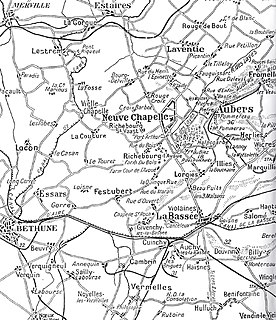
The Battle of Aubers Ridge was a British offensive on the Western Front on 9 May 1915 during World War I. The battle was part of the British contribution to the Second Battle of Artois, a Franco-British offensive intended to exploit the German diversion of troops to the Eastern Front. The French Tenth Army was to attack the German 6th Army north of Arras and capture Vimy Ridge, preparatory to an advance on Cambrai and Douai. The British First Army on the left (northern) flank of the Tenth Army, was to attack on the same day and widen the gap in the German defences expected to be made by the Tenth Army and to prevent German troops from being moved south of La Bassée canal.

The Drocourt-Quéant Line was a set of mutually supporting defensive lines constructed by Germany between the French towns of Drocourt and Quéant during World War I. This defensive system was part of the northernmost section of the Hindenburg Line, a vast German defensive system that ran through northeastern France.

The Battle of Canal du Nord was part of the Hundred Days Offensive of the First World War by the Allies against German positions on the Western Front. The battle took place in the Nord-Pas-de-Calais region of France, along an incomplete portion of the Canal du Nord and on the outskirts of Cambrai between 27 September and 1 October 1918. To prevent the Germans from sending reinforcements against one attack, the assault along the Canal du Nord was part of a sequence of Allied attacks at along the Western Front. The attack began the day after the Meuse-Argonne Offensive commenced, a day before an offensive in Belgian Flanders and two days before the Battle of St. Quentin Canal.
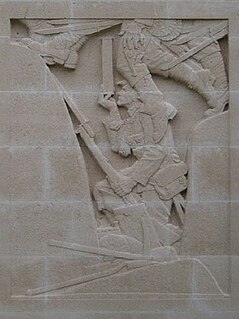
The Cambrai Memorial to the Missing is a Commonwealth War Graves Commission (CWGC) memorial for the missing soldiers of World War I who fought in the Battle of Cambrai on the Western Front.
This is a list of events from 1917 in France.

The use of horses in World War I marked a transitional period in the evolution of armed conflict. Cavalry units were initially considered essential offensive elements of a military force, but over the course of the war, the vulnerability of horses to modern machine gun and artillery fire reduced their utility on the battlefield. This paralleled the development of tanks, which would ultimately replace cavalry in shock tactics. While the perceived value of the horse in war changed dramatically, horses still played a significant role throughout the war.

The 25th Battalion, CEF was a unit in the Canadian Expeditionary Force during the Great War. It was the first of three to be raised entirely in Nova Scotia during the war. The 25th served in Belgium and France as part of the 5th Infantry Brigade, 2nd Canadian Division from 16 September 1915 until the end of the war. Regimental headquarters were established at the Halifax Armouries, with recruitment offices in Sydney, Amherst, New Glasgow, Truro and Yarmouth. Of the 1000 Nova Scotians that started with the battalion, after the first year of fighting, 100 were left in the battalion, while 900 men were killed, taken prisoner, missing or injured.


