
Year 451 (CDLI) was a common year starting on Monday of the Julian calendar. At the time, it was known as the Year of the Consulship of Marcianus and Adelfius. The denomination 451 for this year has been used since the early medieval period, when the Anno Domini calendar era became the prevalent method in Europe for naming years.

Year 274 (CCLXXIV) was a common year starting on Thursday of the Julian calendar. At the time, it was known as the Year of the Consulship of Aurelianus and Capitolinus. The denomination 274 for this year has been used since the early medieval period, when the Anno Domini calendar era became the prevalent method in Europe for naming years.

The Saône is a river in eastern France. It is a right tributary of the Rhône, rising at Vioménil in the Vosges department and joining the Rhône in Lyon, at the southern end of the Presqu'île.

Marne is a department in the Grand Est region of France. It is named after the river Marne which flows through it. The prefecture (capital) of Marne is Châlons-en-Champagne. The subprefectures are Épernay, Reims, and Vitry-le-François. It had a population of 566,855 in 2019.

Châlons-en-Champagne is a city in the Grand Est region of France. It is the capital of the department of Marne, despite being only a quarter the size of the city of Reims.

The Gallic Empire or the Gallic Roman Empire are names used in modern historiography for a breakaway part of the Roman Empire that functioned de facto as a separate state from 260 to 274. It originated during the Crisis of the Third Century, when a series of Roman military leaders and aristocrats declared themselves emperors and took control of Gaul and adjacent provinces without attempting to conquer Italy or otherwise seize the central Roman administrative apparatus.
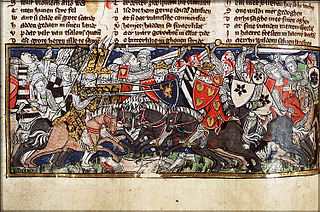
The Battle of the Catalaunian Plains, also called the Battle of the Campus Mauriacus, Battle of Châlons, Battle of Troyes or the Battle of Maurica, took place on June 20, 451 AD, between a coalition, led by the Roman general Flavius Aetius and the Visigothic king Theodoric I, against the Huns and their vassals, commanded by their king, Attila. It proved one of the last major military operations of the Western Roman Empire, although Germanic foederati composed the majority of the coalition army. Whether the battle was of strategic significance is disputed; historians generally agree that the siege of Aurelianum was the decisive moment in the campaign and stopped the Huns' attempt to advance any further into Roman territory or establish vassals in Roman Gaul. However, the Huns successfully looted and pillaged much of Gaul and crippled the military capacity of the Romans and Visigoths. Attila died only two years later, in 453; after the Battle of Nedao in 454 AD, the coalition of the Huns and the incorporated Germanic vassals gradually disintegrated.
Agricola, the Latin word for farmer, may also refer to:
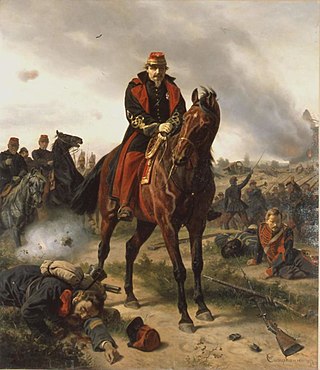
The Battle of Sedan was fought during the Franco-Prussian War from 1 to 2 September 1870. Resulting in the capture of Emperor Napoleon III and over a hundred thousand troops, it effectively decided the war in favour of Prussia and its allies, though fighting continued under a new French government.

Thorismund, became king of the Visigoths after his father Theodoric was killed in the Battle of the Catalaunian Plains in 451 CE. He was murdered in 453 and was succeeded by his brother Theodoric II.

The Free County of Burgundy was a medieval feudal state ruled by a count from 982 to 1678. It was also known as Franche-Comté, from French: franc comte meaning 'free count', and was located in the modern region of Franche-Comté. It bordered the Duchy of Burgundy to the west, which was part of France from 843.

Chalon-sur-Saône is a city in the Saône-et-Loire department in the region of Bourgogne-Franche-Comté in eastern France.
Gaius Memmius may refer to:
In the Battle of Châlons, fought in 274 on the site of modern Châlons-en-Champagne, France, Roman Emperor Aurelian defeated Emperor Tetricus I of the Gallic Empire, whose territories were rejoined with the Roman Empire after fourteen years of separation.
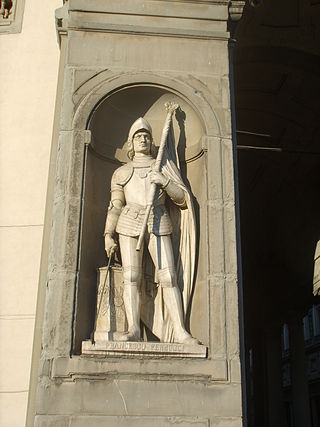
The Battle of Gavinana took place during the War of the League of Cognac. It was fought on 3 August 1530 between the city of Florence and the army of the Holy Roman Empire.

Les Hôpitaux-Vieux is a commune in the Doubs département in the Bourgogne-Franche-Comté region in eastern France.
William of Orange usually refers to either:
Renatus is a first name of Latin origin which means "born again".

The Guisborough Helmet is a Roman cavalry bronze helmet found in 1864 near Guisborough in the North Riding of Yorkshire, England. It was originally fitted with a pair of protective cheek-pieces, which have not survived; the holes by which they were attached can be seen in front of the helmet's ear guards. It is lavishly decorated with incised, punched and embossed figures, indicating that it was probably used for displays or cavalry tournaments, though it may well have been intended to be worn in battle as well. The helmet was found in what appears to have been a carefully arranged deposition in a bed of gravel, distant from any known Roman sites. After it was recovered during road works it was donated to the British Museum in London, where it was restored and is currently on display.
This page is based on this
Wikipedia article Text is available under the
CC BY-SA 4.0 license; additional terms may apply.
Images, videos and audio are available under their respective licenses.

