The Battle of Adrianople, in which Gothic rebels defeated the Eastern Roman Empire, was the main battle of the Gothic War (376–382).

Constantinople became the capital of the Roman Empire during the reign of Constantine the Great in 330. Following the collapse of the Western Roman Empire in the late 5th century, Constantinople remained the capital of the Eastern Roman Empire, the Latin Empire (1204–1261), and the Ottoman Empire (1453–1922). Following the Turkish War of Independence, the Turkish capital then moved to Ankara. Officially renamed Istanbul in 1930, the city is today the largest city in Europe, straddling the Bosporus strait and lying in both Europe and Asia, and the financial centre of Turkey.

Year 1453 (MCDLIII) was a common year starting on Monday of the Julian calendar, the 1453rd year of the Common Era (CE) and Anno Domini (AD) designations, the 453rd year of the 2nd millennium, the 53rd year of the 15th century, and the 4th year of the 1450s decade.

Constantine XI Dragases Palaiologos or DragašPalaeologus was the last Roman/Byzantine emperor, reigning from 1449 until his death in battle at the Fall of Constantinople in 1453. Constantine's death marked the definitive end of the Eastern Roman Empire, which traced its origin to Constantine the Great's foundation of Constantinople as the Roman Empire's new capital in 330.

The fall of Constantinople, also known as the conquest of Constantinople, was the capture of the capital of the Byzantine Empire by the Ottoman Empire. The city was captured on 29 May 1453 as part of the culmination of a 53-day siege which had begun on 6 April.
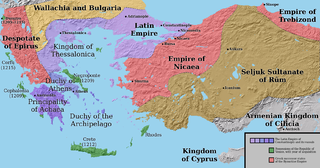
The Empire of Nicaea or the Nicene Empire was the largest of the three Byzantine Greek rump states founded by the aristocracy of the Byzantine Empire that fled when Constantinople was occupied by Western European and Venetian armed forces during the Fourth Crusade, a military event known as the Sack of Constantinople. Like the other Byzantine rump states that formed due to the 1204 fracturing of the empire, such as the Empire of Trebizond and the Despotate of Epirus, it was a continuation of the eastern half of the Roman Empire that survived well into the medieval period. A fourth state, known in historiography as the Latin Empire, was established by an army of Crusaders and the Republic of Venice after the capture of Constantinople and the surrounding environs.
This is an alphabetical index of people, places, things, and concepts related to or originating from the Byzantine Empire. Feel free to add more, and create missing pages. You can track changes to the articles included in this list from here.

The Varangian Guard was an elite unit of the Byzantine army from the tenth to the fourteenth century who served as personal bodyguards to the Byzantine emperors. The Varangian Guard was known for being primarily composed of recruits from Northern Europe, including mainly Norsemen from Scandinavia but also Anglo-Saxons from England. The recruitment of distant foreigners from outside Byzantium to serve as the emperor's personal guard was pursued as a deliberate policy, as they lacked local political loyalties and could be counted upon to suppress revolts by disloyal Byzantine factions.
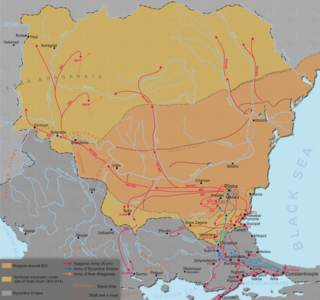
The Battle of Versinikia was fought in 813 between the Byzantine Empire and the Bulgarian Empire, near the city of Adrianople (Edirne) in modern-day Turkey.

The second Arab siege of Constantinople was a combined land and sea offensive in 717–718 by the Muslim Arabs of the Umayyad Caliphate against the capital city of the Byzantine Empire, Constantinople. The campaign marked the culmination of twenty years of attacks and progressive Arab occupation of the Byzantine borderlands, while Byzantine strength was sapped by prolonged internal turmoil. In 716, after years of preparations, the Arabs, led by Maslama ibn Abd al-Malik, invaded Byzantine Asia Minor. The Arabs initially hoped to exploit Byzantine civil strife and made common cause with the general Leo III the Isaurian, who had risen up against Emperor Theodosius III. Leo, however, deceived them and secured the Byzantine throne for himself.

The Christianization of Bulgaria was the process by which 9th-century medieval Bulgaria converted to Christianity. It reflected the need of unity within the religiously divided Bulgarian state as well as the need for equal acceptance on the international stage in Christian Europe. This process was characterized by the shifting political alliances of Boris I of Bulgaria with the kingdom of the East Franks and with the Byzantine Empire, as well as his diplomatic correspondence with the Pope.
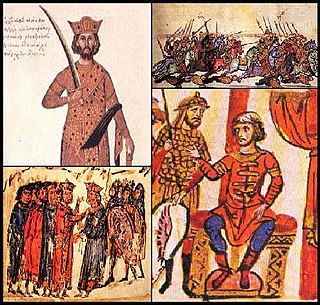
The Byzantine–Bulgarian wars were a series of conflicts fought between the Byzantine Empire and Bulgaria which began after the Bulgars conquered parts of the Balkan peninsula after 680 AD. The Byzantine and First Bulgarian Empire continued to clash over the next century with variable success, until the Bulgarians, led by Krum, inflicted a series of crushing defeats on the Byzantines. After Krum died in 814, his son Omurtag negotiated a thirty-year peace treaty. Simeon I had multiple successful campaigns against the Byzantines during his rule from 893 to 927. His son Peter I negotiated another long-lasting peace treaty. His rule was followed by a period of decline of the Bulgarian state.

The Battle of the Masts was a naval battle fought in 655 between the Rashidun Caliphate under the command of Abu al-A'war and the Byzantine Empire led by emperor Constans II.
Treaty of Constantinople or Treaty of Istanbul may refer to the following treaties signed in Constantinople :

The Byzantine Empire experienced cycles of growth and decay over the course of nearly a thousand years, including major losses during the early Muslim conquests of the 7th century.

The Venetian–Genoese Wars were four conflicts between the Republic of Venice and the Republic of Genoa which took place between 1256 and 1381. Each was resolved almost entirely through naval clashes, and they were connected to each other by interludes during which episodes of piracy and violence between the two Italian trading communities in the Mediterranean Sea and the Black Sea were commonplace, in a "cold war" climate.
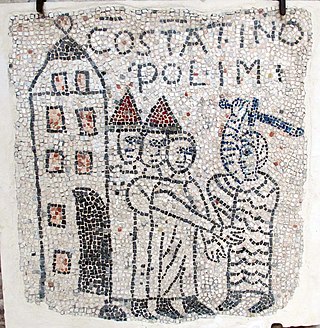
The Sack of Constantinople occurred in April 1204 and marked the culmination of the Fourth Crusade. Crusader armies captured, looted, and destroyed parts of Constantinople, then the capital of the Byzantine Empire. After the capture of the city, the Latin Empire was established and Baldwin of Flanders was crowned Emperor Baldwin I of Constantinople in the Hagia Sophia.

The Byzantine–Sasanian War of 602–628 was the final and most devastating of the series of wars fought between the Byzantine Empire and the Persian Sasanian Empire. The previous war between the two powers had ended in 591 after Emperor Maurice helped the Sasanian king Khosrow II regain his throne. In 602 Maurice was murdered by his political rival Phocas. Khosrow declared war, ostensibly to avenge the death of the deposed emperor Maurice. This became a decades-long conflict, the longest war in the series, and was fought throughout the Middle East: in Egypt, the Levant, Mesopotamia, the Caucasus, Anatolia, Armenia, the Aegean Sea and before the walls of Constantinople itself.
